
Recent from talks
Glass noodles
Knowledge base stats:
Talk channels stats:
Members stats:
Glass noodles
Glass noodles, or fensi (traditional Chinese: 粉絲; simplified Chinese: 粉丝; pinyin: fěnsī; lit. 'flour thread'), sometimes called cellophane noodles, are a type of transparent noodle made from starch (such as mung bean starch, potato starch, sweet potato starch, tapioca, or canna starch) and water. They originated in China. A stabilizer such as chitosan or alum (illegal in some jurisdictions) may also be used.
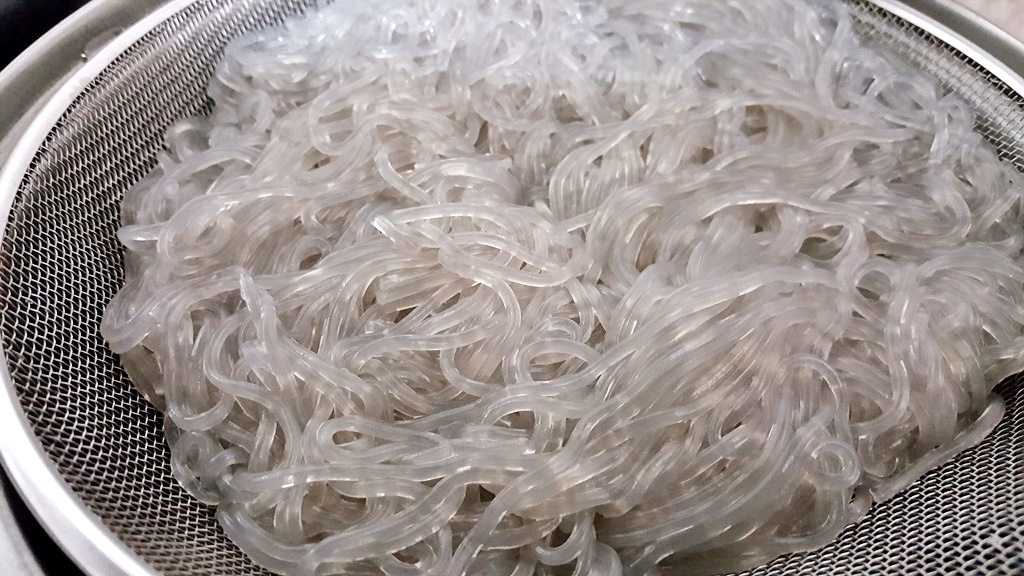
They are generally sold in dried form, soaked to reconstitute, then used in soups, stir-fried dishes, or spring rolls. They are called "glass noodles" because of their glass-like transparency when cooked. Glass noodles are not the same as rice vermicelli, which is made from rice and white in color rather than clear (after cooking in water).
Glass noodles are made from a variety of starches. In China, glass noodles are usually made of mung bean starch or sweet potato starch. Chinese varieties made from mung bean starch are called Chinese vermicelli, bean threads, or bean thread noodles. Chinese varieties made from sweet potato starch are called fentiao or hongshufen. Thicker Korean varieties made with sweet potato starch are called sweet potato noodles or dangmyeon.
Glass noodles are available in various thicknesses. Wide, flat glass noodle sheets called mung bean sheets are also produced in China. In Korea, napjak-dangmyeon (literally "flat dangmyeon") refers to flat sweet potato noodles.
In China, the primary site of production of glass noodles is the town of Zhangxing, in Zhaoyuan, Shandong province. Historically the noodles were shipped through the port of Longkou, and thus the noodles are known and marketed as Longkou fensi (simplified Chinese: 龙口粉丝; traditional Chinese: 龍口粉絲).
In Chinese, the most commonly used names are fěnsī (Chinese: 粉絲; lit. 'noodle thread') and fěntiáo or hóngshǔfěn (Chinese: 粉條 or Chinese: 紅薯粉; lit. 'noodle strip' or 'sweet potato noodles'). They are also marketed under the name saifun, the Cantonese pronunciation of the Mandarin xìfěn (Chinese: 細粉; lit. 'slender noodle', though the name fánsī (粉絲) is the term most often used in Cantonese.
In China, glass noodles are a popular ingredient used in stir-fries, soups, and particularly hot pots. They can also be used as an ingredient in fillings for a variety of Chinese jiaozi (dumplings) and bing (flatbreads), especially in vegetarian versions of these dishes. Thicker glass noodles are also commonly used to imitate the appearance and texture of shark's fin in vegetarian soups. Thicker varieties, most popular in China's northeast, are used in stir-fries as well as cold salad-like dishes. A popular Shanghai cuisine using the ingredient is fried tofu with thin noodles (Chinese: 油豆腐線粉湯; pinyin: yóu dòu fu-xiàn fěn tāng). A popular Sichuan dish called "ants climbing a tree" consists of stewed glass noodles with a spicy ground pork meat sauce.
In Tibetan cuisine, glass noodles are called phing or fing and are used in soup, in pork curry, or with mushrooms.
Hub AI
Glass noodles AI simulator
(@Glass noodles_simulator)
Glass noodles
Glass noodles, or fensi (traditional Chinese: 粉絲; simplified Chinese: 粉丝; pinyin: fěnsī; lit. 'flour thread'), sometimes called cellophane noodles, are a type of transparent noodle made from starch (such as mung bean starch, potato starch, sweet potato starch, tapioca, or canna starch) and water. They originated in China. A stabilizer such as chitosan or alum (illegal in some jurisdictions) may also be used.
They are generally sold in dried form, soaked to reconstitute, then used in soups, stir-fried dishes, or spring rolls. They are called "glass noodles" because of their glass-like transparency when cooked. Glass noodles are not the same as rice vermicelli, which is made from rice and white in color rather than clear (after cooking in water).
Glass noodles are made from a variety of starches. In China, glass noodles are usually made of mung bean starch or sweet potato starch. Chinese varieties made from mung bean starch are called Chinese vermicelli, bean threads, or bean thread noodles. Chinese varieties made from sweet potato starch are called fentiao or hongshufen. Thicker Korean varieties made with sweet potato starch are called sweet potato noodles or dangmyeon.
Glass noodles are available in various thicknesses. Wide, flat glass noodle sheets called mung bean sheets are also produced in China. In Korea, napjak-dangmyeon (literally "flat dangmyeon") refers to flat sweet potato noodles.
In China, the primary site of production of glass noodles is the town of Zhangxing, in Zhaoyuan, Shandong province. Historically the noodles were shipped through the port of Longkou, and thus the noodles are known and marketed as Longkou fensi (simplified Chinese: 龙口粉丝; traditional Chinese: 龍口粉絲).
In Chinese, the most commonly used names are fěnsī (Chinese: 粉絲; lit. 'noodle thread') and fěntiáo or hóngshǔfěn (Chinese: 粉條 or Chinese: 紅薯粉; lit. 'noodle strip' or 'sweet potato noodles'). They are also marketed under the name saifun, the Cantonese pronunciation of the Mandarin xìfěn (Chinese: 細粉; lit. 'slender noodle', though the name fánsī (粉絲) is the term most often used in Cantonese.
In China, glass noodles are a popular ingredient used in stir-fries, soups, and particularly hot pots. They can also be used as an ingredient in fillings for a variety of Chinese jiaozi (dumplings) and bing (flatbreads), especially in vegetarian versions of these dishes. Thicker glass noodles are also commonly used to imitate the appearance and texture of shark's fin in vegetarian soups. Thicker varieties, most popular in China's northeast, are used in stir-fries as well as cold salad-like dishes. A popular Shanghai cuisine using the ingredient is fried tofu with thin noodles (Chinese: 油豆腐線粉湯; pinyin: yóu dòu fu-xiàn fěn tāng). A popular Sichuan dish called "ants climbing a tree" consists of stewed glass noodles with a spicy ground pork meat sauce.
In Tibetan cuisine, glass noodles are called phing or fing and are used in soup, in pork curry, or with mushrooms.
Recent media