


Community hub
Recent from talks
Contribute something
Nothing was collected or created yet.
Sweet potato
View on Wikipedia
| Sweet potato | |
|---|---|

| |
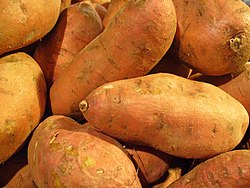
| Sweet potato tubers | |
Scientific classification 
| |
| Kingdom: | Plantae |
| Clade: | Tracheophytes |
| Clade: | Angiosperms |
| Clade: | Eudicots |
| Clade: | Asterids |
| Order: | Solanales |
| Family: | Convolvulaceae |
| Genus: | Ipomoea |
| Species: | I. batatas
|
| Binomial name | |
| Ipomoea batatas | |


The sweet potato or sweetpotato[a] (Ipomoea batatas) is a dicotyledonous plant in the morning glory family, Convolvulaceae. Its sizeable, starchy, sweet-tasting tuberous roots are used as a root vegetable,[3][4] which is a staple food in parts of the world. Cultivars of the sweet potato have been bred to bear tubers with flesh and skin of various colors. Moreover, the young shoots and leaves are occasionally eaten as greens. The sweet potato and the potato are only distantly related, both being in the order Solanales. Although darker sweet potatoes are often known as "yams" in parts of North America, they are even more distant from actual yams, which are monocots in the order Dioscoreales.[5]
The sweet potato is native to the tropical regions of South America in what is present-day Ecuador.[6][7] Of the approximately 50 genera and more than 1,000 species of Convolvulaceae, I. batatas is the only crop plant of major importance—some others are used locally (e.g., I. aquatica "kangkong" as a green vegetable), but many are poisonous. The genus Ipomoea that contains the sweet potato also includes several garden flowers called morning glories, but that term is not usually extended to I. batatas. Some cultivars of I. batatas are grown as ornamental plants under the name tuberous morning glory, and used in a horticultural context. Sweet potatoes can also be called yams in North America. When soft varieties were first grown commercially there, there was a need to differentiate between the two. Enslaved Africans had already been calling the 'soft' sweet potatoes 'yams' because they resembled the unrelated yams in Africa.[8] Thus, 'soft' sweet potatoes were referred to as 'yams' to distinguish them from the 'firm' varieties.
Description
[edit]_(49108875711).jpg)

The plant is a herbaceous perennial vine, bearing alternate triangle-shaped or palmately lobed leaves and medium-sized sympetalous flowers. The stems are usually crawling on the ground and form adventitious roots at the nodes. The leaves are screwed along the stems. The leaf stalk is 13 to 51 centimetres (5 to 20 inches) long. The leaf blades are very variable, 5 to 13 cm (2 to 5 in) long, the shape is heart-, kidney- to egg-shaped, rounded or triangular and spear-shaped, the edge can be entire, toothed or often three to seven times lobed, cut or divided. Most of the leaf surfaces are bare, rarely hairy, and the tip is rounded to pointed. The leaves are mostly green in color, but the accumulation of anthocyanins, especially along the leaf veins, can make them purple. Depending on the variety, the total length of a stem can be between 0.5 and 4 metres (1+1⁄2 and 13 feet). Some cultivars also form shoots up to 16 m (52 ft) in length. However, these do not form underground storage organs.[citation needed]
The hermaphrodite, five-fold and short-stalked flowers are single or few in stalked, zymous inflorescences that arise from the leaf axils and stand upright. It produces flowers when the day is short. The small sepals are elongated and tapering to a point and spiky and (rarely only 7) 10 to 15 millimetres (3⁄8 to 5⁄8 in) long, usually finely haired or ciliate. The inner three are a little longer. The 4 to 7 cm (1+1⁄2 to 2+3⁄4 in) long, overgrown and funnel-shaped, folded crown, with a shorter hem, can be lavender to purple-lavender in color, the throat is usually darker in color, but white crowns can also appear. The enclosed stamens are of unequal length with glandular filaments. The two-chamber ovary is upper constant with a relatively short stylus.[citation needed] Seeds are only produced from cross-pollination.[9]
The flowers open before sunrise and stay open for a few hours. They close again in the morning and begin to wither. The edible tuberous root is long and tapered, with a smooth skin whose color ranges between yellow, orange, red, brown, purple, and beige. Its flesh ranges from beige through white, red, pink, violet, yellow, orange, and purple. Sweet potato cultivars with white or pale yellow flesh are less sweet and moist than those with red, pink or orange flesh.[10]
Taxonomy
[edit]
The sweet potato originates in South America in what is present-day Ecuador.[6][7] The domestication of sweet potato occurred in either Central or South America.[12] In Central America, domesticated sweet potatoes were present at least 5,000 years ago,[13] with the origin of I. batatas possibly between the Yucatán Peninsula of Mexico and the mouth of the Orinoco River in Venezuela.[14] The cultigen was most likely spread by local people to the Caribbean and South America by 2500 BCE.[15]
I. trifida, a diploid, is the closest wild relative of the sweet potato, which originated with an initial cross between a tetraploid and another diploid parent, followed by a second complete genome duplication event.[16] The oldest radiocarbon dating remains of the sweet potato known today were discovered in caves from the Chilca Canyon, in the south-central zone of Peru, and yield an age of 8080 ± 170 BC.[17][18]
Transgenicity
[edit]The genome of cultivated sweet potatoes contains sequences of DNA from Agrobacterium (sensu lato; specifically, one related to Rhizobium rhizogenes), with genes actively expressed by the plants.[19] The T-DNA transgenes were not observed in closely related wild relatives of the sweet potato.[19] Studies indicated that the sweet potato genome evolved over millennia, with eventual domestication of the crop taking advantage of natural genetic modifications.[19] These observations make sweet potatoes the first known example of a naturally transgenic food crop.[19][20][21][22]: 141 [23][24]
Cultivation
[edit]Dispersal history
[edit]_Lam._-_%E8%B5%A4%E8%97%B7,_%E7%99%BD%E8%97%B7_-_idem.,_1804.jpg)
Before the arrival of Europeans to the Americas, sweet potato was grown in Polynesia, generally spread by vine cuttings rather than by seeds.[25] Sweet potato has been radiocarbon-dated in the Cook Islands to 1210–1400 CE.[26] A common hypothesis is that a vine cutting was brought to central Polynesia by Polynesians who had traveled to South America and back, and spread from there across Polynesia to Easter Island, Hawaii and New Zealand.[27][28] Genetic similarities have been found between Polynesian peoples and indigenous Americans including the Zenú, a people inhabiting the Pacific coast of present-day Colombia, indicating that Polynesians could have visited South America and taken sweet potatoes prior to European contact.[29] Dutch linguists and specialists in Amerindian languages Willem Adelaar and Pieter Muysken have suggested that the word for sweet potato is shared by Polynesian languages and languages of South America: Proto-Polynesian *kumala[30] (compare Rapa Nui kumara, Hawaiian ʻuala, Māori kūmara) may be connected with Quechua and Aymara k'umar ~ k'umara. Adelaar and Muysken assert that the similarity in the word for sweet potato is proof of either incidental contact or sporadic contact between the Central Andes and Polynesia.[31]
Some researchers, citing divergence time estimates, suggest that sweet potatoes might have been present in Polynesia thousands of years before humans arrived there.[32][33] However, the present scholarly consensus favours the pre-Columbian contact model.[34][35]
The sweet potato arrived in Europe with the Columbian exchange. It is recorded, for example, in Elinor Fettiplace's Receipt Book, compiled in England in 1604.[36][37]
Sweet potatoes were first introduced to the Philippines during the Spanish colonial period (1521–1898) via the Manila galleons, along with other New World crops.[38] It was introduced to the Fujian of China in about 1594 from Luzon, in response to a major crop failure. The growing of sweet potatoes was encouraged by the Governor Chin Hsüeh-tseng (Jin Xuezeng).[39]
Sweet potatoes were also introduced to the Ryukyu Kingdom, present-day Okinawa, Japan, in the early 1600s by the Portuguese.[40][41][42] Sweet potatoes became a staple in Japan because they were important in preventing famine when rice harvests were poor.[42][43] Aoki Konyō helped popularize the cultivation of the sweet potato in Japan, and the Tokugawa bakufu sponsored, published, and disseminated a vernacular Japanese translation of his research monograph on sweet potatoes to encourage their growth more broadly.[44] Sweet potatoes were planted in Shōgun Tokugawa Yoshimune's private garden.[45] It was first introduced to Korea in 1764.[46] Kang P'il-ri and Yi Kwang-ryŏ embarked on a project to grow sweet potatoes in Seoul in 1766, using the knowledge of Japanese cultivators they learned in Tongnae starting in 1764. The project succeeded for a year but ultimately failed in winter 1767 after Kang's unexpected death.[47]
Names
[edit]Although the soft, orange sweet potato is often called a "yam" in parts of North America, the sweet potato is very distinct from the botanical yam (Dioscorea), which has a cosmopolitan distribution,[48] and belongs to the monocot family Dioscoreaceae. A different crop plant, the oca (Oxalis tuberosa, a species of wood sorrel), is called a "yam" in many parts of the world.[49]
Although the sweet potato is not closely related botanically to the common potato, they have a shared etymology. The first Europeans to taste sweet potatoes were members of Christopher Columbus's expedition in 1492. Later explorers found many cultivars under an assortment of local names, but the name which stayed was the indigenous Taíno name of batata. The Spanish combined this with the Quechua word for potato, papa, to create the word patata for the common potato.[50]
Though the sweet potato is also called batata (בטטה) in Hebrew, this is not a direct loan of the Taíno word. Rather, the Spanish patata was loaned into Arabic as batata (بطاطا), owing to the lack of a /p/ sound in Arabic, while the sweet potato was called batata ḥilwa (بطاطا حلوة); literally ('sweet potato'). The Arabic batata was loaned into Hebrew as designating the sweet potato only, as Hebrew had its own word for the common potato, תפוח אדמה (tapuakh adama, literally 'earth apple'; compare French pomme de terre).
Some organizations and researchers advocate for the styling of the name as one word—sweetpotato—instead of two, to emphasize the plant's genetic uniqueness from both common potatoes and yams and to avoid confusion of it being classified as a type of common potato.[51][52][53] In its current usage in American English, the styling of the name as two words is still preferred.[54]
In Argentina, Colombia, Venezuela, Puerto Rico, and the Dominican Republic, the sweet potato is called batata. In Brazil, the sweet potato is called batata doce. In Mexico, Bolivia, Peru, Chile, Central America, and the Philippines, the sweet potato is known as camote (alternatively spelled kamote in the Philippines), derived from the Nahuatl word camotli.[55][56] In Peru and Bolivia, the general word in Quechua for the sweet potato is apichu, but there are variants used such as khumara, kumar (Ayacucho Quechua), and kumara (Bolivian Quechua),[57] strikingly similar to the Polynesian name kumara and its regional Oceanic cognates (kumala, umala, ʻuala, etc.[58]), which has led some scholars to suspect an instance of pre-Columbian trans-oceanic contact.[59] This theory is also supported by genetic evidence.[60]
In Australia, about 90% of production is devoted to the orange cultivar 'Beauregard',[61] which was originally[62][63] developed by the Louisiana Agricultural Experiment Station in 1981.[64]
In New Zealand, the Māori varieties bore elongated tubers with white skin and a whitish flesh,[65] which points to pre-European cross-Pacific travel.[66] Known as kumara (from the Māori language kūmara), the most common cultivar now is the red 'Owairaka', but orange ('Beauregard'), gold, purple and other cultivars are also grown.[67][68]
Habitat
[edit]The plant does not tolerate frost. It grows best at an average temperature of 24 °C (75 °F), with abundant sunshine and warm nights. Annual rainfalls of 750–1,000 mm (30–39 in) are considered most suitable, with a minimum of 500 mm (20 in) in the growing season. The crop is sensitive to drought at the tuber initiation stage 50–60 days after planting, and it is not tolerant to waterlogging, which may cause tuber rots and reduce the growth of storage roots if aeration is poor.[69]


Depending on the cultivar and conditions, tuberous roots mature in two to nine months. With care, early-maturing cultivars can be grown as an annual summer crop in warm temperate areas, such as the Eastern United States and China. Sweet potatoes rarely flower when the daylight is longer than 11 hours, as is normal outside of the tropics. They are mostly propagated by stem or root cuttings or by adventitious shoots called "slips" that grow out from the tuberous roots during storage. True seeds are used for breeding only.[9]
They grow well in many farming conditions and have few natural enemies; pesticides are rarely needed. Sweet potatoes are grown on a variety of soils, but well-drained, light- and medium-textured soils with a pH range of 4.5–7.0 are more favorable for the plant.[4] They can be grown in poor soils with little fertilizer. However, sweet potatoes are very sensitive to aluminium toxicity and will die about six weeks after planting if lime is not applied at planting in this type of soil.[4] As they are sown by vine cuttings rather than seeds, sweet potatoes are relatively easy to plant. As the rapidly growing vines shade out weeds, little weeding is needed. A commonly used herbicide to rid the soil of any unwelcome plants that may interfere with growth is DCPA, also known as Dacthal. In the tropics, the crop can be maintained in the ground and harvested as needed for market or home consumption. In temperate regions, sweet potatoes are most often grown on larger farms and are harvested before first frosts.[citation needed]
Sweet potatoes are cultivated throughout tropical and warm temperate regions wherever there is sufficient water to support their growth.[70] Sweet potatoes became common as a food crop in the islands of the Pacific Ocean, South India, Uganda and other African countries.[71]
A cultivar of the sweet potato called the boniato is grown in the Caribbean; its flesh is cream-colored, unlike the more common orange hue seen in other cultivars. Boniatos are not as sweet and moist as other sweet potatoes, but their consistency and delicate flavor are different from the common orange-colored sweet potato.[citation needed]
 China China |
48.9 |
 Malawi Malawi |
6.9 |
 Tanzania Tanzania |
4.4 |
 Angola Angola |
1.7 |
 Ethiopia Ethiopia |
1.6 |
| World | 89.5 |
| Source: FAOSTAT of the United Nations[72] | |
Sweet potatoes have been a part of the diet in the U.S. for most of its history, especially in the Southeast. The annual per capita consumption of sweet potatoes in the United States is only about 1.5–2 kg (3+1⁄2–4+1⁄2 lb), down from 13 kg (29 lb) in 1920. "Orange sweet potatoes (the most common type encountered in the US) received higher appearance liking scores compared with yellow or purple cultivars."[73] Purple and yellow sweet potatoes were not as well liked by consumers compared to orange sweet potatoes "possibly because of the familiarity of orange color that is associated with sweet potatoes."[73]
In the Southeastern U.S., sweet potatoes are traditionally cured to improve storage, flavor, and nutrition, and to allow wounds on the periderm of the harvested root to heal.[74] Proper curing requires drying the freshly dug roots on the ground for two to three hours, then storage at 29–32 °C (85–90 °F) with 90 to 95% relative humidity from five to fourteen days. Cured sweet potatoes can keep for thirteen months when stored at 13–15 °C (55–59 °F) with >90% relative humidity. Colder temperatures injure the roots.[75][76]
Production
[edit]In 2020, global production of sweet potatoes was 89 million tonnes, led by China with 55% of the world total (table). Secondary producers were Malawi, Tanzania, and Nigeria.[72] It is the fifth most important food crop in developing countries.[77] Studies are being done to develop a salt tolerant variety to combat the effects of climate change.[77][78]
Diseases
[edit]Sweet potato suffers from Sweet potato chlorotic stunt virus (a Crinivirus).[79] In synergy with other any of a large number of other viruses, Untiveros et al., 2007 finds SPCSV produces an even more severe symptomology.[79] I. batatas suffers from several Phytophthoras including P. carotovorum, P. odoriferum, and P. wasabiae.[80]
Uses
[edit]Nutrition
[edit]| Nutritional value per 100 g (3.5 oz) | |||||||||||||||||||||||||||||||||||||||||||||
|---|---|---|---|---|---|---|---|---|---|---|---|---|---|---|---|---|---|---|---|---|---|---|---|---|---|---|---|---|---|---|---|---|---|---|---|---|---|---|---|---|---|---|---|---|---|
| Energy | 378 kJ (90 kcal) | ||||||||||||||||||||||||||||||||||||||||||||
20.7 g | |||||||||||||||||||||||||||||||||||||||||||||
| Starch | 7.05 g | ||||||||||||||||||||||||||||||||||||||||||||
| Sugars | 6.5 g | ||||||||||||||||||||||||||||||||||||||||||||
| Dietary fiber | 3.3 g | ||||||||||||||||||||||||||||||||||||||||||||
0.15 g | |||||||||||||||||||||||||||||||||||||||||||||
2.0 g | |||||||||||||||||||||||||||||||||||||||||||||
| |||||||||||||||||||||||||||||||||||||||||||||
| Other constituents | Quantity | ||||||||||||||||||||||||||||||||||||||||||||
| Water | 75.8 g | ||||||||||||||||||||||||||||||||||||||||||||
| †Percentages estimated using US recommendations for adults,[81] except for potassium, which is estimated based on expert recommendation from the National Academies.[82] | |||||||||||||||||||||||||||||||||||||||||||||
| Nutritional value per 100 g (3.5 oz) | |||||||||||||||||||||||||||||||||||||||||||||||
|---|---|---|---|---|---|---|---|---|---|---|---|---|---|---|---|---|---|---|---|---|---|---|---|---|---|---|---|---|---|---|---|---|---|---|---|---|---|---|---|---|---|---|---|---|---|---|---|
| Energy | 359 kJ (86 kcal) | ||||||||||||||||||||||||||||||||||||||||||||||
20.1 g | |||||||||||||||||||||||||||||||||||||||||||||||
| Starch | 12.7 g | ||||||||||||||||||||||||||||||||||||||||||||||
| Sugars | 4.2 g | ||||||||||||||||||||||||||||||||||||||||||||||
| Dietary fiber | 3 g | ||||||||||||||||||||||||||||||||||||||||||||||
0.1 g | |||||||||||||||||||||||||||||||||||||||||||||||
1.6 g | |||||||||||||||||||||||||||||||||||||||||||||||
| |||||||||||||||||||||||||||||||||||||||||||||||
| Other constituents | Quantity | ||||||||||||||||||||||||||||||||||||||||||||||
| Water | 77.3 g | ||||||||||||||||||||||||||||||||||||||||||||||
"Sweet potato, raw". USDA Database. Archived from the original on 3 April 2019. Retrieved 24 March 2021. | |||||||||||||||||||||||||||||||||||||||||||||||
| †Percentages estimated using US recommendations for adults,[81] except for potassium, which is estimated based on expert recommendation from the National Academies.[82] | |||||||||||||||||||||||||||||||||||||||||||||||
Cooked sweet potato (baked in skin) is 76% water, 21% carbohydrates, 2% protein, and contains negligible fat (table). In a 100-gram reference amount, baked sweet potato provides 359 kilojoules (86 kilocalories) of food energy, and rich contents (20% or more of the Daily Value, DV) of vitamin A (120% DV), vitamin C (24% DV), manganese (24% DV), and vitamin B6 (20% DV). It is a moderate source (10–19% DV) of some B vitamins and potassium. Between 50% and 90% of the sugar content is sucrose.[83] Maltose content is very low, but baking can increase the maltose content from between 10% and 20%.[83]
Sweet potato cultivars with dark orange flesh have more beta-carotene (converted to a higher vitamin A content once digested) than those with light-colored flesh, and their increased cultivation is being encouraged in Africa where vitamin A deficiency is a serious health problem.[84] Sweet potato leaves are edible and can be prepared like spinach or turnip greens.[85]
Comparison to other food staples
[edit]The table below presents the relative performance of sweet potato (in column)[G] to other staple foods on a dry weight basis to account for their different water contents. While sweet potato provides less edible energy and protein per unit weight than cereals, it has higher nutrient density than cereals.[86]
According to a study by the United Nations Food and Agriculture Organization, sweet potatoes are the most efficient staple food to grow in terms of farmland, yielding approximately 290,000 kilojoules per hectare (28,000 kcal/acre) daily.[87]
| Staple | Maize (corn)[A] | Rice, white[B] | Wheat[C] | Potatoes[D] | Cassava[E] | Soybeans, green[F] | Sweet potatoes[G] | Yams[Y] | Sorghum[H] | Plantain[Z] | RDA |
|---|---|---|---|---|---|---|---|---|---|---|---|
| Water content (%) | 10 | 12 | 13 | 79 | 60 | 68 | 77 | 70 | 9 | 65 | |
| Raw grams per 100 g dry weight | 111 | 114 | 115 | 476 | 250 | 313 | 435 | 333 | 110 | 286 | |
| Nutrient | |||||||||||
| Energy (kJ) | 1698 | 1736 | 1574 | 1533 | 1675 | 1922 | 1565 | 1647 | 1559 | 1460 | 8,368–10,460 |
| Protein (g) | 10.4 | 8.1 | 14.5 | 9.5 | 3.5 | 40.6 | 7.0 | 5.0 | 12.4 | 3.7 | 50 |
| Fat (g) | 5.3 | 0.8 | 1.8 | 0.4 | 0.7 | 21.6 | 0.2 | 0.6 | 3.6 | 1.1 | 44–77 |
| Carbohydrates (g) | 82 | 91 | 82 | 81 | 95 | 34 | 87 | 93 | 82 | 91 | 130 |
| Fiber (g) | 8.1 | 1.5 | 14.0 | 10.5 | 4.5 | 13.1 | 13.0 | 13.7 | 6.9 | 6.6 | 30 |
| Sugar (g) | 0.7 | 0.1 | 0.5 | 3.7 | 4.3 | 0.0 | 18.2 | 1.7 | 0.0 | 42.9 | minimal |
| Minerals | [A] | [B] | [C] | [D] | [E] | [F] | [G] | [Y] | [H] | [Z] | RDA |
| Calcium (mg) | 8 | 32 | 33 | 57 | 40 | 616 | 130 | 57 | 31 | 9 | 1,000 |
| Iron (mg) | 3.01 | 0.91 | 3.67 | 3.71 | 0.68 | 11.09 | 2.65 | 1.80 | 4.84 | 1.71 | 8 |
| Magnesium (mg) | 141 | 28 | 145 | 110 | 53 | 203 | 109 | 70 | 0 | 106 | 400 |
| Phosphorus (mg) | 233 | 131 | 331 | 271 | 68 | 606 | 204 | 183 | 315 | 97 | 700 |
| Potassium (mg) | 319 | 131 | 417 | 2005 | 678 | 1938 | 1465 | 2720 | 385 | 1426 | 4700 |
| Sodium (mg) | 39 | 6 | 2 | 29 | 35 | 47 | 239 | 30 | 7 | 11 | 1,500 |
| Zinc (mg) | 2.46 | 1.24 | 3.05 | 1.38 | 0.85 | 3.09 | 1.30 | 0.80 | 0.00 | 0.40 | 11 |
| Copper (mg) | 0.34 | 0.25 | 0.49 | 0.52 | 0.25 | 0.41 | 0.65 | 0.60 | - | 0.23 | 0.9 |
| Manganese (mg) | 0.54 | 1.24 | 4.59 | 0.71 | 0.95 | 1.72 | 1.13 | 1.33 | - | - | 2.3 |
| Selenium (μg) | 17.2 | 17.2 | 81.3 | 1.4 | 1.8 | 4.7 | 2.6 | 2.3 | 0.0 | 4.3 | 55 |
| Vitamins | [A] | [B] | [C] | [D] | [E] | [F] | [G] | [Y] | [H] | [Z] | RDA |
| Vitamin C (mg) | 0.0 | 0.0 | 0.0 | 93.8 | 51.5 | 90.6 | 10.4 | 57.0 | 0.0 | 52.6 | 90 |
| Thiamin (B1) (mg) | 0.43 | 0.08 | 0.34 | 0.38 | 0.23 | 1.38 | 0.35 | 0.37 | 0.26 | 0.14 | 1.2 |
| Riboflavin (B2) (mg) | 0.22 | 0.06 | 0.14 | 0.14 | 0.13 | 0.56 | 0.26 | 0.10 | 0.15 | 0.14 | 1.3 |
| Niacin (B3) (mg) | 4.03 | 1.82 | 6.28 | 5.00 | 2.13 | 5.16 | 2.43 | 1.83 | 3.22 | 1.97 | 16 |
| Pantothenic acid (B5) (mg) | 0.47 | 1.15 | 1.09 | 1.43 | 0.28 | 0.47 | 3.48 | 1.03 | - | 0.74 | 5 |
| Vitamin B6 (mg) | 0.69 | 0.18 | 0.34 | 1.43 | 0.23 | 0.22 | 0.91 | 0.97 | - | 0.86 | 1.3 |
| Folate Total (B9) (μg) | 21 | 9 | 44 | 76 | 68 | 516 | 48 | 77 | 0 | 63 | 400 |
| Vitamin A (IU) | 238 | 0 | 10 | 10 | 33 | 563 | 4178 | 460 | 0 | 3220 | 5000 |
| Vitamin E, alpha-tocopherol (mg) | 0.54 | 0.13 | 1.16 | 0.05 | 0.48 | 0.00 | 1.13 | 1.30 | 0.00 | 0.40 | 15 |
| Vitamin K1 (μg) | 0.3 | 0.1 | 2.2 | 9.0 | 4.8 | 0.0 | 7.8 | 8.7 | 0.0 | 2.0 | 120 |
| Beta-carotene (μg) | 108 | 0 | 6 | 5 | 20 | 0 | 36996 | 277 | 0 | 1306 | 10500 |
| Lutein+zeaxanthin (μg) | 1506 | 0 | 253 | 38 | 0 | 0 | 0 | 0 | 0 | 86 | 6000 |
| Fats | [A] | [B] | [C] | [D] | [E] | [F] | [G] | [Y] | [H] | [Z] | RDA |
| Saturated fatty acids (g) | 0.74 | 0.20 | 0.30 | 0.14 | 0.18 | 2.47 | 0.09 | 0.13 | 0.51 | 0.40 | minimal |
| Monounsaturated fatty acids (g) | 1.39 | 0.24 | 0.23 | 0.00 | 0.20 | 4.00 | 0.00 | 0.03 | 1.09 | 0.09 | 22–55 |
| Polyunsaturated fatty acids (g) | 2.40 | 0.20 | 0.72 | 0.19 | 0.13 | 10.00 | 0.04 | 0.27 | 1.51 | 0.20 | 13–19 |
| [A] | [B] | [C] | [D] | [E] | [F] | [G] | [Y] | [H] | [Z] | RDA |
A raw yellow dent corn
B raw unenriched long-grain white rice
C raw hard red winter wheat
D raw potato with flesh and skin
E raw cassava
F raw green soybeans
G raw sweet potato
H raw sorghum
Y raw yam
Z raw plantains
/* unofficial
Culinary
[edit] | This section needs additional citations for verification. (January 2016) |
The starchy tuberous roots of the sweet potato are by far the most important product of the plant. In some tropical areas, the tubers are a staple food crop. The tuber is often cooked before consumption as this increases its nutrition and digestibility, although the American colonists in the Southeast ate raw sweet potatoes as a staple food.[89]
The vines' tips and young leaves are edible as a green vegetable with a characteristic flavor. Older growths may be used as animal fodder.[90]
Africa
[edit] | This section should specify the language of its non-English content using {{lang}} or {{langx}}, {{transliteration}} for transliterated languages, and {{IPA}} for phonetic transcriptions, with an appropriate ISO 639 code. Wikipedia's multilingual support templates may also be used. (July 2023) |

Amukeke (sun-dried slices of root) and inginyo (sun-dried crushed root) are a staple food for people in northeastern Uganda.[90] Amukeke is mainly served for breakfast, eaten with peanut sauce. Inginyo is mixed with cassava flour and tamarind to make atapa. People eat atapa with smoked fish cooked in peanut sauce or with dried cowpea leaves cooked in peanut sauce. Emukaru (earth-baked root) is eaten as a snack anytime and is mostly served with tea or with peanut sauce. Similar uses are also found in South Sudan.
The young leaves and vine tips of sweet potato leaves are widely consumed as a vegetable in West African countries (Guinea, Sierra Leone and Liberia, for example), as well as in northeastern Uganda, East Africa.[90] According to FAO leaflet No. 13 – 1990, sweet potato leaves and shoots are a good source of vitamins A, C, and B2 (riboflavin), and according to research done by A. Khachatryan, are an excellent source of lutein.
In Kenya, Rhoda Nungo of the home economics department of the Ministry of Agriculture has written a guide to using sweet potatoes in modern recipes.[91] This includes uses both in the mashed form and as flour from the dried tubers to replace part of the wheat flour and sugar in baked products such as cakes, chapatis, mandazis, bread, buns and cookies. A nutritious juice drink is made from the orange-fleshed cultivars, and deep-fried snacks are also included.
In Egypt, sweet potato tubers are known as batata (بطاطا) and are a common street food in winter, when street vendors with carts fitted with ovens sell them to people passing time by the Nile or the sea.[92] The cultivars used are an orange-fleshed one as well as a white/cream-fleshed one. They are also baked at home as a snack or dessert, drenched with honey.
In Ethiopia, the commonly found cultivars are black-skinned, cream-fleshed and called bitatis or mitatis. They are cultivated in the eastern and southern lower highlands and harvested during the rainy season (June/July). In recent years,[when?] better yielding orange-fleshed cultivars were released for cultivation by Haramaya University as a less sugary sweet potato with higher vitamin A content.[93] Sweet potatoes are widely eaten boiled as a favored snack.
In South Africa, sweet potatoes are often eaten as a side dish such as soetpatats.
Asia
[edit]In East Asia, roasted sweet potatoes are popular street food. In China, sweet potatoes, typically yellow cultivars, are baked in a large iron drum and sold as street food during winter. In Korea, sweet potatoes, known as goguma, are roasted in a drum can, baked in foil or on an open fire, typically during winter. In Japan, a dish similar to the Korean preparation is called yaki-imo (roasted sweet potato), which typically uses either the yellow-fleshed "Japanese sweet potato" or the purple-fleshed "Okinawan sweet potato", which is known as beni-imo.
Sweet potato soup, served during winter, consists of sweet potato boiled in water with rock sugar and ginger. In Fujian cuisine and Taiwanese cuisine, sweet potato is often cooked with rice to make congee. Steamed and dried sweet potato is a specialty of Liancheng County. Sweet potato greens are a common side dish in Taiwanese cuisine, often boiled or sautéed and served with a garlic and soy sauce mixture, or simply salted before serving. They, as well as dishes featuring the sweet potato root, are commonly found at bento (Pe̍h-ōe-jī: piān-tong) restaurants. In northeastern Chinese cuisine, sweet potatoes are often cut into chunks and fried, before being drenched into a pan of boiling syrup.[94]
In some regions of India, sweet potato is roasted slowly over kitchen coals at night and eaten with some dressing, while the easier way in the south is simply boiling or pressure cooking before peeling, cubing and seasoning for a vegetable dish as part of the meal. In the Indian state of Tamil Nadu, it is known as sakkara valli kilangu. It is boiled and consumed as an evening snack. In some parts of India, fresh sweet potato is chipped, dried and then ground into flour; this is then mixed with wheat flour and baked into chapatti (bread). Between 15 and 20 percent of the sweet potato harvest is converted by some Indian communities into pickles and snack chips. A part of the tuber harvest is used in India as cattle fodder.[10]
In Pakistan, sweet potato is known as shakarqandi and is cooked as a vegetable dish and also with meat dishes (chicken, mutton or beef). The ash-roasted sweet potatoes are sold as a snack and street food in Pakistani bazaars especially during the winter months.[95]
In Sri Lanka, it is called bathala, and tubers are used mainly for breakfast (boiled sweet potato is commonly served with sambal or grated coconut) or as a supplementary curry dish for rice.
The tubers of this plant, known as kattala in Dhivehi, have been used in the traditional diet of the Maldives. The leaves were finely chopped and used in dishes such as mas huni.[96]

In Japan, both sweet potatoes (called satsuma-imo) and true purple yams (called daijo or beni-imo) are grown. Boiling, roasting and steaming are the most common cooking methods. Also, the use in vegetable tempura is common. Daigaku-imo (ja:大学芋) is a baked and caramel-syruped sweet potato dessert. As it is sweet and starchy, it is used in imo-kinton and some other traditional sweets, such as ofukuimo. What is commonly called "sweet potato" (ja:スイートポテト) in Japan is a cake made by baking mashed sweet potatoes. Shōchū, a Japanese spirit normally made from the fermentation of rice, can also be made from sweet potato, in which case it is called imo-jōchū. Imo-gohan, sweet potato cooked with rice, is popular in Guangdong, Taiwan and Japan. It is also served in nimono or nitsuke, boiled and typically flavored with soy sauce, mirin and dashi.

In Korean cuisine, sweet potato starch is used to produce dangmyeon (cellophane noodles). Sweet potatoes are also boiled, steamed, or roasted, and young stems are eaten as namul. Pizza restaurants such as Pizza Hut and Domino's in Korea are using sweet potatoes as a popular topping. Sweet potatoes are also used in the distillation of a variety of Soju. A popular Korean side dish or snack, goguma-mattang, also known as Korean candied sweet potato, is made by deep-frying sweet potatoes that were cut into big chunks and coating them with caramelized sugar.
In Malaysia and Singapore, sweet potato is often cut into small cubes and cooked with taro and coconut milk (santan) to make a sweet dessert called bubur cha cha. A favorite way of cooking sweet potato is deep-frying slices of sweet potato in batter, served as a tea-time snack. In homes, sweet potatoes are usually boiled. The leaves of sweet potatoes are usually stir-fried with only garlic or with sambal belacan and dried shrimp by Malaysians.
In the Philippines, sweet potatoes (locally known as camote or kamote) are an important food crop in rural areas. They are often a staple among impoverished families in provinces, as they are easier to cultivate and cost less than rice.[97] The tubers are boiled or baked in coals and may be dipped in sugar or syrup. Young leaves and shoots (locally known as talbos ng kamote or camote tops) are eaten fresh in salads with shrimp paste (bagoong alamang) or fish sauce. They can be cooked in vinegar and soy sauce and served with fried fish (a dish known as adobong talbos ng kamote), or with recipes such as sinigang.[97] The stew obtained from boiling camote tops is purple-colored, and is often mixed with lemon as juice. Sweet potatoes are also sold as street food in suburban and rural areas. Fried sweet potatoes coated with caramelized sugar and served in skewers (camote cue) or as French fries are popular afternoon snacks.[98] Sweet potatoes are also used in a variant of halo-halo called ginatan, where they are cooked in coconut milk and sugar and mixed with a variety of rootcrops, sago, jackfruit, and bilu-bilo (glutinous rice balls).[99] Bread made from sweet potato flour is also gaining popularity. Sweet potato is relatively easy to propagate, and in rural areas can be seen abundantly at canals and dikes. The uncultivated plant is usually fed to pigs.
In Indonesia, sweet potatoes are locally known as ubi jalar (lit: "spreading tuber") or simply ubi and are frequently fried with batter and served as snacks with spicy condiments, along with other kinds of fritters such as fried bananas, tempeh, tahu, breadfruit, or cassava. In the mountainous regions of West Papua, sweet potatoes are the staple food among the natives there. Using the bakar batu method of cooking, rocks that have been burned in a nearby bonfire are thrown into a pit lined with leaves. Layers of sweet potatoes, an assortment of vegetables, and pork are piled on top of the rocks. The top of the pile is then insulated with more leaves, creating a pressure of heat and steam inside which cooks all food within the pile after several hours.
In Vietnamese cuisine sweet potatoes are known as khoai lang and they are commonly cooked with a sweetener such as corn syrup, honey, sugar, or molasses.[100]
Young sweet potato leaves are also used as baby food, particularly in Southeast Asia and East Asia.[101][102] Mashed sweet potato tubers are used similarly throughout the world.[103]
-
 Jjin-goguma (steamed sweet potatoes)
 -
 Gungoguma, roasted sweet potatoes
 -
 "Gungoguma drum" for roasting sweet potatoes
 -
 Goguma-mattang (candied sweet potatoes)
 -
 Fried, sweetened sweet potato, India
 -
 Taiwanese pastry
 -
 Imo Jōchū (Japanese spirits made with sweet potato)
 -
 Chinese sweet potato soup, popular during the winter
 -


_2.jpg)
_2.jpg)


.jpg)
United States
[edit]
Candied sweet potatoes are a side dish consisting mainly of sweet potatoes prepared with brown sugar, marshmallows, maple syrup, molasses, orange juice, marron glacé, or other sweet ingredients. It is often served in the US on Thanksgiving. Sweet potato casserole is a side dish of mashed sweet potatoes in a casserole dish, topped with a brown sugar and pecan topping.[104]
The sweet potato became a favorite food item of the French and Spanish settlers, thus beginning a long history of cultivation in Louisiana.[105] Sweet potatoes are recognized as the state vegetable of Alabama,[106] Louisiana,[107] and North Carolina.[108] Sweet potato pie is also a traditional favorite dish in Southern U.S. cuisine. Another variation on the typical sweet potato pie is the Okinawan sweet potato haupia pie, which is made with purple sweet potatoes.

The fried sweet potatoes tradition dates to the early nineteenth century in the United States.[109][better source needed] Sweet potato fries or chips are a common preparation and are made by julienning and deep-frying sweet potatoes in the fashion of French fried potatoes. Roasting sliced or chopped sweet potatoes lightly coated in animal or vegetable oil at high heat became common in the United States at the start of the 21st century, a dish called "sweet potato fries". Sweet potato mash is served as a side dish, often at Thanksgiving dinner or with barbecue.
John Bettencourt Avila is called the "father of the sweet potato industry" in North America.[110][111]
Oceania
[edit]Māori grew several varieties of small, yellow-skinned, finger-sized kūmara (with names including taputini,[112] taroamahoe, pehu, hutihuti, and rekamaroa[113]) that they had brought with them from east Polynesia. Modern trials have shown that these smaller varieties were capable of producing well,[114] but when American whalers, sealers and trading vessels introduced larger cultivars in the early 19th century, they quickly predominated.[115][116][117][118]
Prior to 2021, archaeologists believed that the sweet potato failed to flourish in New Zealand south of Christchurch due to the colder climate, forcing Māori in those latitudes to become (along with the Moriori of the Chatham Islands) the only Polynesian people who subsisted solely on hunting and gathering. However, a 2021 analysis of material excavated from a site near Dunedin, some 250 km (160 mi) further south, revealed that sweet potatoes were grown and stored there during the 15th century, before the industry was disrupted by factors speculated to be due to the Little Ice Age.[34]
Māori traditionally cooked kūmara in a hāngī (earth oven). This is still a common practice when there are large gatherings on marae.
In 1947, black rot (Ceratocystis fimbriata) appeared in kūmara around Auckland and increased in severity through the 1950s.[119] A disease-free strain was developed by Joe and Fay Gock. They gave the strain to the nation, earning them the Bledisloe Cup in 2013.[120][121]
There are three main cultivars of kūmara sold in New Zealand: 'Owairaka Red' ("red"), 'Toka Toka Gold' ("gold"), and 'Beauregard' ("orange"). The country grows around 24,000 metric tons of kūmara annually,[122] with nearly all of it (97%) grown in the Northland Region.[123] Kūmara are widely available throughout New Zealand year-round, where they are a popular alternative to potatoes.[124]
Kūmara are often included in roast meals, and served with sour cream and sweet chili sauce.[citation needed] They are served alongside such vegetables as potatoes and pumpkin and as such, are generally prepared in a savory manner. They are ubiquitous in supermarkets, roast meal takeaway shops and hāngī.
.jpg)
Among the Urapmin people of Papua New Guinea, taro (known in Urap as ima) and the sweet potato (Urap: wan) are the main sources of sustenance, and in fact the word for 'food' in Urap is a compound of these two words.[125]
Europe
[edit]In the Veneto (northeast Italy), sweet potato is known as patata mericana in the Venetian language (patata americana in Italian, meaning "American potato"), and it is cultivated above all in the southern area of the region;.[126][127]
In Spain, sweet potato is called boniato. On the evening of All Souls' Day, in Catalonia (northeastern Spain) it is traditional to serve roasted sweet potato and chestnuts, panellets and sweet wine. The occasion is called La Castanyada.[128][129] As of 2023 Spain is the largest sweet potato producer in Europe.[130]
South America
[edit]In Peru, sweet potatoes are called camote and are frequently served alongside ceviche. Sweet potato chips are also a commonly sold snack, be it on the street or in packaged foods.[citation needed]
Dulce de batata is a traditional Argentine, Paraguayan and Uruguayan dessert, which is made of sweet potatoes. It is a sweet jelly, which resembles a marmalade because of its color and sweetness but it has a harder texture, and has to be sliced into thin portions with a knife as if it were a pie.
Globally
[edit]Globally, sweet potatoes are now a staple ingredient of modern sushi cuisine, specifically used in maki rolls. The advent of sweet potato as a sushi ingredient is credited to chef Bun Lai of Miya's Sushi, who first introduced sweet potato rolls in the 1990s as a plant-based alternative to traditional fish-based sushi rolls.[131][132][133]
Molecular gastronomy
[edit]Freezing a sweet potato until solid, baking at a low temperature, then increasing to a high temperature brings out the sweetness by caramelizing converted sugars.[134][135][136][137]
Ceramics
[edit]
Ceramics modeled after sweet potatoes or camotes are often found in the Moche culture.[138]
Dyes
[edit]In South America, the juice of red sweet potatoes is combined with lime juice to make a dye for cloth. By varying the proportions of the juices, every shade from pink to black can be obtained.[139] Purple sweet potato color is also used as a natural food coloring.[140]
Aquariums
[edit]Cuttings of sweet potato vine, either edible or ornamental cultivars, will rapidly form roots in water and will grow in it, indefinitely, in good lighting with a steady supply of nutrients. For this reason, sweet potato vine is ideal for use in home aquariums, trailing out of the water with its roots submerged, as its rapid growth is fueled by toxic ammonia and nitrates, a waste product of aquatic life, which it removes from the water. This improves the living conditions for fish, which also find refuge in the extensive root systems.[citation needed]
Ornamentals
[edit]
Ornamental sweet potatoes are popular landscape, container, and bedding plants. Grown as an annual in zones up to USDA hardiness Zone 9, they grow rapidly and spread quickly. Cultivars are available in many colors, such as green, yellow, and purple.[141] Some ornamental varieties, like 'Blackie', flower more than others.[142] These ornamental cultivars are not poisonous, and although the leaves are edible, the tubers do not have a good taste.[143][144]
See also
[edit]- Ipomoea aquatica (kangkong), another edible member of the morning glory family
- List of sweet potato dishes
Notes
[edit]- ^ This spelling, although less common, has been advocated for because it clarifies the plant's distinctiveness from potatoes and yams.
References
[edit]- ^ Rowe, J., Wood, J., Scotland, R. & Muñoz-Rodríguez, P. (2019). "Ipomoea batatas". IUCN Red List of Threatened Species. 2019 e.T71775024A71775029. doi:10.2305/IUCN.UK.2019-2.RLTS.T71775024A71775029.en. Retrieved 2 June 2024.
{{cite journal}}: CS1 maint: multiple names: authors list (link) - ^ NatureServe (2024). "Ipomoea batatas". Arlington, Virginia. Archived from the original on 15 February 2024. Retrieved 15 February 2024.
- ^ Purseglove, John Williams (1968). Tropical crops: D. Longman Scientific and Technical. New York: John Wiley and Sons. ISBN 978-0-582-46666-1.[page needed]
- ^ a b c Woolfe, Jennifer A. (5 March 1992). Sweet Potato: An Untapped Food Resource. Cambridge, UK: Cambridge University Press (CUP) and the International Potato Center (CIP). ISBN 978-0-521-40295-8.
- ^ Keoke, Emory Dean; Porterfield, Kay Marie (2009). Encyclopedia of American Indian Contributions to the World: 15,000 Years of Inventions and Innovations. Infobase Publishing. p. 256. ISBN 978-0-8160-4052-0.
- ^ a b "Mystery of sweetpotato origin uncovered, as missing link plant found by Oxford research". University of Oxford. 24 January 2022. Archived from the original on 2 September 2023. Retrieved 24 March 2024.
- ^ a b Muñoz-Rodríguez, Pablo; Wells, Tom; Wood, John R. I.; Carruthers, Tom; Anglin, Noelle L.; Jarret, Robert L.; Scotland, Robert W. (22 January 2022). "Discovery and characterization of sweetpotato's closest tetraploid relative". New Phytologist. 234 (4): 1185–1194. Bibcode:2022NewPh.234.1185M. doi:10.1111/nph.17991. ISSN 0028-646X. PMC 9306577. PMID 35064679.
- ^ "What is the difference between sweet potatoes and yams?". Library of Congress. 19 November 2019.
- ^ a b "Pollinating Sweet Potatoes". Home Guides. SF Gate. 11 May 2013. Archived from the original on 15 April 2016. Retrieved 15 October 2021.
- ^ a b Loebenstein, Gad; Thottappilly, George (2009). The sweetpotato. Springer. pp. 391–425. ISBN 978-1-4020-9475-0.
- ^ Wu, Shan; Lau, Kin H.; Cao, Qinghe; Hamilton, John P.; Sun, Honghe; Zhou, Chenxi; Eserman, Lauren; Gemenet, Dorcus C.; Olukolu, Bode A.; Wang, Haiyan; Crisovan, Emily (2 November 2018). "Genome sequences of two diploid wild relatives of cultivated sweetpotato reveal targets for genetic improvement". Nature Communications. 9 (1): 4580. Bibcode:2018NatCo...9.4580W. doi:10.1038/s41467-018-06983-8. ISSN 2041-1723. PMC 6214957. PMID 30389915. S2CID 53215329.
- ^ Geneflow 2009. Bioversity International. ISBN 978-92-9043-813-7.
- ^ "Sweet Potato". Consultative Group on International Agricultural Research. Archived from the original on 7 February 2005.
- ^ Austin, Daniel F. (1988). "The taxonomy, evolution and genetic diversity of sweet potatoes and related wild species". In P. Gregory (ed.). Exploration, Maintenance, and Utilization of Sweet Potato Genetic Resources. First Sweet Potato Planning Conference, 1987. Lima, Peru: International Potato Center. pp. 27–60. ISBN 978-92-9060-115-9.
- ^ Zhang, D.P.; Ghislain, M.; Huaman, Z.; Cervantes, J.C.; Carey, E.E. (1999). "AFLP Assessment of Sweetpotato Genetic Diversity in Four Tropical American Regions" (PDF). International Potato Center (CIP) Program Report 1997-1998. Lima, Peru: International Potato Center (CIP). Archived from the original (PDF) on 23 April 2014.
- ^ Morales Rodríguez, Alfredo; Alfredo Morales Tejón; Dania Rodríguez del Sol; Iván J. Pastrana; Claudia A. Méndez (2017). "Origen, evolución y distribución del boniato (Ipomoea batatas (l.) Lam.). Una revisión". Agricultura Tropical (in Spanish). 3 (1): 1–13. ISSN 2517-9292.
- ^ Engel, Fréderic (1970). "Exploration of the Chilca Canyon". Current Anthropology. 11: 55–58. doi:10.1086/201093. S2CID 144317617.
- ^ Perry, L. (2002). "Starch granule size and the domestication of manioc (Manihot esculenta) and Sweet potato (Ipomoea batatas)". Economic Botany. 56 (4): 345–349. doi:10.1663/0013-0001(2002)056[0335:SGSATD]2.0.CO;2. S2CID 32462935.
- ^ a b c d Kyndt, Tina; Quispea, Dora; Zhaic, Hong; Jarretd, Robert; Ghislainb, Marc; Liuc, Qingchang; Gheysena, Godelieve; Kreuzeb, Jan F. (20 April 2015). "The genome of cultivated sweet potato contains Agrobacterium T-DNAs with expressed genes: An example of a naturally transgenic food crop". Proceedings of the National Academy of Sciences of the United States of America. 112 (18): 5844–5849. Bibcode:2015PNAS..112.5844K. doi:10.1073/pnas.1419685112. PMC 4426443. PMID 25902487.
- ^ "Sweet potato is a natural GMO". Genetic Engineering & Biotechnology News. 22 April 2015. Archived from the original on 25 April 2015. Retrieved 23 April 2015.
- ^ Doucleff, Michaeleen (5 May 2015). "Natural GMO? Sweet Potato Genetically Modified 8,000 Years Ago". NPR. Archived from the original on 15 January 2022. Retrieved 15 January 2022.
- ^ Lebot, Vincent (2020). Tropical Root and Tuber Crops: Cassava, Sweet Potato, Yams And Aroids. Wallingford, Oxfordshire, UK Boston, USA: CABI (Centre for Agriculture and Bioscience International). p. 541. ISBN 978-1-78924-336-9. OCLC 1110672215.
- ^ Soucy, Shannon M.; Huang, Jinling; Gogarten, Johann Peter (17 July 2015). "Horizontal gene transfer: building the web of life". Nature Reviews Genetics. 16 (8). Nature Portfolio: 472–482. doi:10.1038/nrg3962. ISSN 1471-0056. PMID 26184597. S2CID 6794788.
- ^ Andersen, Martin Marchman; Landes, Xavier; Xiang, Wen; Anyshchenko, Artem; Falhof, Janus; Østerberg, Jeppe Thulin; Olsen, Lene Irene; Edenbrandt, Anna Kristina; Vedel, Suzanne Elizabeth; Thorsen, Bo Jellesmark; Sandøe, Peter; Gamborg, Christian; Kappel, Klemens; Palmgren, Michael G. (2015). "Feasibility of new breeding techniques for organic farming". Trends in Plant Science. 20 (7). Cell Press: 426–434. Bibcode:2015TPS....20..426A. doi:10.1016/j.tplants.2015.04.011. ISSN 1360-1385. PMID 26027462. S2CID 205454618.
- ^ "Batatas, Not Potatoes". Botgard.ucla.edu. Archived from the original on 19 May 2008. Retrieved 12 September 2010.
- ^ Wilmshurst, Janet M.; Hunt, Terry L.; Lipo, Carl P.; Anderson, Atholl J. (27 December 2010). "High-precision radiocarbon dating shows recent and rapid initial human colonization of East Polynesia". Proceedings of the National Academy of Sciences. 108 (5): 1815–1820. Bibcode:2011PNAS..108.1815W. doi:10.1073/pnas.1015876108. ISSN 0027-8424. PMC 3033267. PMID 21187404.
For example, the earliest presence of sweet potato (Ipomoea batatas) in Mangaia, Cook Islands, dated to A.D. 1210–1400 and was regarded as a late occurrence
- ^ van Tilburg, Jo Anne (1994). Easter Island: Archaeology, ecology, and culture. Washington, D.C.: Smithsonian Institution Press.
- ^ Bassett, Gordon; et al. "Gardening at the Edge: Documenting the limits of tropical Polynesian kumara horticulture in southern New Zealand" (PDF). New Zealand: University of Canterbury. Archived from the original (PDF) on 24 July 2011.
- ^ Lizzie Wade (8 July 2020). "Polynesians steering by the stars met Native Americans long before Europeans arrived". Science. doi:10.1126/science.abd7159. S2CID 225642378. Archived from the original on 17 July 2020. Retrieved 30 June 2022.
- ^ Greenhill, Simon J.; Clark, Ross; Biggs, Bruce (2010). "Entries for KUMALA.1 [LO] Sweet Potato (Ipomoea)". POLLEX-Online: The Polynesian Lexicon Project Online. Archived from the original on 8 February 2013. Retrieved 16 July 2013.
- ^ Adelaar, Willem F. H.; Muysekn, Pieter C. (10 June 2004). "Genetic relations of South American Indian languages". The Languages of the Andes. Cambridge University Press. p. 41. ISBN 978-1-139-45112-3.
- ^ "Sweet potato history casts doubt on early contact between Polynesia and the Americas". EurekaAlert! Cell Press. 12 April 2018. Archived from the original on 23 September 2018. Retrieved 23 September 2018.
- ^ Muñoz-Rodríguez, Pablo; Carruthers, Tom; Wood, John R.I.; Williams, Bethany R.M.; Weitemier, Kevin; Kronmiller, Brent; Ellis, David; Anglin, Noelle L.; Longway, Lucas; Harris, Stephen A.; Rausher, Mark D.; Kelly, Steven; Liston, Aaron; Scotland, Robert W. (2018). "Reconciling conflicting phylogenies in the origin of sweet potato and dispersal to Polynesia". Current Biology. 28 (8): 1246–1256.e12. Bibcode:2018CBio...28E1246M. doi:10.1016/j.cub.2018.03.020. hdl:10568/92130. ISSN 0960-9822. PMID 29657119.
- ^ a b Barber, Ian; Higham, Thomas F. G. (14 April 2021). "Archaeological science meets Māori knowledge to model pre-Columbian sweet potato (Ipomoea batatas) dispersal to Polynesia's southernmost habitable margins". PLOS One. 16 (4) e0247643. Bibcode:2021PLoSO..1647643B. doi:10.1371/journal.pone.0247643. PMC 8046222. PMID 33852587.
- ^ Matisoo-Smith, Lisa (13 April 2018). "When did sweet potatoes arrive in the Pacific – Expert Reaction". www.sciencemediacentre.co.nz. Science Media Centre. Archived from the original on 29 March 2019. Retrieved 30 March 2019.
We would like to see more robust data, ideally from multiple sources, presented before we can accept the data and reconsider the current interpretation that the sweet potato was brought to Polynesia by humans at some point around 1000–1200 AD.
- ^ Fettiplace, Elinor (1986) [1604]. Spurling, Hilary (ed.). Elinor Fettiplace's Receipt Book: Elizabethan Country House Cooking. Viking.
- ^ Dickson Wright, 2011. Pages 149–169
- ^ Loebenstein, Gad (2009). "Origin, Distribution and Economic Importance". In Loebenstein, Gad; Thottappilly, George (eds.). The Sweetpotato. Springer. ISBN 978-1-4020-9474-3. Archived from the original on 24 March 2024. Retrieved 18 May 2019.
- ^ Spence, Jonathan D. (1993). Chinese Roundabout: Essays in History and Culture (illustrated, reprint, revised ed.). W. W. Norton & Company. p. 167. ISBN 978-0-393-30994-2. Archived from the original on 24 March 2024. Retrieved 28 November 2015.
- ^ Goodman, Grant K. (2013). Japan and the Dutch 1600–1853. London: Routledge. pp. 66–67. doi:10.4324/9781315028064. ISBN 978-1-315-02806-4.
- ^ Gunn, Geoffrey C. (2003). "First Globalization: The Eurasian Exchange, 1500-1800". The Sixteenth Century Journal. 36 (3): 932–933. doi:10.2307/20477565. JSTOR 20477565.
- ^ a b Obrien, Patricia J. (1972). "The sweet potato: Its origin and dispersal". American Anthropologist. 74 (3): 342–365. doi:10.1525/aa.1972.74.3.02a00070.
- ^ Itoh, Makiko (22 April 2017). "The storied history of the potato in Japanese cooking". The Japan Times. Archived from the original on 27 July 2020. Retrieved 5 April 2018.
- ^ Ro, Sang-ho (2021). Neo-Confucianism and Science in Korea: Humanity and Nature, 1706–1814. Oxon: Routledge. p. 58. ISBN 978-0-367-44100-5.
- ^ Takekoshi, Yosaburō (1930). Economic Aspects of the History of the Civilization of Japan. Taylor & Francis. p. 352. ISBN 978-0-415-32380-2. Archived from the original on 24 March 2024. Retrieved 28 November 2015.
{{cite book}}: ISBN / Date incompatibility (help) - ^ Kim, Jinwung (2012). A History of Korea: From 'Land of the Morning Calm' to states in conflict. Indiana University Press. p. 255. ISBN 978-0-253-00078-1. Archived from the original on 24 March 2024. Retrieved 28 November 2015.
- ^ Ro (2021), 59.
- ^ "Dioscorea". Plants of the World Online. Royal Botanic Gardens, Kew. Archived from the original on 10 August 2019. Retrieved 13 October 2019.
- ^ "Oca". International Potato Center (CIP) Genebank. Archived from the original on 24 March 2024. Retrieved 30 April 2021.
- ^ Herrero, María Antonieta Andión (2004). Los indigenismos en la Historia de las Indias de Bartolomé de las Casas (in Spanish). Editorial CSIC – CSIC Press. p. 78. ISBN 978-84-00-08266-6. Archived from the original on 24 March 2024. Retrieved 2 February 2021.
- ^ "Sweetpotato: One Word or Two?". International Potato Center (CIP). 12 November 2014. Archived from the original on 28 December 2019. Retrieved 29 December 2019.
- ^ Averre, Charles W.; Wilson, L. George. "Sweetpotato — Why one word?". NCSU Plant Pathology. North Carolina State University Department of Plant Pathology. Archived from the original on 30 December 2019. Retrieved 29 December 2019.
- ^ Loebenstein, Gad; Thottappilly, George, eds. (2009). The Sweetpotato. Springer Science & Business Media. p. 298. ISBN 978-1-4020-9475-0. Archived from the original on 24 March 2024. Retrieved 30 December 2019.
- ^ "What is a Sweetpotato?" (PDF), UC Vegetable Research & Information Center, Division of Agriculture and Natural Resources, University of California, p. 2, October 2010, archived (PDF) from the original on 27 September 2020, retrieved 29 December 2019
- ^ El Diccionario de la lengua española, Real Academia Española
- ^ "Nahuatl influences in Tagalog". El Galéon de Acapulco News. Embajada de México, Filipinas. Archived from the original on 27 April 2013. Retrieved 16 February 2012.
- ^ Diccionario Quechua Simi Taqe AMLQ. "Quechua: apichu". www.runa-simi.org (in Spanish). Archived from the original on 21 February 2022. Retrieved 2 February 2021.
- ^ "Ipomoea batatas". Hawaiian Ecosystems at Risk: Pacific Island Ecosystems at Risk. Archived from the original on 1 July 2023. Retrieved 1 July 2023.
- ^ Doucleff, Michaeleen (23 January 2013). "How The Sweet Potato Crossed The Pacific Way Before The Europeans Did". NPR. Archived from the original on 15 October 2021. Retrieved 15 October 2021.
- ^ Timmer, John (21 January 2013). "Polynesians reached South America, picked up sweet potatoes, went home". Ars Technica. Archived from the original on 8 July 2020. Retrieved 8 July 2020.
- ^ Rolston, L. H.; Clark, C. A.; Cannon, J. M.; Randle, W. M.; Riley, E. G.; Wilson, P. W.; Robbins, M. L. (December 1987). "Beauregard' Sweet Potato". HortScience. 22 (6): 1338–1339. doi:10.21273/HORTSCI.22.6.1338. S2CID 89381179. Archived (PDF) from the original on 24 March 2024. Retrieved 13 September 2023.
- ^ Main, Jeffrey L.; Silva, Juan; Arancibia, Ramon (May 2016). "Mississippi Sweetpotato Variety Trial, 2013" (PDF). Mississippi Agricultural & Forestry Experiment Station. Archived (PDF) from the original on 11 October 2023. Retrieved 29 December 2023.
- ^ "State of Success: Louisiana". nifa.usda.gov National Institute of Food and Agriculture. 9 November 2022. Archived from the original on 6 September 2023. Retrieved 13 September 2023.
- ^ Dominic Jolimont; Margaret Jolimont. "Sweet potato". Slater Community Gardens. Archived from the original on 10 July 2019. Retrieved 10 July 2019.
- ^ Yen, D. E. (1963). "The New Zealand Kumara or Sweet Potato". Economic Botany. 17 (1): 31–45. Bibcode:1963EcBot..17...31Y. doi:10.1007/BF02985351. ISSN 0013-0001. JSTOR 4252401. S2CID 32823869.
- ^ Field, Michael (23 January 2013). "Kumara origin points to pan-Pacific voyage". stuff.co.nz. Archived from the original on 10 July 2019. Retrieved 10 July 2019.
- ^ Yen, D. E. (1963). "The New Zealand Kumara or Sweet Potato". Economic Botany. 17 (1): 31–45. Bibcode:1963EcBot..17...31Y. doi:10.1007/bf02985351. JSTOR 4252401. S2CID 32823869.
- ^ "Types of kumara grown in New Zealand". Kaipara Kumara. Archived from the original on 10 July 2019. Retrieved 10 July 2019.
- ^ Ahn, Peter (1993). Tropical soils and fertilizer use. Intermediate Tropical Agriculture Series. UK: Longman Scientific and Technical Ltd. ISBN 978-0-582-77507-7.[page needed]
- ^ O'Hair, Stephen K. (1990). "Tropical root and tuber crops". In Janick, J.; Simon, J.E. (eds.). Advances in New Crops. Portland, OR: Timber Press. pp. 424–428. Archived from the original on 5 October 2014. Retrieved 26 September 2014.
- ^ Roullier, Caroline; Duputié, Anne; Wennekes, Paul; Benoit, Laure; Fernández Bringas, Víctor Manuel; Rossel, Genoveva; Tay, David; McKey, Doyle; Lebot, Vincent (27 May 2013). "Disentangling the Origins of Cultivated Sweet Potato (Ipomoea batatas (L.) Lam.)". PLOS ONE. 8 (5) e62707. Bibcode:2013PLoSO...862707R. doi:10.1371/journal.pone.0062707. ISSN 1932-6203. PMC 3664560. PMID 23723970.
- ^ a b "Sweet potato production in 2019; World Regions/Production Quantity from pick lists". Statistics Division (FAOSTAT). Food and Agriculture Organization of the United Nations. 2020. Archived from the original on 16 October 2023. Retrieved 24 March 2021.
- ^ a b Leksrisompong, P.P.; Whitson, M.E.; Truong, V.D.; Drake, M.A. (2012). "Sensory attributes and consumer acceptance of sweet potato cultivars with varying flesh colors". Journal of Sensory Studies. 27 (1): 59–69. doi:10.1111/j.1745-459x.2011.00367.x.
- ^ "Sweet potatoes". North Carolina Sweet Potato Commission (NCSPC). Archived from the original on 27 April 1999. Retrieved 22 July 2006.
- ^ "Sweetpotato: Organic Production". National Sustainable Agriculture Information Service. Archived from the original on 26 May 2011. Retrieved 3 November 2010.
- ^ "Sweet potato". Produce Facts. UC Davis. Archived from the original on 5 November 2010.
- ^ a b Verma, Virendra M. (8 November 2016). "Development of Salt Tolerant Sweet Potato (Ipomoea batatas (L.) Lam.) through Tissue Culture". College of Micronesia - Land Grant Program. Archived from the original on 5 December 2024. Retrieved 8 February 2025.
- ^ Rahman, Atiq; Uddin, Nasir (2022). "Challenges and Opportunities for Saline Agriculture in Coastal Bangladesh". In Negacz, Katarzyna; Vellinga, Pier; Barrett-Lennard, Edward; Choukr-Allah, Redouane; Elzenga, Theo (eds.). Future of Sustainable Agriculture in Saline Environments (First ed.). Boca Raton, Florida: CRC Press. p. 139. ISBN 978-0-367-62146-9. OCLC 1256558135. Retrieved 8 February 2025.
- ^ a b Jones, Roger; Naidu, Rayapati (2019). "Global Dimensions of Plant Virus Diseases: Current Status and Future Perspectives". Annual Review of Virology. 6 (1). Annual Reviews: 387–409. doi:10.1146/annurev-virology-092818-015606. ISSN 2327-056X. PMID 31283443. S2CID 195845201.
- ^ Charkowski, Amy (2018). "The Changing Face of Bacterial Soft-Rot Diseases". Annual Review of Phytopathology. 56 (1). Annual Reviews: 269–288. doi:10.1146/annurev-phyto-080417-045906. ISSN 0066-4286. PMID 29958075. S2CID 49619951.
- ^ a b United States Food and Drug Administration (2024). "Daily Value on the Nutrition and Supplement Facts Labels". FDA. Archived from the original on 27 March 2024. Retrieved 28 March 2024.
- ^ a b "TABLE 4-7 Comparison of Potassium Adequate Intakes Established in This Report to Potassium Adequate Intakes Established in the 2005 DRI Report". p. 120. In: Stallings, Virginia A.; Harrison, Meghan; Oria, Maria, eds. (2019). "Potassium: Dietary Reference Intakes for Adequacy". Dietary Reference Intakes for Sodium and Potassium. pp. 101–124. doi:10.17226/25353. ISBN 978-0-309-48834-1. PMID 30844154. NCBI NBK545428.
- ^ a b Lai Y, Huang C, Liao WC (2013). "Studies of sugar composition and starch morphology of baked sweet potatoes (Ipomoea batatas (L.) Lam)". Journal of Food Science and Technology. 58 (6): 1193–11999. doi:10.1007/s13197-011-0453-6. PMC 3791245. PMID 24426034.
- ^ Neela, Satheesh; Fanta, Solomon W. (17 May 2019). "Review on nutritional composition of orange-fleshed sweet potato and its role in management of vitamin A deficiency (Review)". Food Science & Nutrition. 7 (6): 1920–1945. doi:10.1002/fsn3.1063. ISSN 2048-7177. PMC 6593376. PMID 31289641.
- ^ Dyer, Mary H. (21 May 2015). "Are sweet potato leaves edible?". Gardening Know How. Potato vine plant leaves. Archived from the original on 23 March 2018. Retrieved 23 April 2018.
- ^ Scott, G.; Best, R.; Rosegrant, M.; Bokanga, M. (2000). Roots and tubers in the global food system: A vision statement to the year 2020 (PDF). International Potato Center, and others. ISBN 978-92-9060-203-3. Archived (PDF) from the original on 10 July 2012. Retrieved 22 January 2012.
- ^ "Roots, tubers, plantains and bananas in human nutrition". Food and Agriculture Organization. Archived from the original on 29 October 2017. Retrieved 29 October 2017.
- ^ "Nutrient data laboratory". United States Department of Agriculture. Retrieved 10 August 2016.
- ^ Alicia (19 February 2019). "Can You Eat Sweet Potato Raw?". EnkiVeryWell. Archived from the original on 12 April 2021. Retrieved 14 March 2021.
- ^ a b c
- Abidin, P.E. (2004). Sweetpotato breeding for northeastern Uganda: Farmer varieties, farmer-participatory selection, and stability of performance (PhD Thesis). The Netherlands: Wageningen University. p. 152 pp. ISBN 90-8504-033-7.
- Well cited including by Mwanga et al., 2010.
- ^ Nungo, Rhoda A., ed. (1994). Nutritious Kenyan Sweet Potato Recipes. Kakamega, Kenya: Kenya Agricultural Research Institute.
- ^ "The batata man". Egypt Independent. 19 October 2011. Archived from the original on 15 July 2019. Retrieved 15 July 2019.
- ^ Tsegaw, Tekalign; Dechassa, Nigussie (2008). "Registration of Adu and Barkume: Improved sweet potato (Ipomoea batatas) varieties for eastern Ethiopia". East African Journal of Sciences. 2 (2): 189–191. doi:10.4314/eajsci.v2i2.40382. Archived from the original on 21 September 2017. Retrieved 20 April 2018.(registration required)
- ^ "CaiPu". ttmeishi.com (in Chinese). Archived from the original on 4 October 2007.
- ^ Aazim, Mohiuddin (17 December 2012). "Exploiting sweet potato potential". InpaperMagazine. Dawn. Archived from the original on 11 July 2019. Retrieved 12 July 2019.
- ^ Romero-Frias, Xavier (1999). The Maldive Islanders: A study of the popular culture of an ancient ocean kingdom. Barcelona, ES. ISBN 978-84-7254-801-5.
{{cite book}}: CS1 maint: location missing publisher (link) - ^ a b "Fusion kamote". The Manila Times (The Sunday Times) Editorials. 16 March 2008. Archived from the original on 23 July 2011. Retrieved 20 February 2011.
- ^ Nicole J. Managbanag (25 October 2010). "Elections and banana cue". Sun.Star. sunstar.com.ph/. Archived from the original on 7 January 2011. Retrieved 20 February 2011.
- ^ Daluz, Susan G. (2005). "A recipe that supported a brood of 12". Philippine Daily Inquirer. INQ7 Interactive, Inc. an Inquirer and GMA Network Company. Inquirer News Service. Archived from the original on 23 July 2011. Retrieved 20 February 2011.
- ^ Bác sĩ Nguyễn Ý Đức. Dinh dưỡng và thực phẩm (in Vietnamese). Tủ sách Rộng mở tâm hồn. Archived from the original on 22 April 2023. Retrieved 19 March 2023.
- ^ "Sweet Potato". South Pacific Commission. South Pacific Foods. Food and Agriculture Organization of the United Nations. 1990. ISSN 1018-0966. Leaflet No. 13. Archived from the original on 17 December 2014. Retrieved 22 July 2012.
- ^ Ma, Idelia; Glorioso, G. (January–December 2003). "10 Best Foods for Babies". Food and Nutrition Research Institute. Department of Science and Technology, Republic of the Philippines. Archived from the original on 27 May 2013. Retrieved 22 July 2012.
- ^ Ember, Carol R.; Ember, Melvin, eds. (2004). "Cultures". Encyclopedia of Medical Anthropology. Springer. p. 596. ISBN 978-0-306-47754-6. Archived from the original on 24 March 2024. Retrieved 6 October 2020.
- ^ Diana Rattray. "Sweet potato casserole recipe with crunchy pecan topping". Southern Food. About.com. Archived from the original on 16 November 2010. Retrieved 26 November 2010.
- ^ "History of the Louisiana Yambilee". Yambilee.com. Archived from the original on 13 May 2008. Retrieved 14 April 2008.
- ^ "Ivey OKs Naming Sweet Potato as Alabama's State Vegetable". usnews.com. 17 April 2021. Archived from the original on 20 April 2021. Retrieved 20 April 2021.
- ^ "RS 49:170.11". Revised Statutes. Louisiana State Legislature. Archived from the original on 28 July 2018. Retrieved 28 July 2018.
- ^ "Sweet Potato – North Carolina State Vegetable". State of North Carolina. Archived from the original on 22 April 2012. Retrieved 17 February 2014.
- ^ McLellan Plaisted, S. (October 2011). "Sweet potato fries are not new". hearttoearthcookery.com. Historical Society of York County, Pennsylvania. Archived from the original on 4 May 2018. Retrieved 3 May 2018.
- ^ Johns, Stephanie Bernardo (1981). The Ethnic Almanac. Doubleday. p. 373. ISBN 978-0-385-14143-7.
- ^ Hook, Julius Nicholas (1983). Family Names: The Origins, Meanings, Mutations, and History of More Than 2,800 American Names. Collier. p. 178. ISBN 978-0-02-080000-2.
- ^ Burtenshaw, M. (2009). "A guide to growing pre-European Māori kumara" (PDF). The Open Polytechnic of New Zealand. Archived (PDF) from the original on 22 May 2011. Retrieved 17 February 2011.
- ^ Tapsell, Enid (1947). "Original Kumara". TJPS. pp. 325–332. Archived from the original on 24 July 2011. Retrieved 17 February 2011.
- ^ Wilson, Dee (29 April 2009). "Heritage kumara shows its worth". The Marlborough Express. Archived from the original on 14 June 2011. Retrieved 15 November 2011.
- ^ "Waitangi tribunal and the kumara claim". The Grower. Horticulture New Zealand. Archived from the original on 24 July 2011.
- ^ Stokes, Jon (1 February 2007). "Kumara claim becomes hot potato". The New Zealand Herald. Archived from the original on 22 January 2012. Retrieved 15 November 2011.
- ^ "DNA analysis expected to solve kumara row". The New Zealand Herald. NZPA. 8 February 2007. Archived from the original on 30 January 2012. Retrieved 15 November 2011.
- ^ Yen, Douglas Ernest (2005) [1966]. "Kumara". In A. H. McLintock (ed.). An Encyclopaedia of New Zealand. ISBN 978-0-478-18451-8. Archived from the original on 25 April 2013. Retrieved 11 February 2011.
- ^ Slade, D. A. (1960). "Black rot an important disease of Kumaras". New Zealand Journal of Agriculture. 100 (4).
- ^ Loren, Anna (8 August 2013). "Bledisloe Cup for service to horticulture". Manukau Courier. Archived from the original on 25 December 2018. Retrieved 24 December 2018.
- ^ "Loading Docs 2016 – How Mr and Mrs Gock Saved the Kumara". Loading Docs. NZ On Screen. Archived from the original on 10 July 2019. Retrieved 10 July 2019.
- ^ "Fresh Facts: New Zealand Horticulture" (PDF). Plant & Food Research. 2018. ISSN 1177-2190. Archived (PDF) from the original on 7 July 2019. Retrieved 4 August 2019.
- ^ Barrington, Mike; Downey, Robyn (18 March 2006). "Ohakune has its carrot ... and Dargaville has its kumara". The Northern Advocate. Archived from the original on 24 July 2011. Retrieved 24 July 2012.
- ^ "How to cook with kumara". Taranaki Daily News. 3 March 2009. Archived from the original on 14 June 2011. Retrieved 15 November 2011.
- ^ Robbins, Joel (1995). "Dispossessing the Spirits: Christian Transformations of Desire and Ecology among the Urapmin of Papua New Guinea". Ethnology. 34 (3): 211–24. doi:10.2307/3773824. JSTOR 3773824.
- ^ Parrella, Giuseppe; Troiano, Elisa (6 October 2021). "First report of Sweet potato virus G in sweet potato in Italy". New Disease Reports. 44 (2): 1. doi:10.1002/ndr2.12050. ISSN 2044-0588.
- ^ "la patata americana di Anguillara". Mondo agricolo veneto. Archived from the original on 12 January 2010.
- ^ Català, Col·lectiu de (1979). "Mots. La Castanyada". Carrer dels Arbres. Revista anuari del Museu de Badalona (5): 2. ISSN 2014-9794.
- ^ es:Castanyada#Castañada
- ^ "The European market potential for sweet potatoes | CBI". www.cbi.eu. Retrieved 23 July 2024.
- ^ Knighton, Ryan (6 October 2016). "The Sushi Chef Turning Invasive Species Into Delicacies". Popular Mechanics. Archived from the original on 22 April 2019. Retrieved 22 April 2019.
- ^ Kleiner, Matthew (1 February 2019). "Sushi's Role". Yale Daily News. Archived from the original on 22 April 2019. Retrieved 12 July 2019.
- ^ Arnott, Christopher (September–October 2016). "New Haven: Sushi celebrity". Yale Alumni Magazine. Archived from the original on 22 April 2019. Retrieved 12 July 2019.
- ^ Sontag, Elazar (8 January 2021). "For a 'Proper Proper Proper' Baked Sweet Potato, Freeze It First". Eater. Archived from the original on 1 November 2022. Retrieved 1 November 2022.
- ^ "The Best Way to Cook Whole Sweet Potatoes". Serious Eats. 19 November 2021. Archived from the original on 1 November 2022. Retrieved 1 November 2022.
- ^ Chan, Chin-Feng; Chiang, Chih-Ming; Lai, Yung-Chang; Huang, Che-Lun; Kao, Shu-Chen; Liao, Wayne C. (5 December 2012). "Changes in sugar composition during baking and their effects on sensory attributes of baked sweet potatoes". Journal of Food Science and Technology. 51 (12): 4072–4077. doi:10.1007/s13197-012-0900-z. ISSN 0022-1155. PMC 4252450. PMID 25477683.
- ^ Nabubuya, Agnes; Namutebi, Agnes; Byaruhanga, Yusuf; Schuller, Reidar B.; Narvhus, Judith; Wicklund, Trude (16 July 2017). "Viscoelastic properties of sweet potato complementary porridges as influenced by endogenous amylases". Food Science & Nutrition. 5 (6): 1072–1078. doi:10.1002/fsn3.492. ISSN 2048-7177. PMC 5694867. PMID 29188034.
- ^ Berrin, Katherine; Larco Museum staff (1997). The Spirit of Ancient Peru: Treasures from the Museo Arqueológico Rafael Larco Herrera. New York, NY: Thames and Hudson.
- ^ Verrill, Alpheus Hyatt; Barrett, Otis Warren (1937). Foods America gave the World: The strange, fascinating and often romantic histories of many native American food plants, their origin, and other interesting and curious facts concerning them. Boston, MA: L.C. Page & Co. p. 47. Archived from the original on 24 March 2024. Retrieved 11 September 2020.
- ^ "Purple sweet potatoes among "new naturals" for food and beverage colors". September 2013. Archived from the original on 9 May 2017. Retrieved 6 May 2017.
- ^ "Sweet Potato Vine: How to Grow These Gorgeous Flowing Vines". Epic Gardening. 12 June 2017. Archived from the original on 13 October 2021. Retrieved 15 October 2021.
- ^ "Growing Sweet Potato Vine (Ipomoea batatas) – Garden Design". GardenDesign.com. Archived from the original on 21 October 2021. Retrieved 15 October 2021.
- ^ "Ipomoea batatas (Edible Sweetpotato, Ornamental Sweetpotato, Sweetpotato, Sweetpotato Vine, Water Spinach)". North Carolina Extension Gardener Plant Toolbox. Archived from the original on 27 October 2021. Retrieved 15 October 2021.
- ^ "Are Ornamental Sweet Potatoes Edible? | Gardener's Path". Gardener's Path. 14 August 2020. Archived from the original on 26 October 2021. Retrieved 15 October 2021.
External links
[edit]


- "Sweet Potato". fao.org. 1990. FAO Leaflet 13. Archived from the original on 17 December 2014. Retrieved 21 June 2007.
| Cultivation | |
|---|---|
| Culinary usage | |
| Diseases | |
| Related | |

| International | |
|---|---|
| National | |
| Other | |

Sweet potato
View on GrokipediaDescription and Taxonomy
Botanical Description
The sweet potato (Ipomoea batatas) is a herbaceous perennial vine belonging to the Convolvulaceae family, often cultivated as an annual in temperate climates due to its sensitivity to frost. It displays a vigorous, trailing or twining growth habit, with robust stems that can extend up to 16 feet (5 meters) in length, spreading rapidly to form dense ground cover or climbing supports.[10][11][12] The leaves are alternate, cordate (heart-shaped), and typically measure 2 to 6 inches long, with entire margins; coloration varies from green to purple or variegated among cultivars, contributing to its ornamental appeal in some varieties.[11][10] The defining feature of the plant is its underground storage roots, commonly referred to as tubers, which function as carbohydrate reservoirs and the primary edible component. These tubers exhibit diverse morphologies, ranging from cylindrical to irregular or lobed shapes, with average lengths of 4 to 6 inches and diameters of 1 to 3 inches, though larger specimens up to 24 inches long can occur depending on cultivar and growing conditions.[11][12] Skin colors span white, yellow, red, and purple, while internal flesh varies from white and yellow to orange and purple, influencing culinary uses and nutritional profiles.[10][12] Unlike the tubers of common potatoes (Solanum tuberosum), which are modified underground stems (stolons), sweet potato tubers are true adventitious roots developed from the plant's fibrous root system.[11] Flowering in sweet potato is infrequent under cultivation, particularly in commercial settings where environmental conditions favor vegetative growth over reproduction. When produced, the flowers are funnel-shaped, akin to those of other morning glories in the Convolvulaceae, measuring 1 to 3 inches across and displaying colors from lavender or purple to white or pink; they typically emerge in spring or summer but rarely set viable seed.[11][10] Propagation occurs almost exclusively through vegetative means, using slips—sprouted vine cuttings or shoots from mature tubers—planted directly into soil, ensuring genetic uniformity and high yields without reliance on sexual reproduction.[12][10] As a dicotyledonous plant, the sweet potato is botanically distinct from true potatoes in the Solanaceae family and from true yams (Dioscorea species), which are monocots in the Dioscoreaceae family native to Africa and Asia; sweet potato tubers are root tubers with smoother, thinner skin and sweeter, moister flesh that can be orange, white, or purple, whereas true yams are stem tubers with rough, scaly, bark-like skin and starchy, drier, less sweet flesh usually white or yellowish, capable of growing much larger up to several feet long and over 100 pounds, and primarily cultivated in tropical regions like Africa while sweet potatoes, originating from Central and South America, are more widely grown globally including in the United States.[13][14] Its root-based tubers and vining habit underscore its evolutionary adaptation for tropical and subtropical environments, where it thrives in full sun and well-drained soils.[11][12]Taxonomy and Genetics
The sweet potato, scientifically classified as Ipomoea batatas (L.) Lam., belongs to the genus Ipomoea within the family Convolvulaceae, order Solanales, class Magnoliopsida, phylum Tracheophyta, and kingdom Plantae.[15] It is a hexaploid species with 90 chromosomes (2n = 6x = 90), a ploidy level that contributes to its genetic complexity and adaptability.[16] Earlier models suggested an autopolyploid origin from the diploid species Ipomoea trifida, native to Central America, but a 2025 phased chromosome-level genome assembly indicates a segmental allopolyploid genome resulting from hybridization among multiple wild tetraploid ancestors.[17][18] This hybrid structure, with approximately one-third derived from a progenitor related to the wild tetraploid I. aequatoriensis and significant portions from unidentified progenitors, including one related to the wild tetraploid I. batatas from Central America, arose through natural genomic merging and recombination, enhancing traits like disease resistance and environmental adaptability. This segmental allopolyploid structure features intertwined sequences from different wild species along the chromosomes, rather than distinct subgenomes, challenging earlier models of a single autopolyploid origin.[18][19] The genus Ipomoea encompasses over 500 species, many of which serve as wild relatives for sweet potato breeding programs.[20] Key species include I. trifida and the recently identified tetraploid I. aequatoriensis, which are used to introgress traits such as drought tolerance and resilience to arid conditions into cultivated varieties.[21] Other relatives like I. triloba also show potential for enhancing genetic diversity in breeding efforts.[22] Due to its natural hexaploidy, the sweet potato exhibits inherent genetic robustness, but breeding challenges persist from its complex genome and self-incompatibility.[23] Research has explored genetically modified varieties for traits like virus resistance, with successful transgenic lines developed against sweet potato chlorotic stunt virus and other pathogens, yet no widespread commercial transgenic cultivars exist as of 2025, owing to regulatory hurdles and reliance on conventional breeding.[24] Emerging precision breeding techniques, such as cisgenics, are under investigation to introduce nematode resistance without foreign DNA, potentially accelerating future improvements.[25]History and Cultivation
Origins and Dispersal
The sweet potato (Ipomoea batatas) originated in Central America, particularly in the Mesoamerican region, where it was domesticated by indigenous peoples approximately 5,000 to 8,000 years ago. Archaeological evidence, including carbonized remains and tuber fragments, from sites in Mexico and coastal Peru, with the earliest remains dating to around 8000 BCE (though possibly from wild plants), indicates early cultivation and domestication approximately 5,000 years ago as humans selected for larger, sweeter tubers from wild ancestors like Ipomoea trifida.[26][27][28] Prior to European contact, the crop dispersed across the Pacific to Polynesia through pre-Columbian voyages by ancient seafarers, possibly as early as 1000 CE. This transoceanic spread is supported by archaeological finds of sweet potato remains in sites like Mangaia Island (dated to AD 1200–1300) and Hawai'i, genetic analyses showing shared lineages between South American and Polynesian cultivars, and linguistic evidence such as the cognate term kumara (or variants like kumala) linking Quechua names from the Andes to Polynesian languages across islands from New Zealand to [Easter Island](/page/Easter Island).[29][30][31] Following Christopher Columbus's voyages, the sweet potato was introduced to Europe in 1492, when his expedition returned from the Caribbean with tubers misidentified as a type of yam by Spanish explorers. From Iberian ports, it rapidly spread to Africa and Asia via colonial trade networks and the transatlantic slave trade between the 16th and 18th centuries, with Portuguese traders facilitating its establishment in West Africa and the Manila galleons carrying it to the Philippines and Southeast Asia by the early 1600s.[1][32] In the modern era, the sweet potato gained prominence for enhancing global food security, notably during 18th-century famines in China, where its introduction via Southeast Asian routes in the late 16th century allowed widespread adoption on marginal lands, averting widespread starvation and contributing to population stabilization amid environmental stresses like droughts.[33][34]Cultivation Practices
Sweet potatoes are primarily a tropical and subtropical crop, thriving in warm climates with optimal daytime temperatures of 25–30°C and nighttime temperatures of 15–20°C for tuber formation and overall growth.[35] The plant requires a frost-free period of 90–120 days and is highly sensitive to frost, with physiological processes halting below 10°C, while soil temperatures must exceed 18°C (65°F) for successful establishment.[36] Although drought-tolerant once rooted, it benefits from relative humidity around 80% and consistent soil moisture during the 60–120-day growth cycle to maximize yields.[35] For soil, well-drained, friable sandy loams or similar textures deeper than 25 cm are ideal, with a pH of 5.5–6.5 to support root expansion and prevent nutrient lockup.[35] Heavier clay soils can be used if amended for drainage, but alkaline or waterlogged conditions hinder performance.[37] Propagation occurs vegetatively through slips or vine cuttings, as the crop does not produce viable true seeds for farming.[38] Cuttings of 25–30 cm with 4–6 nodes are sourced from disease-free mother vines and planted at a depth of 7–10 cm in ridges, mounds, or furrows to elevate roots above water levels and facilitate harvest.[35] Recommended spacing is 22–30 cm between plants within rows and 70–90 cm between rows, achieving densities of about 37,000 plants per hectare for balanced yield.[35] Planting timing aligns with warm soil conditions, typically in late spring for temperate zones or year-round in equatorial regions, with maturity reached in 3–5 months depending on cultivar and environment.[39] Crop management emphasizes balanced inputs to sustain productivity while minimizing environmental impact. Soil is prepared by deep tilling and testing to guide fertilization, which prioritizes potassium (e.g., 200 kg K₂O/ha) for tuber bulking, supplemented by moderate nitrogen and phosphorus based on site needs.[35] Irrigation is essential immediately after transplanting to reduce stand losses, delivering 200–250 m³/ha every 7–10 days during vegetative growth and ceasing 15 days pre-harvest to toughen skins.[35] Rotation with non-related crops every 3–4 years combats soil depletion and pathogen accumulation, while hilling at 25–30 days aids weed suppression and root protection through manual or mechanical means.[38] Sustainability practices leverage the crop's low external input needs, positioning it as resilient for small-scale and resource-poor farming systems. Intercropping with nitrogen-fixing legumes like pigeonpea improves soil fertility, enhances water retention, and boosts tuber yields in rainfed setups.[40] Amid climate change challenges such as erratic rainfall and rising temperatures, breeding efforts target drought- and heat-tolerant varieties to maintain production stability in vulnerable regions.[41]Varieties and Breeding
Sweet potato cultivars exhibit significant diversity, primarily categorized by the color of their tuber flesh, which influences both culinary uses and nutritional profiles. Common flesh colors include white, yellow, orange, and purple, with each type adapted to various growing regions and consumer preferences. White-fleshed varieties, such as those prevalent in Asia, offer a mild flavor and firm texture, while yellow-fleshed ones provide a slightly sweeter taste. Orange-fleshed cultivars, rich in beta-carotene, dominate commercial production in the United States and parts of Africa, and purple-fleshed types, valued for their anthocyanin content, are popular in Japan and Hawaii.[42][39][10] Prominent examples include Beauregard, a widely grown orange-fleshed variety in the southeastern United States, developed by Louisiana State University for its high yield, uniform shape, and resistance to internal cork virus. Covington, another U.S. staple released by North Carolina State University, features orange flesh with excellent storage qualities and blocky roots suitable for mechanical harvest. The Okinawan, also known as Hawaiian purple, is a purple-fleshed cultivar originating from Japan but adapted in Hawaii, noted for its moist texture and antioxidant properties.[36][43] Local naming conventions for sweet potatoes vary widely by region, reflecting historical and cultural influences. In Latin America, particularly Mexico and Central America, the term "camote" is commonly used, derived from Nahuatl origins and spread via Spanish colonization. In Oceania, including New Zealand and Polynesian islands, "kumara" serves as the traditional name, tied to Maori heritage and pre-colonial introductions. These names often coexist with scientific nomenclature but highlight regional adaptations and dispersal patterns.[44][45] Breeding programs for sweet potatoes prioritize traits that enhance productivity and resilience, given the crop's hexaploid genome, which complicates traditional selection. Key objectives include increasing yield and root size for commercial viability, improving resistance to diseases like sweetpotato virus disease and Alternaria stem blight, and developing weevil tolerance to reduce post-harvest losses. Nutritional enhancement is a major focus, particularly breeding orange-fleshed varieties to boost beta-carotene levels for vitamin A fortification in vitamin-deficient regions. Climate-resilient traits, such as drought tolerance, are increasingly targeted to support smallholder farmers in arid areas of sub-Saharan Africa and Asia.[46][47][48] Recent advances in sweet potato breeding leverage genomic tools to accelerate variety development amid climate challenges. In 2024, the LSU AgCenter released Avoyelles, an early-maturing orange-fleshed variety with superior disease resistance and yield potential tailored for the U.S. South, discovered in Avoyelles Parish fields. The International Potato Center (CIP) has advanced climate-smart lines through the RTB Breeding Network, developing drought-tolerant, biofortified varieties for Africa and Asia, integrating vitamin A enhancement with heat and water stress resilience. As of 2024, CIP and partners have released over 80 biofortified varieties in Africa, enhancing nutrition and resilience for smallholder farmers. Polyploid breeding strategies, accounting for the crop's six sets of chromosomes, combined with marker-assisted selection using SNP platforms, enable precise trait stacking for yield, nutrition, and abiotic stress tolerance.[49][50][51][52]Production
Global Production Statistics
In 2023, global sweet potato production reached approximately 94 million metric tons, reflecting a key staple crop in many regions.[53] Projections indicate an increase to around 95 million metric tons by 2025, driven by a compound annual growth rate (CAGR) of about 3%, primarily fueled by rising demand in Asia and Africa for food security and nutritional needs.[54] Average yields worldwide range from 20 to 25 tons per hectare, though intensive farming systems can achieve higher outputs, such as over 30 tons per hectare in China. These yields underscore the crop's efficiency in diverse agroecological zones, contributing to its role in global agriculture. The economic value of the global sweet potato market is estimated at $51.7 billion in 2025, with major drivers including enhanced food security initiatives and expanding export markets; for instance, U.S. exports reached approximately $213 million in 2023.[54][55] This valuation highlights the crop's growing commercial significance beyond subsistence farming.[54] Recent trends show a slight decline in production during 2023, attributed to adverse weather conditions in key growing areas, while output is rising in Africa due to expanded cultivation efforts.[56] Looking ahead, climate change is projected to reduce yields by 12-18% in the U.S. South by 2060, posing challenges to sustained growth.[57]Major Producing Regions
China dominates global sweet potato production, accounting for approximately 55% of the world's output with over 50 million metric tons harvested in 2023.[58] This intensive farming in Asia, particularly in China's subtropical and temperate regions, relies on high-yield varieties and mechanized practices suited to the crop's adaptability to diverse soils and climates.[59] In Africa, production is concentrated in subsistence agriculture across countries like Nigeria, Tanzania, and Uganda, contributing over 25% of global totals through smallholder farms that emphasize drought-tolerant varieties for food security.[60] Orange-fleshed sweet potatoes (OFSP) have been widely adopted in these regions to combat vitamin A deficiencies, with ongoing breeding for nutritional enhancement.[61] In the Americas, the United States produces around 1.25 million metric tons annually, primarily in North Carolina, where export-oriented cultivation focuses on orange and white-fleshed varieties for fresh markets.[62] Egypt, a key player in North Africa, has shifted toward export-focused production, harvesting varieties adapted to arid conditions for international trade.[63] Trade dynamics highlight significant flows from these regions: the US and Egypt export substantial volumes to Europe, with Egypt shipping 149,551 metric tons to the EU in 2024 alone, while African exports overall grew by about 11% post-2023 amid rising demand.[64] The EU relies heavily on imports, with Spain as the leading intra-regional producer but importing from Egypt and the US to meet consumption needs.[65] Regional vulnerabilities persist, notably the 2023-2024 El Niño event, which induced droughts in parts of Asia, reducing yields in China and Southeast Asia through erratic rainfall and heat stress. In Africa, similar climate pressures have prompted adaptations like resilient varieties, though subsistence farmers face ongoing risks to output stability.[66]Pests and Diseases
Sweetpotato crops face significant biotic threats from insect pests and pathogens, which can reduce yields and quality. Major pests include sweetpotato weevils (Cylas spp.), which bore into roots and vines, leading to tunneling damage and secondary infections, with reported yield losses ranging from 5% to 97% in infested areas.[67] Wireworms, the larvae of click beetles (Elateridae family), feed on roots and tubers, creating shallow to deep holes that lower marketability, contributing to overall pest-related losses of up to 40% in affected fields.[68][69] Root-knot nematodes (Meloidogyne incognita) form galls on roots, impairing nutrient uptake and causing severe reductions in storage root quality and quantity, with even low populations leading to up to 50% loss in marketable tubers.[70][71] Key diseases are primarily viral and fungal. Sweet potato virus disease (SPVD) results from the synergistic interaction of sweet potato feathery mottle virus (SPFMV) and sweet potato chlorotic stunt virus (SPCSV), causing stunted growth, leaf chlorosis, and yield reductions of 50-90% in co-infected plants.[72] Sweet potato leaf curl virus (SPLCV), transmitted by whiteflies (Bemisia tabaci), induces leaf curling, puckering, and reduced foliage, spreading rapidly in warm conditions and exacerbating yield losses.[73] Emerging post-2023 threats include variants of Fusarium wilt caused by Fusarium oxysporum, which leads to vascular discoloration and plant collapse, and postharvest rots from Fusarium solani, resulting in surface lesions and decay during storage.[74][75] Management strategies emphasize integrated pest management (IPM), combining cultural, biological, and host resistance approaches due to limited efficacy and regulatory restrictions on chemical controls.[76] Resistant varieties, such as those bred for tolerance to weevils and nematodes, are widely recommended to minimize damage without heavy reliance on pesticides.[70] Recent 2024-2025 research has advanced virus detection using AI-based imaging and deep learning models to identify SPVD and SPLCV symptoms in field images, enabling early intervention and reducing spread.[77] Emerging threats are amplified by climate change, with warmer soils promoting nematode reproduction and range expansion, potentially increasing root-knot damage in previously unaffected regions.[78] SPVD incidence reaches up to 90% in African sweetpotato fields, where rising temperatures facilitate vector proliferation and virus persistence.[72]Nutritional Profile
Composition and Nutrients
The raw tuber of the sweet potato (Ipomoea batatas) consists primarily of water, accounting for about 77% of its weight per 100 g serving, with the remaining composition dominated by carbohydrates.[79] It provides approximately 86 kcal of energy, including 20.1 g of carbohydrates (of which 4.2 g are sugars and 3 g dietary fiber). The primary source of sugars in sweet potatoes is starch, which is converted to maltose and sucrose through saccharification by endogenous enzymes such as β-amylase, particularly during cooking or storage, contributing to their characteristic sweetness.[80] 1.6 g of protein, and a negligible amount of fat at 0.1 g. Sweet potatoes often labeled as "yams" (especially orange-fleshed varieties) provide approximately 86-90 kcal per 100 g, lower than true yams in the Dioscorea genus.[79] Sweet potatoes are particularly rich in certain vitamins and minerals, varying by flesh color. Orange-fleshed varieties contain high levels of vitamin A, primarily in the form of beta-carotene, providing around 14,187 IU (709 µg retinol activity equivalents, or 79% of the Daily Value) per 100 g.[79] They also supply vitamin C at 19.7 mg (about 22% of the daily value), low sodium at approximately 55 mg (about 2% of the daily value), and potassium at 337 mg (7% of the daily value) per 100 g raw, with the potassium content higher in baked sweet potatoes (approximately 475 mg per 100 g) due to moisture loss during cooking.[79][81] Other notable micronutrients include manganese (0.26 mg, 11% daily value) and smaller amounts of B vitamins like B6 (0.209 mg, 12% daily value).[79] Bioactive compounds contribute significantly to the nutritional profile, with concentrations influenced by variety. Carotenoids, especially beta-carotene, are abundant in orange-fleshed sweet potatoes (OFSP), reaching up to 8.5 mg per 100 g, while white-fleshed types contain far less, often less than 0.1 mg—making OFSP up to 85 times richer in provitamin A carotenoids, though specific breeding lines may show 8-fold differences.[82] Purple-fleshed varieties are distinguished by anthocyanins, water-soluble pigments with antioxidant properties, typically ranging from 50–300 mg per 100 g fresh weight, alongside polyphenols such as chlorogenic acid.[83] These bioactives vary widely: for instance, OFSP emphasize carotenoids, while purple types prioritize anthocyanins, enhancing overall antioxidant capacity compared to white-fleshed cultivars.[83]| Nutrient (per 100 g raw) | Amount | % Daily Value* |
|---|---|---|
| Water | 77 g | - |
| Energy | 86 kcal | 4% |
| Protein | 1.6 g | 3% |
| Total Fat | 0.1 g | 0% |
| Carbohydrates | 20.1 g | 7% |
| Dietary Fiber | 3 g | 11% |
| Sugars | 4.2 g | - |
| Vitamin A (as beta-carotene, orange variety) | 14,187 IU | 79% |
| Vitamin C | 19.7 mg | 22% |
| Potassium | 337 mg | 7% |
| Sodium | 55 mg | 2% |