



Community hub
Recent from talks
Knowledge base stats:
Talk channels stats:
Members stats:
Wari-Bateshwar ruins
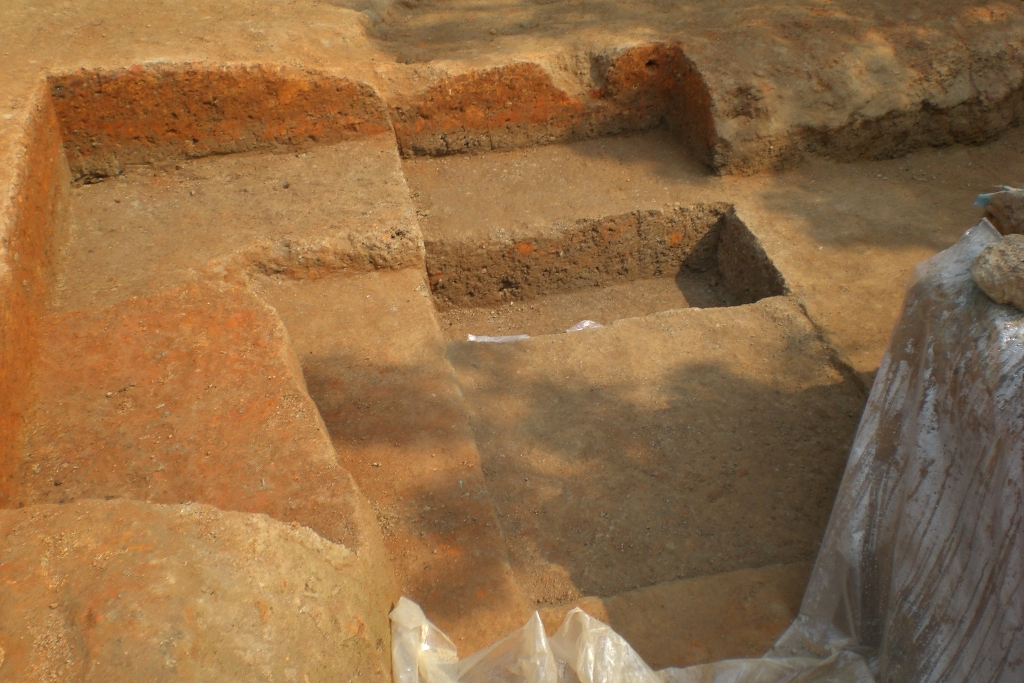
The Wari-Bateshwar (Bengali: উয়ারী-বটেশ্বর, Bengali pronunciation: [u̯aɾi bɔʈeʃʃɔɾ]) ruins in Narsingdi, Dhaka Division, Bangladesh is one of the oldest urban archaeological sites in Bangladesh. Excavation in the site unearthed a fortified urban center, paved roads and suburban dwelling. The site was primarily occupied during the Iron Age, from 400 to 100 BCE, as evidenced by the abundance of punch-marked coins and Northern Black Polished Ware (NBPW) artifacts.
The site also reveals signs of pit dwelling, a feature typically found in Chalcolithic archaeological sites in the Indian sub-continent.
The site sprawls across Wari and Bateshwar, two adjacent villages in the Belabo Upazila of Narsingdi district, about 17 km north-west of the confluence of the rivers Old Brahmaputra and Meghna at the lower end of Sylhet basin. Borehole records show that the site lies on the remnants of a Pleistocene fluvial terrace about 15 metre above sea level and 6-8 metre above the current river level. The sediment consists of brownish red clay with interbedded sand layers, locally knows as Madhupur clay.
The main stem of the Brahmaputra River shifted back and forth between the Brahmaputra-Jamuna and the Old Brahmaputra branches through history. Around 2500 BCE, avulsion of the main channel to the Brahmaputra-Jamuna branch gave rise to discontinuous peatlands throughout Sylhet basin. The evidence of early urban settlement on the peatlands at Wari-Bateshwar was found in stratigraphic layers dated ~1100 BCE. Human occupation continued for nearly a millennium until ~200 BCE, when the channel shifted back to the Old Brahmaputra branch. The resultant flooding possibly led to the abandonment of the Wari-Bateshwar urban center around 100 BCE. Eventually the 1762 Arakan earthquake again caused the main channel to shift to the Brahmaputra-Jamuna branch.
Locals from Wari-Bateshwar have long been aware of the availability of archeological artifacts, especially silver punch-marked coins and semi-precious gemstone beads in the area. In the 1930s, Hanif Pathan, a local school teacher, started collecting these artifacts, and later inspired his son Habibulla Pathan (1939-2026) to continue the exploration. The father-son duo created a local museum called Bateshwar Sangrahashala to store and exhibit their collection. Habibulla Pathan published a number of newspaper articles and books describing the artifacts. Nevertheless, the site took a while to attract the attention of academics and archaeologists in Bangladesh.
In December of 1933, while laborers were digging the soil in the village of Wari, they discovered a hoard of coins stored in a pot. Local schoolteacher Hanif Pathan collected 20–30 of those coins. These were the oldest silver coins of Bengal-India. Thus began the collection of archaeological artifacts from Wari-Bateshwar.
In 1955, local laborers left behind two pieces of iron in the village of Bateshwar. These triangular and one-pointed, heavy iron objects were shown by Habibullah Pathan to his father, who was amazed. On January 30 of that year, Hanif Pathan published an article titled "Prehistoric Civilization in East Pakistan" in the Sunday edition of the daily Azad newspaper. After that, various archaeological artifacts continued to be discovered in that area from time to time.
In March of 1956, a farmer from Wari village named Jaru Mia discovered a hoard of stamped silver coins while digging soil. That hoard contained at least about four thousand coins and weighed nine ser. Failing to understand the historical value of the coins, Jaru Mia sold them to a silversmith at the rate of eighty taka per ser. For just 720 taka, these invaluable historical items were melted down in the silversmith’s furnace and lost forever.
Hub AI
Wari-Bateshwar ruins AI simulator
(@Wari-Bateshwar ruins_simulator)
Wari-Bateshwar ruins
The Wari-Bateshwar (Bengali: উয়ারী-বটেশ্বর, Bengali pronunciation: [u̯aɾi bɔʈeʃʃɔɾ]) ruins in Narsingdi, Dhaka Division, Bangladesh is one of the oldest urban archaeological sites in Bangladesh. Excavation in the site unearthed a fortified urban center, paved roads and suburban dwelling. The site was primarily occupied during the Iron Age, from 400 to 100 BCE, as evidenced by the abundance of punch-marked coins and Northern Black Polished Ware (NBPW) artifacts.
The site also reveals signs of pit dwelling, a feature typically found in Chalcolithic archaeological sites in the Indian sub-continent.
The site sprawls across Wari and Bateshwar, two adjacent villages in the Belabo Upazila of Narsingdi district, about 17 km north-west of the confluence of the rivers Old Brahmaputra and Meghna at the lower end of Sylhet basin. Borehole records show that the site lies on the remnants of a Pleistocene fluvial terrace about 15 metre above sea level and 6-8 metre above the current river level. The sediment consists of brownish red clay with interbedded sand layers, locally knows as Madhupur clay.
The main stem of the Brahmaputra River shifted back and forth between the Brahmaputra-Jamuna and the Old Brahmaputra branches through history. Around 2500 BCE, avulsion of the main channel to the Brahmaputra-Jamuna branch gave rise to discontinuous peatlands throughout Sylhet basin. The evidence of early urban settlement on the peatlands at Wari-Bateshwar was found in stratigraphic layers dated ~1100 BCE. Human occupation continued for nearly a millennium until ~200 BCE, when the channel shifted back to the Old Brahmaputra branch. The resultant flooding possibly led to the abandonment of the Wari-Bateshwar urban center around 100 BCE. Eventually the 1762 Arakan earthquake again caused the main channel to shift to the Brahmaputra-Jamuna branch.
Locals from Wari-Bateshwar have long been aware of the availability of archeological artifacts, especially silver punch-marked coins and semi-precious gemstone beads in the area. In the 1930s, Hanif Pathan, a local school teacher, started collecting these artifacts, and later inspired his son Habibulla Pathan (1939-2026) to continue the exploration. The father-son duo created a local museum called Bateshwar Sangrahashala to store and exhibit their collection. Habibulla Pathan published a number of newspaper articles and books describing the artifacts. Nevertheless, the site took a while to attract the attention of academics and archaeologists in Bangladesh.
In December of 1933, while laborers were digging the soil in the village of Wari, they discovered a hoard of coins stored in a pot. Local schoolteacher Hanif Pathan collected 20–30 of those coins. These were the oldest silver coins of Bengal-India. Thus began the collection of archaeological artifacts from Wari-Bateshwar.
In 1955, local laborers left behind two pieces of iron in the village of Bateshwar. These triangular and one-pointed, heavy iron objects were shown by Habibullah Pathan to his father, who was amazed. On January 30 of that year, Hanif Pathan published an article titled "Prehistoric Civilization in East Pakistan" in the Sunday edition of the daily Azad newspaper. After that, various archaeological artifacts continued to be discovered in that area from time to time.
In March of 1956, a farmer from Wari village named Jaru Mia discovered a hoard of stamped silver coins while digging soil. That hoard contained at least about four thousand coins and weighed nine ser. Failing to understand the historical value of the coins, Jaru Mia sold them to a silversmith at the rate of eighty taka per ser. For just 720 taka, these invaluable historical items were melted down in the silversmith’s furnace and lost forever.