
Recent from talks
Soyuz-2
Knowledge base stats:
Talk channels stats:
Members stats:
Soyuz-2
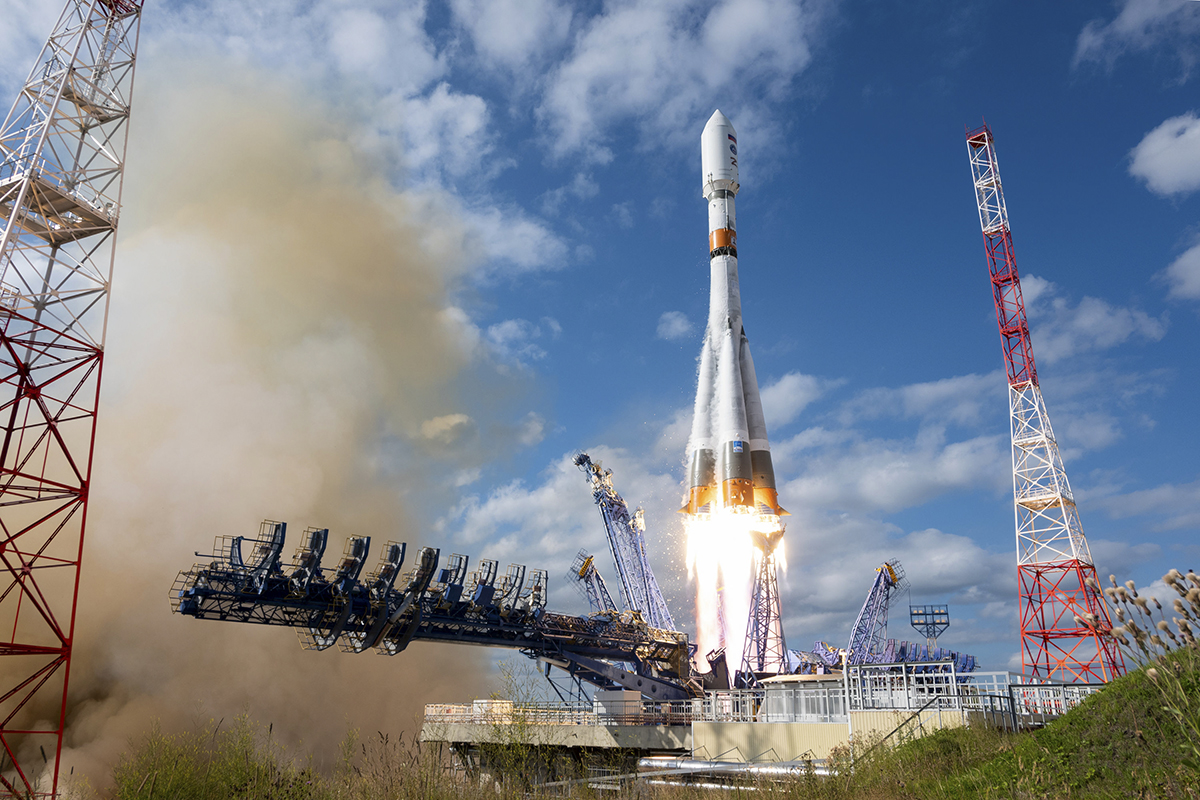
Soyuz‑2 (Russian: Союз‑2, lit. 'Union‑2'; GRAU index: 14A14) is a Russian expendable medium-lift launch vehicle and the seventh major iteration of the Soyuz rocket family. Compared to its predecessors, Soyuz-2 features significant upgrades, including improved engines and a digital flight control system that enables launches from fixed platforms and supports larger payload fairings.
Developed by the Progress Rocket Space Centre (RKTs Progress) in Samara, Soyuz-2 is used to place payloads into low Earth orbit in standard configuration but can also support missions to higher orbits using an additional upper stage, most commonly the Fregat, though the smaller Volga is available as a less expensive option. Since its introduction in 2004, Soyuz-2 has gradually replaced earlier Soyuz variants and is launched from the facilities of its R-7 derived predecessors: Site 31/6 at the Baikonur Cosmodrome in Kazakhstan and Sites 43/3 and 43/4 at the Plesetsk Cosmodrome in northwestern Russia, and, since 2016, Site 1S at the Vostochny Cosmodrome in eastern Russia.
The Soyuz‑2 family includes several variants. The base model, Soyuz‑2.1a, debuted on 8 November 2004, followed by the Soyuz‑2.1b, with a 15 percent more powerful third stage, on 27 December 2006. A derivative version, Soyuz‑ST, was introduced in 2011 with modifications for operation at the Guiana Space Centre, the European Space Agency's launch site in French Guiana. Launches from this site were suspended in 2022 following the Russian invasion of Ukraine.
The Soyuz-2 project was launched by RKTs Progress with support from the Russian government in the early 1990s as the "Rus" program. In the aftermath of the collapse of the Soviet Union, the program aimed to consolidate the launch vehicle's subcontractor network within the Russian Federation and transition to fully domestic production. The project evolved into Soyuz-2, introducing technical upgrades to replace the aging Soyuz-U (in service since 1973) and Molniya-M (in service since 1965). These earlier models relied on an analog guidance, navigation, and control systems developed in the 1960s by a Ukrainian firm, the Polisvit Special Design Bureau. The modernization effort also included engine upgrades, allowing for improved performance through newer, more powerful designs.
The Soyuz-2 upgrades included a fully digital flight control system, modernized RD-107A and RD-108A engines with an improved injection system for the boosters and core stage, and a new RD-0124 third-stage engine engine using oxygen-rich staged combustion. These enhancements aimed to increase payload capacity by approximately 1,200 kilograms (2,600 lb).
Development of the digital control system began in 1993 at NPO Avtomatiki in Yekaterinburg.The new system featured three redundant processing units and dual gyroscopes, significantly improving reliability. According to NPO Avtomatiki's deputy director, participation in the Soyuz-2 program helped save the company.
However, progress slowed during the financial crisis facing the Russian space industry in the late 1990s and early 2000s. As a result, the upgrade plan was divided into phases. The RD-107A and RD-108A engines were introduced early as part of the Soyuz-FG, a transitional design based on the Soyuz-U. The majority of design changes were incorporated into the Soyuz-2.1a, while development of the RD-0124 was delayed and eventually implemented on the Soyuz-2.1b.
Soyuz-2.1a conducted its first suborbital test from the Plesetsk Cosmodrome on 8 November 2004. It made its first operational flight in October 2006, successfully launching the MetOp-A satellite for ESA and EUMETSAT. The Soyuz-2.1b, equipped with the new third-stage, debuted on 27 December 2006. Over time, the Soyuz-2 family replaced its predecessors: Molniya-M in 2010, Soyuz-U in 2017, and Soyuz-FG in 2019.
Hub AI
Soyuz-2 AI simulator
(@Soyuz-2_simulator)
Soyuz-2
Soyuz‑2 (Russian: Союз‑2, lit. 'Union‑2'; GRAU index: 14A14) is a Russian expendable medium-lift launch vehicle and the seventh major iteration of the Soyuz rocket family. Compared to its predecessors, Soyuz-2 features significant upgrades, including improved engines and a digital flight control system that enables launches from fixed platforms and supports larger payload fairings.
Developed by the Progress Rocket Space Centre (RKTs Progress) in Samara, Soyuz-2 is used to place payloads into low Earth orbit in standard configuration but can also support missions to higher orbits using an additional upper stage, most commonly the Fregat, though the smaller Volga is available as a less expensive option. Since its introduction in 2004, Soyuz-2 has gradually replaced earlier Soyuz variants and is launched from the facilities of its R-7 derived predecessors: Site 31/6 at the Baikonur Cosmodrome in Kazakhstan and Sites 43/3 and 43/4 at the Plesetsk Cosmodrome in northwestern Russia, and, since 2016, Site 1S at the Vostochny Cosmodrome in eastern Russia.
The Soyuz‑2 family includes several variants. The base model, Soyuz‑2.1a, debuted on 8 November 2004, followed by the Soyuz‑2.1b, with a 15 percent more powerful third stage, on 27 December 2006. A derivative version, Soyuz‑ST, was introduced in 2011 with modifications for operation at the Guiana Space Centre, the European Space Agency's launch site in French Guiana. Launches from this site were suspended in 2022 following the Russian invasion of Ukraine.
The Soyuz-2 project was launched by RKTs Progress with support from the Russian government in the early 1990s as the "Rus" program. In the aftermath of the collapse of the Soviet Union, the program aimed to consolidate the launch vehicle's subcontractor network within the Russian Federation and transition to fully domestic production. The project evolved into Soyuz-2, introducing technical upgrades to replace the aging Soyuz-U (in service since 1973) and Molniya-M (in service since 1965). These earlier models relied on an analog guidance, navigation, and control systems developed in the 1960s by a Ukrainian firm, the Polisvit Special Design Bureau. The modernization effort also included engine upgrades, allowing for improved performance through newer, more powerful designs.
The Soyuz-2 upgrades included a fully digital flight control system, modernized RD-107A and RD-108A engines with an improved injection system for the boosters and core stage, and a new RD-0124 third-stage engine engine using oxygen-rich staged combustion. These enhancements aimed to increase payload capacity by approximately 1,200 kilograms (2,600 lb).
Development of the digital control system began in 1993 at NPO Avtomatiki in Yekaterinburg.The new system featured three redundant processing units and dual gyroscopes, significantly improving reliability. According to NPO Avtomatiki's deputy director, participation in the Soyuz-2 program helped save the company.
However, progress slowed during the financial crisis facing the Russian space industry in the late 1990s and early 2000s. As a result, the upgrade plan was divided into phases. The RD-107A and RD-108A engines were introduced early as part of the Soyuz-FG, a transitional design based on the Soyuz-U. The majority of design changes were incorporated into the Soyuz-2.1a, while development of the RD-0124 was delayed and eventually implemented on the Soyuz-2.1b.
Soyuz-2.1a conducted its first suborbital test from the Plesetsk Cosmodrome on 8 November 2004. It made its first operational flight in October 2006, successfully launching the MetOp-A satellite for ESA and EUMETSAT. The Soyuz-2.1b, equipped with the new third-stage, debuted on 27 December 2006. Over time, the Soyuz-2 family replaced its predecessors: Molniya-M in 2010, Soyuz-U in 2017, and Soyuz-FG in 2019.
Recent media