



Community hub
Recent from talks
Knowledge base stats:
Talk channels stats:
Members stats:
Soyuz 5
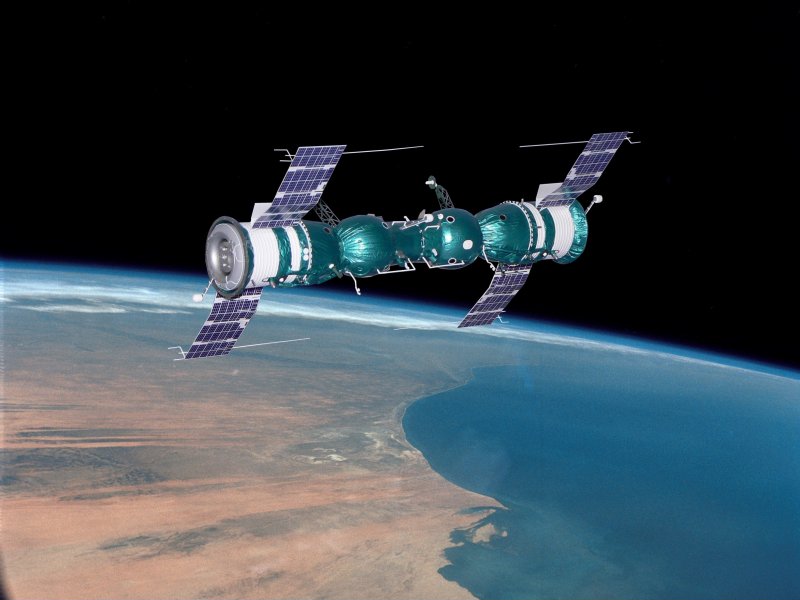
Soyuz 5 (Russian: Союз 5, Union 5) was a Soyuz mission using the Soyuz 7K-OK spacecraft launched by the Soviet Union on 15 January 1969, which docked with Soyuz 4 in orbit. It was the first docking of two crewed spacecraft of any nation, and the first transfer of crew from one space vehicle to another of any nation, the only time a transfer was accomplished with a space walk – two months before the United States Apollo 9 mission performed the first internal crew transfer.
The mission, flown by cosmonauts Boris Volynov, Aleksei Yeliseyev, and Yevgeny Khrunov, was also memorable for its dramatic re-entry. The craft's service module did not separate, so it entered the atmosphere nose-first, leaving Volynov hanging by his restraining straps. As the craft aerobraked, the atmosphere burned through the service module, allowing the remaining descent module to right itself before the escape hatch was burned through. During the descent, the parachute lines tangled and the landing rockets failed, resulting in a hard landing that broke Volynov's teeth.
Launch preparations for Soyuz 5 went smoothly and the frigid mid-winter weather at the cosmodrome moderated a bit on January 15, with temperatures climbing to −7 °C (19 °F). During the countdown, a positive electrical discharge was detected around the base of the booster, so a halt was called to replace a voltage regulator. A technician had to strip down to his underwear in the chilly winter air to be able to fit inside the instrument compartment and remove four bolts holding the regulator in place. He swapped it with a replacement unit but was only able to get three of the bolts in place before his hands began to freeze, so the booster would have to launch with a missing bolt despite the possible safety risk posed. Liftoff took place at 10:04 AM local time and went flawlessly.
Soyuz 5 was piloted by commander Boris Volynov and carried flight engineers Aleksei Yeliseyev and Yevgeny Khrunov as the crew to be transferred to Soyuz 4 for reentry. The mission plan contained scientific, technical, and medical-biological research, testing of spacecraft systems and design elements, docking of piloted spacecraft, and transfer of cosmonauts from one craft to another in orbit.
Volynov remained behind on Soyuz 5, and returned to Earth in a remarkable re-entry. The service module of the Soyuz failed to separate after retrofire, but by that point it was too late to abort. While this had occurred on various Vostok and Voskhod flights, it was a much more serious problem for Volynov, as the Soyuz service module was much larger than the small retropack the earlier vehicles employed.
When the Soyuz started aerobraking in the upper reaches of the atmosphere, the combined spacecraft sought the most aerodynamically stable position - nose forward, with the heavy descent module facing directly into the air stream with only its light metal entry hatch at the front to protect it. The gaskets sealing the hatch began to burn, filling the compartment with dangerous fumes and smoke. The deceleration, while normal for reentry, pulled Volynov outward against his harness rather than against the padded seat. As the thermal and aerodynamic stresses on the combined craft increased, struts between the descent and service modules broke off or burned through before the hatch failed. The descent module immediately righted itself once the service module was gone, with the heat shield forward to take the brunt of re-entry.
There was one final problem in store for Volynov when the parachute cables partially tangled and the soft-landing rockets failed, resulting in a hard impact which broke some of his teeth. The capsule came down in the Ural Mountains at 200 km (120 mi) of the southwest of Kostanay, near Orenburg, Soviet Union, far short of its target landing site in Kazakhstan. The local temperature was −38 °C (−36 °F), and knowing that it would be many hours before rescue teams could reach him, Volynov abandoned the capsule and, having spotted smoke rising from a distant chimney, walked for several kilometers to find shelter at a local peasant's house. It would be seven years until Volynov flew again, on Soyuz 21.
Hub AI
Soyuz 5 AI simulator
(@Soyuz 5_simulator)
Soyuz 5
Soyuz 5 (Russian: Союз 5, Union 5) was a Soyuz mission using the Soyuz 7K-OK spacecraft launched by the Soviet Union on 15 January 1969, which docked with Soyuz 4 in orbit. It was the first docking of two crewed spacecraft of any nation, and the first transfer of crew from one space vehicle to another of any nation, the only time a transfer was accomplished with a space walk – two months before the United States Apollo 9 mission performed the first internal crew transfer.
The mission, flown by cosmonauts Boris Volynov, Aleksei Yeliseyev, and Yevgeny Khrunov, was also memorable for its dramatic re-entry. The craft's service module did not separate, so it entered the atmosphere nose-first, leaving Volynov hanging by his restraining straps. As the craft aerobraked, the atmosphere burned through the service module, allowing the remaining descent module to right itself before the escape hatch was burned through. During the descent, the parachute lines tangled and the landing rockets failed, resulting in a hard landing that broke Volynov's teeth.
Launch preparations for Soyuz 5 went smoothly and the frigid mid-winter weather at the cosmodrome moderated a bit on January 15, with temperatures climbing to −7 °C (19 °F). During the countdown, a positive electrical discharge was detected around the base of the booster, so a halt was called to replace a voltage regulator. A technician had to strip down to his underwear in the chilly winter air to be able to fit inside the instrument compartment and remove four bolts holding the regulator in place. He swapped it with a replacement unit but was only able to get three of the bolts in place before his hands began to freeze, so the booster would have to launch with a missing bolt despite the possible safety risk posed. Liftoff took place at 10:04 AM local time and went flawlessly.
Soyuz 5 was piloted by commander Boris Volynov and carried flight engineers Aleksei Yeliseyev and Yevgeny Khrunov as the crew to be transferred to Soyuz 4 for reentry. The mission plan contained scientific, technical, and medical-biological research, testing of spacecraft systems and design elements, docking of piloted spacecraft, and transfer of cosmonauts from one craft to another in orbit.
Volynov remained behind on Soyuz 5, and returned to Earth in a remarkable re-entry. The service module of the Soyuz failed to separate after retrofire, but by that point it was too late to abort. While this had occurred on various Vostok and Voskhod flights, it was a much more serious problem for Volynov, as the Soyuz service module was much larger than the small retropack the earlier vehicles employed.
When the Soyuz started aerobraking in the upper reaches of the atmosphere, the combined spacecraft sought the most aerodynamically stable position - nose forward, with the heavy descent module facing directly into the air stream with only its light metal entry hatch at the front to protect it. The gaskets sealing the hatch began to burn, filling the compartment with dangerous fumes and smoke. The deceleration, while normal for reentry, pulled Volynov outward against his harness rather than against the padded seat. As the thermal and aerodynamic stresses on the combined craft increased, struts between the descent and service modules broke off or burned through before the hatch failed. The descent module immediately righted itself once the service module was gone, with the heat shield forward to take the brunt of re-entry.
There was one final problem in store for Volynov when the parachute cables partially tangled and the soft-landing rockets failed, resulting in a hard impact which broke some of his teeth. The capsule came down in the Ural Mountains at 200 km (120 mi) of the southwest of Kostanay, near Orenburg, Soviet Union, far short of its target landing site in Kazakhstan. The local temperature was −38 °C (−36 °F), and knowing that it would be many hours before rescue teams could reach him, Volynov abandoned the capsule and, having spotted smoke rising from a distant chimney, walked for several kilometers to find shelter at a local peasant's house. It would be seven years until Volynov flew again, on Soyuz 21.