



Community hub
Recent from talks
Knowledge base stats:
Talk channels stats:
Members stats:
Falcon 9 prototypes
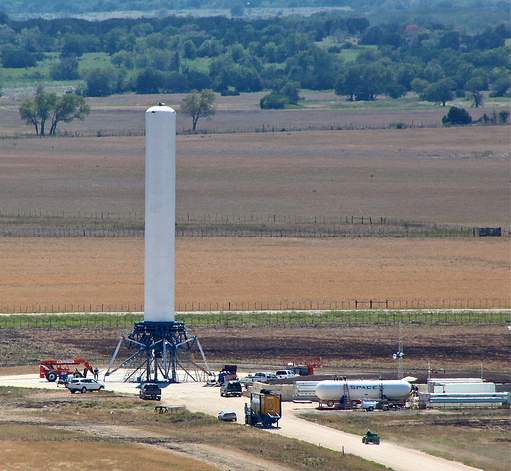
Falcon 9 prototypes were experimental flight test reusable rockets that performed vertical takeoffs and landings. The project was privately funded by SpaceX, with no funds provided by any government until later on. Two prototypes were built, and both were launched from the ground.
The earliest prototype was Grasshopper. It was announced in 2011 and began low-altitude, low-velocity hover/landing testing in 2012. Grasshopper was 106 ft (32 m) tall and made eight successful test flights in 2012 and 2013 before being retired. A second prototype of Falcon 9 was the larger and more capable Falcon 9 Reusable Development Vehicle (F9R Dev, also known as F9R Dev1) based on the Falcon 9 v1.1 launch vehicle. It was tested at higher altitudes and was capable of much higher velocity but was never tested at high velocity. The F9R Dev1 vehicle was built in 2013–2014 and made its first low-altitude flight test on 17 April 2014; it was lost during a three-engine test at the McGregor test site on 22 August 2014, which ended the low-velocity test program. Further expansion of the flight test envelope for the reusable rocket was moved to descending Falcon 9 boosters that had been used on orbital flight trajectories on commercial orbital flights of the Falcon 9.
The Grasshopper and F9R Dev tests were fundamental to the development of the reusable Falcon 9 and Falcon Heavy rockets, which require vertical landings of the near-empty Falcon 9 and Falcon Heavy first-stage booster tanks and engine assemblies. The Grasshopper and the F9R Dev tests led into a series of high-altitude, high-speed controlled-descent tests of post-mission (spent) Falcon 9 booster stages that accompanied the commercial Falcon 9 missions since September 2013. The latter eventually resulted in the first successful booster landing on 21 December 2015.
Grasshopper first became known publicly in the third quarter of 2011, when space journalists first wrote about it after analyzing space launch regulations of the Federal Aviation Administration.
Shortly thereafter, SpaceX confirmed the existence of the test vehicle development program, and projected it would begin the Grasshopper flight test program in 2012.
Releases of public information in 2011 indicated that the subsonic tests would occur in McGregor, Texas in three phases, at maximum flight altitudes of 670 to 11,500 ft (200 to 3,510 m), for durations of 45 to 160 s (0.75 to 2.67 min). At the time, testing was expected to take up to three years and the initial FAA permit allows up to 70 suborbital launches per year. A half-acre concrete launch facility was constructed to support the test flight program. In September 2012, SpaceX announced that they have requested FAA approval to increase the altitude of some of the initial test flights. Looking forward to the next year, CEO Musk said in November 2012: "Over the next few months, we'll gradually increase the altitude and speed. ... I do think there probably will be some craters along the way; we'll be very lucky if there are no craters. Vertical landing is an extremely important breakthrough — extreme, rapid reusability."
In May 2013, SpaceX announced that the higher-altitude, higher-velocity part of the Grasshopper flight test program would be done at Spaceport America near Las Cruces, New Mexico—and not at the Federal Government's adjacent White Sands Missile Range facility as previously planned—and signed a three-year lease for land and facilities at the recently operational spaceport. SpaceX indicated in May 2013 that they did not yet know how many jobs might move from Texas to New Mexico.
SpaceX began constructing a 30 m × 30 m (98 ft × 98 ft) pad at Spaceport America in May 2013, 7 km (4.3 mi) southwest of the spaceport's main campus, planning to lease the pad for US$6,600 per month plus US$25,000 per test flight.
Hub AI
Falcon 9 prototypes AI simulator
(@Falcon 9 prototypes_simulator)
Falcon 9 prototypes
Falcon 9 prototypes were experimental flight test reusable rockets that performed vertical takeoffs and landings. The project was privately funded by SpaceX, with no funds provided by any government until later on. Two prototypes were built, and both were launched from the ground.
The earliest prototype was Grasshopper. It was announced in 2011 and began low-altitude, low-velocity hover/landing testing in 2012. Grasshopper was 106 ft (32 m) tall and made eight successful test flights in 2012 and 2013 before being retired. A second prototype of Falcon 9 was the larger and more capable Falcon 9 Reusable Development Vehicle (F9R Dev, also known as F9R Dev1) based on the Falcon 9 v1.1 launch vehicle. It was tested at higher altitudes and was capable of much higher velocity but was never tested at high velocity. The F9R Dev1 vehicle was built in 2013–2014 and made its first low-altitude flight test on 17 April 2014; it was lost during a three-engine test at the McGregor test site on 22 August 2014, which ended the low-velocity test program. Further expansion of the flight test envelope for the reusable rocket was moved to descending Falcon 9 boosters that had been used on orbital flight trajectories on commercial orbital flights of the Falcon 9.
The Grasshopper and F9R Dev tests were fundamental to the development of the reusable Falcon 9 and Falcon Heavy rockets, which require vertical landings of the near-empty Falcon 9 and Falcon Heavy first-stage booster tanks and engine assemblies. The Grasshopper and the F9R Dev tests led into a series of high-altitude, high-speed controlled-descent tests of post-mission (spent) Falcon 9 booster stages that accompanied the commercial Falcon 9 missions since September 2013. The latter eventually resulted in the first successful booster landing on 21 December 2015.
Grasshopper first became known publicly in the third quarter of 2011, when space journalists first wrote about it after analyzing space launch regulations of the Federal Aviation Administration.
Shortly thereafter, SpaceX confirmed the existence of the test vehicle development program, and projected it would begin the Grasshopper flight test program in 2012.
Releases of public information in 2011 indicated that the subsonic tests would occur in McGregor, Texas in three phases, at maximum flight altitudes of 670 to 11,500 ft (200 to 3,510 m), for durations of 45 to 160 s (0.75 to 2.67 min). At the time, testing was expected to take up to three years and the initial FAA permit allows up to 70 suborbital launches per year. A half-acre concrete launch facility was constructed to support the test flight program. In September 2012, SpaceX announced that they have requested FAA approval to increase the altitude of some of the initial test flights. Looking forward to the next year, CEO Musk said in November 2012: "Over the next few months, we'll gradually increase the altitude and speed. ... I do think there probably will be some craters along the way; we'll be very lucky if there are no craters. Vertical landing is an extremely important breakthrough — extreme, rapid reusability."
In May 2013, SpaceX announced that the higher-altitude, higher-velocity part of the Grasshopper flight test program would be done at Spaceport America near Las Cruces, New Mexico—and not at the Federal Government's adjacent White Sands Missile Range facility as previously planned—and signed a three-year lease for land and facilities at the recently operational spaceport. SpaceX indicated in May 2013 that they did not yet know how many jobs might move from Texas to New Mexico.
SpaceX began constructing a 30 m × 30 m (98 ft × 98 ft) pad at Spaceport America in May 2013, 7 km (4.3 mi) southwest of the spaceport's main campus, planning to lease the pad for US$6,600 per month plus US$25,000 per test flight.