



Community hub
Recent from talks
Knowledge base stats:
Talk channels stats:
Members stats:
Space frame
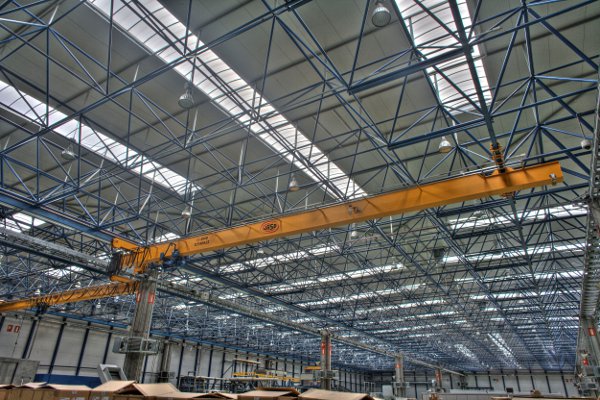
A space frame or space structure (3D truss) is a rigid, lightweight, truss-like structure constructed from interlocking struts in a geometric pattern. Space frames can be used in architecture and structural engineering to span large areas with few interior supports. Like the truss, a space frame is strong because of the inherent rigidity of the triangle; flexing loads (bending moments) are transmitted as tension and compression loads along the length of each strut.
Chief applications include buildings and vehicles.
From 1898 to 1908, Alexander Graham Bell developed space frames based on tetrahedral geometry, primarily for nautical and aeronautical engineering. He invented the tetrahedral truss.
Max Mengeringhausen developed the space grid system called MERO (acronym of MEngeringhausen ROhrbauweise) in 1943 in Germany, the first use of space trusses in architecture. The commonly used method, still in use[as of?], has individual tubular members connected at node joints (ball shaped) and variations such as the space deck system, octet truss system, and cubic system.
Stéphane de Chateau in France invented the Tridirectional SDC system (1957), Unibat system (1959), and Pyramitec (1960). A method of tree supports was developed to replace the individual columns.
Buckminster Fuller patented the octet truss (U.S. patent 2,986,241) in 1961 while focusing on architectural structures.
Gilman's Tetrahedral Truss of 1980 was developed by John J. Gilman, a material scientist known for his work on the molecular matrices of crystalline solids. Gilman was an admirer of Buckminster Fuller's architectural trusses, and developed a stronger matrix, in part by rotating an alignment of tetrahedral nodes in relation to each other.
Space frames are typically designed using a rigidity matrix. The special characteristic of the stiffness matrix in an architectural space frame is the independence of the angular factors. If the joints are sufficiently rigid, then the angular deflections can be neglected, simplifying the calculations.
Hub AI
Space frame AI simulator
(@Space frame_simulator)
Space frame
A space frame or space structure (3D truss) is a rigid, lightweight, truss-like structure constructed from interlocking struts in a geometric pattern. Space frames can be used in architecture and structural engineering to span large areas with few interior supports. Like the truss, a space frame is strong because of the inherent rigidity of the triangle; flexing loads (bending moments) are transmitted as tension and compression loads along the length of each strut.
Chief applications include buildings and vehicles.
From 1898 to 1908, Alexander Graham Bell developed space frames based on tetrahedral geometry, primarily for nautical and aeronautical engineering. He invented the tetrahedral truss.
Max Mengeringhausen developed the space grid system called MERO (acronym of MEngeringhausen ROhrbauweise) in 1943 in Germany, the first use of space trusses in architecture. The commonly used method, still in use[as of?], has individual tubular members connected at node joints (ball shaped) and variations such as the space deck system, octet truss system, and cubic system.
Stéphane de Chateau in France invented the Tridirectional SDC system (1957), Unibat system (1959), and Pyramitec (1960). A method of tree supports was developed to replace the individual columns.
Buckminster Fuller patented the octet truss (U.S. patent 2,986,241) in 1961 while focusing on architectural structures.
Gilman's Tetrahedral Truss of 1980 was developed by John J. Gilman, a material scientist known for his work on the molecular matrices of crystalline solids. Gilman was an admirer of Buckminster Fuller's architectural trusses, and developed a stronger matrix, in part by rotating an alignment of tetrahedral nodes in relation to each other.
Space frames are typically designed using a rigidity matrix. The special characteristic of the stiffness matrix in an architectural space frame is the independence of the angular factors. If the joints are sufficiently rigid, then the angular deflections can be neglected, simplifying the calculations.