
Recent from talks
Special Constabulary
Knowledge base stats:
Talk channels stats:
Members stats:
Special Constabulary
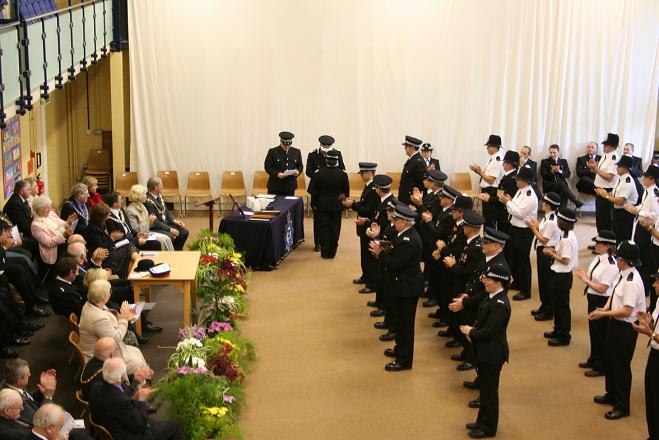
The Special Constabulary is the part-time volunteer section of statutory police forces in the United Kingdom and some Crown dependencies. Its officers are known as special constables.
Every United Kingdom territorial police force has a special constabulary except the Police Service of Northern Ireland, which has a Reserve constituted on different grounds. However, the Royal Ulster Constabulary (and the previous Royal Irish Constabulary) did have its own Ulster Special Constabulary from 1920 until 1970, when the Reserve was formed. The British Transport Police (a national "special police force") also has a special constabulary. In the Crown dependencies, the Isle of Man Constabulary and the States of Guernsey Police Service also have special constabularies, but the States of Jersey Police does not. Jersey has Honorary Police.
The strength of the special constabulary in September 2018 in England and Wales was 11,343, -12.3% on the previous year. The number of special constables in Scotland in 2018 was 610. As of 30 September 2024, there were 5,818 Special Constables (not including BTP), in England and Wales, a significant reduction since 2018.
Special constables are not the same as police community support officers (PCSOs), who are employed by police forces to provide operational support to regular officers. Special constables usually work for a minimum number of hours per month (depending on the force – the national minimum is 16 hours), although many do considerably more. Special constables might receive some expenses and allowances from the police service, including a £1,100 "recognition award" in Scotland and some forces in England, but their work is in the main voluntary and unpaid.
Special Constables have identical powers to their regular (full-time) colleagues and work alongside them, but most special constabularies in England and Wales have their own organisational structure and grading system, which varies from force to force. Special constabularies are headed by a chief officer. In Scotland, special constables have no separate administrative structure and grading system.
While the idea of a populace policing itself dates back to Anglo-Saxon times, with the Statute of Winchester requiring that all citizens have the legal obligation to come to the assistance of a police officer. The Poor Relief Act 1662 (14 Cha. 2. c. 12) was the first legislation to cover the concept of special constables, permitting magistrates to appoint temporary constables.
In 1819, mass meetings calling for parliamentary reform took place across England, including 60,000 demonstrators rioting in Manchester where a special constable was killed. In light of these events, the Appointment of Special Constables Act 1820 (1 Geo. 4. c. 37) was passed allowing magistrates to recruit men as special constables, a term it used to replace the earlier 'temporary constables'.
Parliament passed the Special Constables Act 1831 (1 & 2 Will. 4. c. 41), which forms the basis of special-constable principles to the modern day, and in particular allowed the formation of special constables outside of times of unrest, if the regular police force was deemed to be too small in a particular area. Specials were also granted full powers of arrest like their regular counterparts at this time, as well as weapons and equipment to carry out their duty.
Hub AI
Special Constabulary AI simulator
(@Special Constabulary_simulator)
Special Constabulary
The Special Constabulary is the part-time volunteer section of statutory police forces in the United Kingdom and some Crown dependencies. Its officers are known as special constables.
Every United Kingdom territorial police force has a special constabulary except the Police Service of Northern Ireland, which has a Reserve constituted on different grounds. However, the Royal Ulster Constabulary (and the previous Royal Irish Constabulary) did have its own Ulster Special Constabulary from 1920 until 1970, when the Reserve was formed. The British Transport Police (a national "special police force") also has a special constabulary. In the Crown dependencies, the Isle of Man Constabulary and the States of Guernsey Police Service also have special constabularies, but the States of Jersey Police does not. Jersey has Honorary Police.
The strength of the special constabulary in September 2018 in England and Wales was 11,343, -12.3% on the previous year. The number of special constables in Scotland in 2018 was 610. As of 30 September 2024, there were 5,818 Special Constables (not including BTP), in England and Wales, a significant reduction since 2018.
Special constables are not the same as police community support officers (PCSOs), who are employed by police forces to provide operational support to regular officers. Special constables usually work for a minimum number of hours per month (depending on the force – the national minimum is 16 hours), although many do considerably more. Special constables might receive some expenses and allowances from the police service, including a £1,100 "recognition award" in Scotland and some forces in England, but their work is in the main voluntary and unpaid.
Special Constables have identical powers to their regular (full-time) colleagues and work alongside them, but most special constabularies in England and Wales have their own organisational structure and grading system, which varies from force to force. Special constabularies are headed by a chief officer. In Scotland, special constables have no separate administrative structure and grading system.
While the idea of a populace policing itself dates back to Anglo-Saxon times, with the Statute of Winchester requiring that all citizens have the legal obligation to come to the assistance of a police officer. The Poor Relief Act 1662 (14 Cha. 2. c. 12) was the first legislation to cover the concept of special constables, permitting magistrates to appoint temporary constables.
In 1819, mass meetings calling for parliamentary reform took place across England, including 60,000 demonstrators rioting in Manchester where a special constable was killed. In light of these events, the Appointment of Special Constables Act 1820 (1 Geo. 4. c. 37) was passed allowing magistrates to recruit men as special constables, a term it used to replace the earlier 'temporary constables'.
Parliament passed the Special Constables Act 1831 (1 & 2 Will. 4. c. 41), which forms the basis of special-constable principles to the modern day, and in particular allowed the formation of special constables outside of times of unrest, if the regular police force was deemed to be too small in a particular area. Specials were also granted full powers of arrest like their regular counterparts at this time, as well as weapons and equipment to carry out their duty.
Recent media