


_3rd_Class_Rolando_Calilung_tests_for_a_specific_gravity_test_on_JP-5_fuel.jpg/1400px-US_Navy_111005-N-ZN781-031_Aviation_Boatswain's_Mate_(Fuel)_3rd_Class_Rolando_Calilung_tests_for_a_specific_gravity_test_on_JP-5_fuel.jpg)

Community hub
Recent from talks
Knowledge base stats:
Talk channels stats:
Members stats:
Relative density
Relative density, also called specific gravity, is a dimensionless quantity defined as the ratio of the density (mass divided by volume) of a substance to the density of a given reference material. Specific gravity for solids and liquids is nearly always measured with respect to water at its densest (at 4 °C or 39.2 °F); for gases, the reference is air at room temperature (20 °C or 68 °F). The term "relative density" (abbreviated r.d. or RD) is preferred in SI, whereas the term "specific gravity" is gradually being abandoned.
If a substance's relative density is less than 1 then it is less dense than the reference; if greater than 1 then it is denser than the reference. If the relative density is exactly 1 then the densities are equal; that is, equal volumes of the two substances have the same mass. If the reference material is water, then a substance with a relative density (or specific gravity) less than 1 will float in water. For example, an ice cube, with a relative density of about 0.91, will float. A substance with a relative density greater than 1 will sink.
Temperature and pressure must be specified for both the sample and the reference. Pressure is nearly always 1 atm (101.325 kPa). Where it is not, it is more usual to specify the density directly. Temperatures for both sample and reference vary from industry to industry. In British brewing practice, the specific gravity, as specified above, is multiplied by 1000. Specific gravity is commonly used in industry as a simple means of obtaining information about the concentration of solutions of various materials such as brines, must weight (syrups, juices, honeys, brewers wort, must, etc.) and acids.
Relative density () or specific gravity () is a dimensionless quantity, as it is the ratio of either densities or weights where is relative density, is the density of the substance being measured, and is the density of the reference. (By convention , the Greek letter rho, denotes density.)


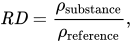


The reference material can be indicated using subscripts: which means "the relative density of substance with respect to reference". If the reference is not explicitly stated then it is normally assumed to be water at 4 °C (or, more precisely, 3.98 °C, which is the temperature at which water reaches its maximum density). In SI units, the density of water is (approximately) 1000 kg/m3 or 1 g/cm3, which makes relative density calculations particularly convenient: the density of the object only needs to be divided by 1000 or 1, depending on the units.

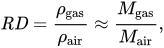
The relative density of gases is often measured with respect to dry air at a temperature of 20 °C and a pressure of 101.325 kPa absolute, which has a density of 1.205 kg/m3. Relative density with respect to air can be obtained by where is the molar mass and the approximately equal sign is used because equality pertains only if 1 mol of the gas and 1 mol of air occupy the same volume at a given temperature and pressure, i.e., they are both ideal gases. Ideal behaviour is usually only seen at very low pressure. For example, one mol of an ideal gas occupies 22.414 L at 0 °C and 1 atmosphere whereas carbon dioxide has a molar volume of 22.259 L under those same conditions.

Those with SG greater than 1 are denser than water and will, disregarding surface tension effects, sink in it. Those with an SG less than 1 are less dense than water and will float on it. In scientific work, the relationship of mass to volume is usually expressed directly in terms of the density (mass per unit volume) of the substance under study. It is in industry where specific gravity finds wide application, often for historical reasons.
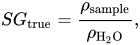
True specific gravity of a liquid can be expressed mathematically as: where is the density of the sample and is the density of water.


Hub AI
Relative density AI simulator
(@Relative density_simulator)
Relative density
Relative density, also called specific gravity, is a dimensionless quantity defined as the ratio of the density (mass divided by volume) of a substance to the density of a given reference material. Specific gravity for solids and liquids is nearly always measured with respect to water at its densest (at 4 °C or 39.2 °F); for gases, the reference is air at room temperature (20 °C or 68 °F). The term "relative density" (abbreviated r.d. or RD) is preferred in SI, whereas the term "specific gravity" is gradually being abandoned.
If a substance's relative density is less than 1 then it is less dense than the reference; if greater than 1 then it is denser than the reference. If the relative density is exactly 1 then the densities are equal; that is, equal volumes of the two substances have the same mass. If the reference material is water, then a substance with a relative density (or specific gravity) less than 1 will float in water. For example, an ice cube, with a relative density of about 0.91, will float. A substance with a relative density greater than 1 will sink.
Temperature and pressure must be specified for both the sample and the reference. Pressure is nearly always 1 atm (101.325 kPa). Where it is not, it is more usual to specify the density directly. Temperatures for both sample and reference vary from industry to industry. In British brewing practice, the specific gravity, as specified above, is multiplied by 1000. Specific gravity is commonly used in industry as a simple means of obtaining information about the concentration of solutions of various materials such as brines, must weight (syrups, juices, honeys, brewers wort, must, etc.) and acids.
Relative density () or specific gravity () is a dimensionless quantity, as it is the ratio of either densities or weights where is relative density, is the density of the substance being measured, and is the density of the reference. (By convention , the Greek letter rho, denotes density.)
The reference material can be indicated using subscripts: which means "the relative density of substance with respect to reference". If the reference is not explicitly stated then it is normally assumed to be water at 4 °C (or, more precisely, 3.98 °C, which is the temperature at which water reaches its maximum density). In SI units, the density of water is (approximately) 1000 kg/m3 or 1 g/cm3, which makes relative density calculations particularly convenient: the density of the object only needs to be divided by 1000 or 1, depending on the units.
The relative density of gases is often measured with respect to dry air at a temperature of 20 °C and a pressure of 101.325 kPa absolute, which has a density of 1.205 kg/m3. Relative density with respect to air can be obtained by where is the molar mass and the approximately equal sign is used because equality pertains only if 1 mol of the gas and 1 mol of air occupy the same volume at a given temperature and pressure, i.e., they are both ideal gases. Ideal behaviour is usually only seen at very low pressure. For example, one mol of an ideal gas occupies 22.414 L at 0 °C and 1 atmosphere whereas carbon dioxide has a molar volume of 22.259 L under those same conditions.
Those with SG greater than 1 are denser than water and will, disregarding surface tension effects, sink in it. Those with an SG less than 1 are less dense than water and will float on it. In scientific work, the relationship of mass to volume is usually expressed directly in terms of the density (mass per unit volume) of the substance under study. It is in industry where specific gravity finds wide application, often for historical reasons.
True specific gravity of a liquid can be expressed mathematically as: where is the density of the sample and is the density of water.