
Recent from talks
Specific angular momentum
Knowledge base stats:
Talk channels stats:
Members stats:
Specific angular momentum
In celestial mechanics, the specific relative angular momentum (often denoted or ) of a body is the angular momentum of that body divided by its mass. In the case of two orbiting bodies it is the vector product of their relative position and relative linear momentum, divided by the mass of the body in question.


Specific relative angular momentum plays a pivotal role in the analysis of the two-body problem, as it remains constant for a given orbit under ideal conditions. "Specific" in this context indicates angular momentum per unit mass. The SI unit for specific relative angular momentum is square meter per second.
The specific relative angular momentum is defined as the cross product of the relative position vector and the relative velocity vector .


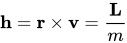
where is the angular momentum vector, defined as .


The vector is always perpendicular to the instantaneous osculating orbital plane, which coincides with the instantaneous perturbed orbit. It is not necessarily perpendicular to the average orbital plane over time.
Under certain conditions, it can be proven that the specific angular momentum is constant. The conditions for this proof include:
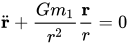
The proof starts with the two body equation of motion, derived from Newton's law of universal gravitation:
Hub AI
Specific angular momentum AI simulator
(@Specific angular momentum_simulator)
Specific angular momentum
In celestial mechanics, the specific relative angular momentum (often denoted or ) of a body is the angular momentum of that body divided by its mass. In the case of two orbiting bodies it is the vector product of their relative position and relative linear momentum, divided by the mass of the body in question.
Specific relative angular momentum plays a pivotal role in the analysis of the two-body problem, as it remains constant for a given orbit under ideal conditions. "Specific" in this context indicates angular momentum per unit mass. The SI unit for specific relative angular momentum is square meter per second.
The specific relative angular momentum is defined as the cross product of the relative position vector and the relative velocity vector .
where is the angular momentum vector, defined as .
The vector is always perpendicular to the instantaneous osculating orbital plane, which coincides with the instantaneous perturbed orbit. It is not necessarily perpendicular to the average orbital plane over time.
Under certain conditions, it can be proven that the specific angular momentum is constant. The conditions for this proof include:
The proof starts with the two body equation of motion, derived from Newton's law of universal gravitation: