Hubbry Logo
Speed of electricitySpeed of electricityMain
Open search
Speed of electricity
Community hub
Speed of electricity
logo
7 pages, 0 posts
0 subscribers
Be the first to start a discussion here.
Speed of electricity
from Wikipedia

The word electricity refers generally to the movement of electrons, or other charge carriers, through a conductor in the presence of a potential difference or an electric field. The speed of this flow has multiple meanings. In everyday electrical and electronic devices, the signals travel as electromagnetic waves typically at 50%–99% of the speed of light in vacuum. The electrons themselves move much more slowly. See Drift velocity and Electron mobility.

Electromagnetic waves

[edit]

The speed at which energy or signals travel down a cable is actually the speed of the electromagnetic wave traveling along (guided by) the cable. I.e., a cable is a form of a waveguide. The propagation of the wave is affected by the interaction with the material(s) in and surrounding the cable, caused by the presence of electric charge carriers, interacting with the electric field component, and magnetic dipoles, interacting with the magnetic field component.[1]

These interactions are typically described using mean-field theory by the permeability and the permittivity of the materials involved.

The energy or signal usually flows overwhelmingly outside the electric conductor of a cable. The purpose of the conductor is thus not to conduct energy, but to guide the energy-carrying wave.[1]: 360 

Velocity of electromagnetic waves in good dielectrics

[edit]

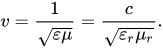
The velocity of electromagnetic waves in a low-loss dielectric is given by[1]: 346 

where

  • = speed of light in vacuum.
  • = the permeability of free space = 4π x 10−7 H/m.
  • = relative magnetic permeability of the material. Usually in good dielectrics, e.g. vacuum, air, Teflon, .
  • .
  • = the permittivity of free space = 8.854 x 10⁻¹² F/m.
  • = relative permittivity of the material. Usually in good conductors e.g. copper, silver, gold, .
  • .

Velocity of electromagnetic waves in good conductors

[edit]

The velocity of transverse electromagnetic (TEM) mode waves in a good conductor is given by[1]: 360  [2]: 142  [3]: 50–52 

where

  • = frequency.
  • = angular frequency = 2πf.
  • = conductivity of annealed copper = 5.96×10⁷ S/m.
  • = conductivity of the material relative to the conductivity of copper. For hard drawn copper may be as low as 0.97.
  • .

and permeability is defined as above in § Velocity of electromagnetic waves in good dielectrics:

  • = the permeability of free space = 4π x 10−7 H/m.
  • = relative magnetic permeability of the material. Nonmagnetic conductive materials such as copper typically have a near 1.
  • .

This velocity is the speed with which electromagnetic waves penetrate into the conductor and is not the drift velocity of the conduction electrons. In copper at 60 Hz, 3.2 m/s. As a consequence of Snell's Law and the extremely low speed, electromagnetic waves always enter good conductors in a direction that is within a milliradian of normal to the surface, regardless of the angle of incidence.

Electromagnetic waves in circuits

[edit]

In the theoretical investigation of electric circuits, the velocity of propagation of the electromagnetic field through space is usually not considered; the field is assumed, as a precondition, to be present throughout space. The magnetic component of the field is considered to be in phase with the current, and the electric component is considered to be in phase with the voltage. The electric field starts at the conductor, and propagates through space at the speed of light, which depends on the material it is traveling through.[4]

The electromagnetic fields do not move through space. It is the electromagnetic energy that moves. The corresponding fields simply grow and decline in a region of space in response to the flow of energy. At any point in space, the electric field corresponds not to the condition of the electric energy flow at that moment, but to that of the flow at a moment earlier. The latency is determined by the time required for the field to propagate from the conductor to the point under consideration. In other words, the greater the distance from the conductor, the more the electric field lags.[4]

Since the velocity of propagation is very high – about 300,000 kilometers per second – the wave of an alternating or oscillating current, even of high frequency, is of considerable length. At 60 cycles per second, the wavelength is 5,000 kilometers, and even at 100,000 hertz, the wavelength is 3 kilometers. This is a very large distance compared to those typically used in field measurement and application.[4]

The important part of the electric field of a conductor extends to the return conductor, which usually is only a few feet distant. At greater distance, the aggregate field can be approximated by the differential field between conductor and return conductor, which tend to cancel. Hence, the intensity of the electric field is usually inappreciable at a distance which is still small compared to the wavelength.[4]

Within the range in which an appreciable field exists, this field is practically in phase with the flow of energy in the conductor. That is, the velocity of propagation has no appreciable effect unless the return conductor is very distant, or entirely absent, or the frequency is so high that the distance to the return conductor is an appreciable portion of the wavelength.[4]

Charge carrier drift

[edit]

The drift velocity is the average velocity of a particle, such as an electron, due to an electric field. In general, electrons propagate randomly in a conductor at the Fermi velocity.[5] Free electrons in a conductor follow random paths. In the absence of an electric field, the electrons have no net velocity.

When direct current flows, the electron drift velocity is proportional to the current. The drift velocity in a 2 mm diameter copper wire with 1 ampere current flowing is approximately 8 cm per hour. Alternating current causes no net movement. The electrons travel back and forth with the alternating flow, over a distance of less than a micrometer – see example calculation.

See also

[edit]

References

[edit]

Further reading

[edit]
Revisions and contributorsEdit on WikipediaRead on Wikipedia
from Grokipedia
The speed of electricity, often misunderstood as the movement of electrons, actually describes the velocity of electromagnetic signals through conductive materials, which travels at approximately 50% to 99% of the in vacuum (about 150,000 to 300,000 km/s), depending on the medium and configuration. In contrast, the drift of electrons themselves—the average speed at which they advance along a wire under an —is extremely slow, typically on the order of millimeters per second or a few meters per hour in standard circuits. This rapid signal occurs because electrical effects spread via interacting electromagnetic fields surrounding the conductor, akin to a among densely packed electrons, rather than requiring electrons to traverse the full . The concept gained early scientific recognition in 1857 when German physicist demonstrated, through theoretical analysis building on Wilhelm Weber's electrodynamics, that electrical disturbances in thin, low-resistance wires propagate at a speed nearly equal to that of , independent of the wire's cross-section or the density of the current. This insight predated James Clerk Maxwell's electromagnetic theory by several years and highlighted the wave-like nature of electrical transmission, influencing the development of and later . In practical applications, such as household wiring or cables, the —a measure of signal speed relative to —varies with the material; for example, unshielded wire approaches 95-97% of c, while insulated cables like those with polyethylene achieve about 66%. These speeds enable near-instantaneous responses in everyday devices, like lights turning on when a switch is flipped, despite the negligible electron drift. Understanding this distinction is crucial in fields like , where signal delay in long transmission lines can affect high-speed data transfer and power distribution efficiency.

Conceptual Overview

Definition and Common Misconceptions

The "speed of electricity" refers to the velocity of electromagnetic signals in a circuit, which occurs at speeds approaching that of in —typically 50% to 99% of c3×108c \approx 3 \times 10^8 m/s in everyday wires—rather than the motion of individual charge carriers. This signal carries and through the interactions of electromagnetic fields, with electrons serving primarily as intermediaries that respond locally to these fields. A prevalent misconception equates the speed of electricity with the drift velocity of electrons, often visualized as a chain of particles pushing one another like water molecules in a pipe. In truth, electrons drift slowly—on the order of millimeters per second in typical household currents—while the electromagnetic disturbance races ahead. This error traces to 19th-century educational analogies comparing electric current to fluid flow in pipes, a model derisively called the "drain-pipe theory" by physicist Sir Oliver Lodge around 1900 for its oversimplification of field effects. Consider a common example: flipping a causes the bulb to illuminate nearly instantly, even though electrons move sluggishly. For a 30 cm wire in a typical setup, the electromagnetic signal propagates in about 1 (assuming ~2/3c2/3 c), enabling the fields to reach the bulb and initiate filament heating long before significant electron displacement occurs. More precisely, the signal velocity aligns with the group velocity of electromagnetic waves—the speed of the wave packet's envelope carrying energy and information—distinct from the phase velocity, which tracks the crests of the individual oscillations.

Relation to Speed of Light

The speed of electrical signals is intrinsically linked to the speed of light through the principles of electromagnetism. In 1865, James Clerk Maxwell published his seminal work unifying electricity and magnetism, formulating a set of equations that predict the existence of electromagnetic waves propagating through space. These equations yield a wave speed in vacuum given by c=1μ0ϵ03×108c = \frac{1}{\sqrt{\mu_0 \epsilon_0}} \approx 3 \times 10^8
Add your contribution
Related Hubs
User Avatar
No comments yet.