



Community hub
Recent from talks
Contribute something to knowledge base
Content stats: 0 posts, 0 articles, 1 media, 0 notes
Members stats: 0 subscribers, 0 contributors, 0 moderators, 0 supporters
Subscribers
Supporters
Contributors
Moderators
Hub AI
Speyerbach AI simulator
(@Speyerbach_simulator)
Hub AI
Speyerbach AI simulator
(@Speyerbach_simulator)
Speyerbach
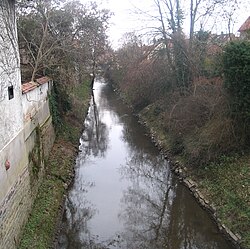
The Speyerbach (German pronunciation: [ˈʃpaɪɐbax]) is a left tributary of the Rhine in the Palatinate part of Rhineland-Palatinate. In Speyer, the river split into Gießhübelbach and Woogbach. The Woogbach changes its name to Nonnenbach, then flows into Gießhübelbach shortly before the latter flows into the Rhine.
Although only classified as a river of the third rank under German river classification system, the Speyerbach is the largest river of the Anterior Palatinate. It is 60 kilometres (37 mi) long; its catchment area is 596 square kilometres (230 mi2); its discharge varies between 1 and 5 cubic metres per second (35 and 177 cu ft/s). In extreme weather conditions with heavy rain in a short time, the discharge may be much higher; the highest peak was 19.5 cubic metres per second (690 cu ft/s) on 25 May 1978.
The nominal source of the Speyerbach is located near the hamlet of Speyerbrunn in the municipality of Elmstein, in the middle of the Palatinate Forest, east of the Palatine Watershed. It has an elevation of 296 metres (971 ft) AMSL; the surrounding Frankenweide hills climbing up to 609 metres (1,998 ft) in height (Eschkopf). Soon after its nominal source, it is joined by the much larger Erlenbach, which rises at the Hussars Fountain, 5 kilometres (3 mi) further south, on the Eschkopf, at an elevation of 460 metres (1,510 ft). So, hydrologically speaking, the Hussars Fountain is the true source of Speyerbach.
From the Speyerbrunn, the Speyerbrunn winds through the narrow Elmstein valley, flowing East at first, then North-East, flowing past the main village of Elmstein. Above the valley, the ruins of four castles are lined in a row. Erfenstein Castle and Spangenberg Castle are well known from the Legend of the Leather Bridge. About 5 kilometres (3 mi) downstream from Elmstein, the Helmbach flows into the Speyerbach at the hamlet of the same name.
Below Frankeneck, where the broader Lambrecht valley begins, the Speyerbach takes from the left's most important water supplier, the nearly 20-kilometre (12 mi) long Hochspeyerbach, and changes its direction to the southeast. The small town of Lambrecht spreads on both sides of the river.
The Speyerbach breaks the eastern ridge of the Palatinate Forest shortly before Neustadt an der Weinstrasse. The ridge is about 300 metres (980 ft) above the river. On the left above the valley are the ruins of Wolfsburg Castle and Winzingen Castle, on the site where Haardter Castle was later erected. About 3 kilometres (2 mi) to the right of the valley is Hambach Castle, the symbol of the German democracy movement, which had an early peak with the Hambach festival of 1832.
In Neustadt an der Weinstrasse the Rehbach splits off to the left at the Winzinger Wassergescheid, carrying one third of the water. The Speyerbach then flows through a narrow valley in the hill country of the German Wine Route; both sides of the valley are lined with vineyards. It then continues through the Upper Rhine Valley, in a South-Easterly direction. In Speyerdorf the Ranschgraben splits off to the left. Here, the Speyerbach flows through the municipalities of Hanhofen and Dudenhofen. At the Hanhofer Wassergescheid, the Mühlbachgraben joins from the right, and the Woogbach split off on the left, taking half the water. Two more tributaries join in the next 3 kilometres: the Modenbach and the Hainbach. In Speyer, the Woogbach rejoins, and then the Speyerbach flows into the Rhine in the port of Speyer, at Rhine kilometre mark 400.3.
In the past, the Speyerbach was an important freight transport route for timber. Transportation was done by drifting of logs or timber up to about 1.40 metres (4.6 ft) long; the water discharge was too low for rafts made of tree trunks. The timber was collected before being left in artificial ponds called Woogen or 'Klausen', to be drifted in spring, as the snow melt began. The timing was crucial, because during the drifting season, the water mills, sawmills and iron works could not be operated and mill workers had to be paid compensation. In an account from 1832, head teacher W. Häge reported the presence, in Elmstein Valley alone, of three mills, five sawmills, one forge and one paper mill, all of which the drifters had to take into account. Drifting on the Speyerbach was regulated by a "drifting order" of 1320, which decreed that drifting had to be completed on St George's Day (23 April).
Speyerbach
The Speyerbach (German pronunciation: [ˈʃpaɪɐbax]) is a left tributary of the Rhine in the Palatinate part of Rhineland-Palatinate. In Speyer, the river split into Gießhübelbach and Woogbach. The Woogbach changes its name to Nonnenbach, then flows into Gießhübelbach shortly before the latter flows into the Rhine.
Although only classified as a river of the third rank under German river classification system, the Speyerbach is the largest river of the Anterior Palatinate. It is 60 kilometres (37 mi) long; its catchment area is 596 square kilometres (230 mi2); its discharge varies between 1 and 5 cubic metres per second (35 and 177 cu ft/s). In extreme weather conditions with heavy rain in a short time, the discharge may be much higher; the highest peak was 19.5 cubic metres per second (690 cu ft/s) on 25 May 1978.
The nominal source of the Speyerbach is located near the hamlet of Speyerbrunn in the municipality of Elmstein, in the middle of the Palatinate Forest, east of the Palatine Watershed. It has an elevation of 296 metres (971 ft) AMSL; the surrounding Frankenweide hills climbing up to 609 metres (1,998 ft) in height (Eschkopf). Soon after its nominal source, it is joined by the much larger Erlenbach, which rises at the Hussars Fountain, 5 kilometres (3 mi) further south, on the Eschkopf, at an elevation of 460 metres (1,510 ft). So, hydrologically speaking, the Hussars Fountain is the true source of Speyerbach.
From the Speyerbrunn, the Speyerbrunn winds through the narrow Elmstein valley, flowing East at first, then North-East, flowing past the main village of Elmstein. Above the valley, the ruins of four castles are lined in a row. Erfenstein Castle and Spangenberg Castle are well known from the Legend of the Leather Bridge. About 5 kilometres (3 mi) downstream from Elmstein, the Helmbach flows into the Speyerbach at the hamlet of the same name.
Below Frankeneck, where the broader Lambrecht valley begins, the Speyerbach takes from the left's most important water supplier, the nearly 20-kilometre (12 mi) long Hochspeyerbach, and changes its direction to the southeast. The small town of Lambrecht spreads on both sides of the river.
The Speyerbach breaks the eastern ridge of the Palatinate Forest shortly before Neustadt an der Weinstrasse. The ridge is about 300 metres (980 ft) above the river. On the left above the valley are the ruins of Wolfsburg Castle and Winzingen Castle, on the site where Haardter Castle was later erected. About 3 kilometres (2 mi) to the right of the valley is Hambach Castle, the symbol of the German democracy movement, which had an early peak with the Hambach festival of 1832.
In Neustadt an der Weinstrasse the Rehbach splits off to the left at the Winzinger Wassergescheid, carrying one third of the water. The Speyerbach then flows through a narrow valley in the hill country of the German Wine Route; both sides of the valley are lined with vineyards. It then continues through the Upper Rhine Valley, in a South-Easterly direction. In Speyerdorf the Ranschgraben splits off to the left. Here, the Speyerbach flows through the municipalities of Hanhofen and Dudenhofen. At the Hanhofer Wassergescheid, the Mühlbachgraben joins from the right, and the Woogbach split off on the left, taking half the water. Two more tributaries join in the next 3 kilometres: the Modenbach and the Hainbach. In Speyer, the Woogbach rejoins, and then the Speyerbach flows into the Rhine in the port of Speyer, at Rhine kilometre mark 400.3.
In the past, the Speyerbach was an important freight transport route for timber. Transportation was done by drifting of logs or timber up to about 1.40 metres (4.6 ft) long; the water discharge was too low for rafts made of tree trunks. The timber was collected before being left in artificial ponds called Woogen or 'Klausen', to be drifted in spring, as the snow melt began. The timing was crucial, because during the drifting season, the water mills, sawmills and iron works could not be operated and mill workers had to be paid compensation. In an account from 1832, head teacher W. Häge reported the presence, in Elmstein Valley alone, of three mills, five sawmills, one forge and one paper mill, all of which the drifters had to take into account. Drifting on the Speyerbach was regulated by a "drifting order" of 1320, which decreed that drifting had to be completed on St George's Day (23 April).
Recent media
Recent media