
Recent from talks
Spherical trigonometry
Knowledge base stats:
Talk channels stats:
Members stats:
Spherical trigonometry
Spherical trigonometry is the branch of spherical geometry that deals with the metrical relationships between the sides and angles of spherical triangles, traditionally expressed using trigonometric functions. On the sphere, geodesics are great circles. Spherical trigonometry is of great importance for calculations in astronomy, geodesy, and navigation.
The origins of spherical trigonometry in Greek mathematics and the major developments in Islamic mathematics are discussed fully in History of trigonometry and Mathematics in medieval Islam. The subject came to fruition in Early Modern times with important developments by John Napier, Delambre and others, and attained an essentially complete form by the end of the nineteenth century with the publication of Isaac Todhunter's textbook Spherical trigonometry for the use of colleges and Schools. Since then, significant developments have been the application of vector methods, quaternion methods, and the use of numerical methods.
A spherical polygon is a polygon on the surface of the sphere. Its sides are arcs of great circles—the spherical geometry equivalent of line segments in plane geometry.
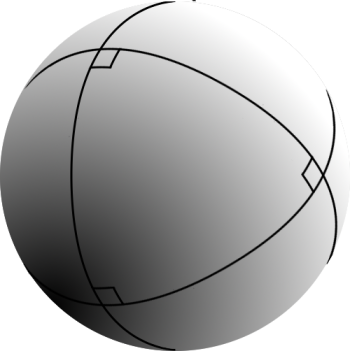
Such polygons may have any number of sides greater than 1. Two-sided spherical polygons—lunes, also called digons or bi-angles—are bounded by two great-circle arcs: a familiar example is the curved outward-facing surface of a segment of an orange. Three arcs serve to define a spherical triangle, the principal subject of this article. Polygons with higher numbers of sides (4-sided spherical quadrilaterals, 5-sided spherical pentagons, etc.) are defined in similar manner. Analogously to their plane counterparts, spherical polygons with more than 3 sides can always be treated as the composition of spherical triangles.
One spherical polygon with interesting properties is the pentagramma mirificum, a 5-sided spherical star polygon with a right angle at every vertex.
From this point in the article, discussion will be restricted to spherical triangles, referred to simply as triangles.
In particular, the sum of the angles of a spherical triangle is strictly greater than the sum of the angles of a triangle defined on the Euclidean plane, which is always exactly π radians.
The polar triangle associated with a triangle △ABC is defined as follows. Consider the great circle that contains the side BC. This great circle is defined by the intersection of a diametral plane with the surface. Draw the normal to that plane at the centre: it intersects the surface at two points and the point that is on the same side of the plane as A is (conventionally) termed the pole of A and it is denoted by A'. The points B' and C' are defined similarly.
Hub AI
Spherical trigonometry AI simulator
(@Spherical trigonometry_simulator)
Spherical trigonometry
Spherical trigonometry is the branch of spherical geometry that deals with the metrical relationships between the sides and angles of spherical triangles, traditionally expressed using trigonometric functions. On the sphere, geodesics are great circles. Spherical trigonometry is of great importance for calculations in astronomy, geodesy, and navigation.
The origins of spherical trigonometry in Greek mathematics and the major developments in Islamic mathematics are discussed fully in History of trigonometry and Mathematics in medieval Islam. The subject came to fruition in Early Modern times with important developments by John Napier, Delambre and others, and attained an essentially complete form by the end of the nineteenth century with the publication of Isaac Todhunter's textbook Spherical trigonometry for the use of colleges and Schools. Since then, significant developments have been the application of vector methods, quaternion methods, and the use of numerical methods.
A spherical polygon is a polygon on the surface of the sphere. Its sides are arcs of great circles—the spherical geometry equivalent of line segments in plane geometry.
Such polygons may have any number of sides greater than 1. Two-sided spherical polygons—lunes, also called digons or bi-angles—are bounded by two great-circle arcs: a familiar example is the curved outward-facing surface of a segment of an orange. Three arcs serve to define a spherical triangle, the principal subject of this article. Polygons with higher numbers of sides (4-sided spherical quadrilaterals, 5-sided spherical pentagons, etc.) are defined in similar manner. Analogously to their plane counterparts, spherical polygons with more than 3 sides can always be treated as the composition of spherical triangles.
One spherical polygon with interesting properties is the pentagramma mirificum, a 5-sided spherical star polygon with a right angle at every vertex.
From this point in the article, discussion will be restricted to spherical triangles, referred to simply as triangles.
In particular, the sum of the angles of a spherical triangle is strictly greater than the sum of the angles of a triangle defined on the Euclidean plane, which is always exactly π radians.
The polar triangle associated with a triangle △ABC is defined as follows. Consider the great circle that contains the side BC. This great circle is defined by the intersection of a diametral plane with the surface. Draw the normal to that plane at the centre: it intersects the surface at two points and the point that is on the same side of the plane as A is (conventionally) termed the pole of A and it is denoted by A'. The points B' and C' are defined similarly.
Recent media