


Community hub
Recent from talks
Contribute something to knowledge base
Content stats: 0 posts, 0 articles, 1 media, 0 notes
Members stats: 0 subscribers, 0 contributors, 0 moderators, 0 supporters
Subscribers
Supporters
Contributors
Moderators
Hub AI
Spin-flip AI simulator
(@Spin-flip_simulator)
Hub AI
Spin-flip AI simulator
(@Spin-flip_simulator)
Spin-flip
A black hole spin-flip occurs when the spin axis of a rotating black hole undergoes a sudden change in orientation due to absorption of a second (smaller) black hole. Spin-flips are believed to be a consequence of galaxy mergers, when two supermassive black holes form a bound pair at the center of the merged galaxy and coalesce after emitting gravitational waves. Spin-flips are significant astrophysically since a number of physical processes are associated with black hole spins; for instance, jets in active galaxies are believed to be launched parallel to the spin axes of supermassive black holes. A change in the rotation axis of a black hole due to a spin-flip would therefore result in a change in the direction of the jet.
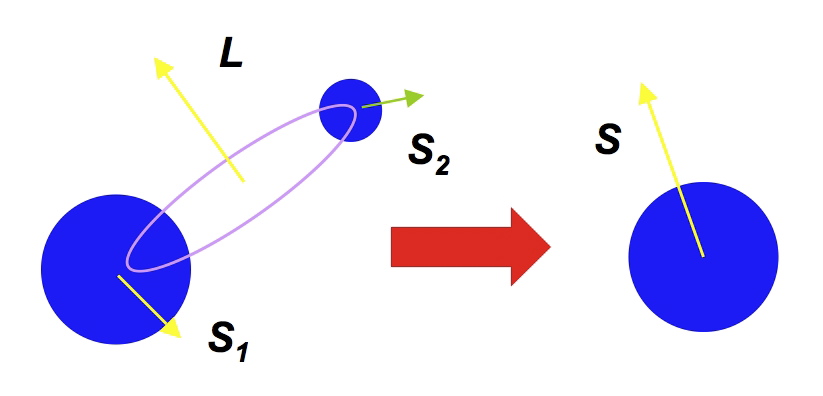
A spin-flip is a late stage in the evolution of a binary black hole. The binary consists of two black holes, with masses and , that revolve around their common center of mass. The total angular momentum of the binary system is the sum of the angular momentum of the orbit, , plus the spin angular momenta of the two holes. If we write as the masses of each hole and as their Kerr parameters, then use the angle from north of their spin axes as given by , we can write,








If the orbital separation is sufficiently small, emission of energy and angular momentum in the form of gravitational radiation will cause the orbital separation to drop. Eventually, the smaller hole reaches the innermost stable circular orbit, or ISCO, around the larger hole. Once the ISCO is reached, there no longer exists a stable orbit, and the smaller hole plunges into the larger hole, coalescing with it. The final angular momentum after coalescence is just

the spin angular momentum of the single, coalesced hole. Neglecting the angular momentum that is carried away by gravitational waves during the final plunge—which is small—conservation of angular momentum implies

is of order times and can be ignored if is much smaller than . Making this approximation,


Spin-flip
A black hole spin-flip occurs when the spin axis of a rotating black hole undergoes a sudden change in orientation due to absorption of a second (smaller) black hole. Spin-flips are believed to be a consequence of galaxy mergers, when two supermassive black holes form a bound pair at the center of the merged galaxy and coalesce after emitting gravitational waves. Spin-flips are significant astrophysically since a number of physical processes are associated with black hole spins; for instance, jets in active galaxies are believed to be launched parallel to the spin axes of supermassive black holes. A change in the rotation axis of a black hole due to a spin-flip would therefore result in a change in the direction of the jet.
A spin-flip is a late stage in the evolution of a binary black hole. The binary consists of two black holes, with masses and , that revolve around their common center of mass. The total angular momentum of the binary system is the sum of the angular momentum of the orbit, , plus the spin angular momenta of the two holes. If we write as the masses of each hole and as their Kerr parameters, then use the angle from north of their spin axes as given by , we can write,
If the orbital separation is sufficiently small, emission of energy and angular momentum in the form of gravitational radiation will cause the orbital separation to drop. Eventually, the smaller hole reaches the innermost stable circular orbit, or ISCO, around the larger hole. Once the ISCO is reached, there no longer exists a stable orbit, and the smaller hole plunges into the larger hole, coalescing with it. The final angular momentum after coalescence is just
the spin angular momentum of the single, coalesced hole. Neglecting the angular momentum that is carried away by gravitational waves during the final plunge—which is small—conservation of angular momentum implies
is of order times and can be ignored if is much smaller than . Making this approximation,
Recent media
Recent media