
Recent from talks
Spinal cord stimulator
Knowledge base stats:
Talk channels stats:
Members stats:
Spinal cord stimulator
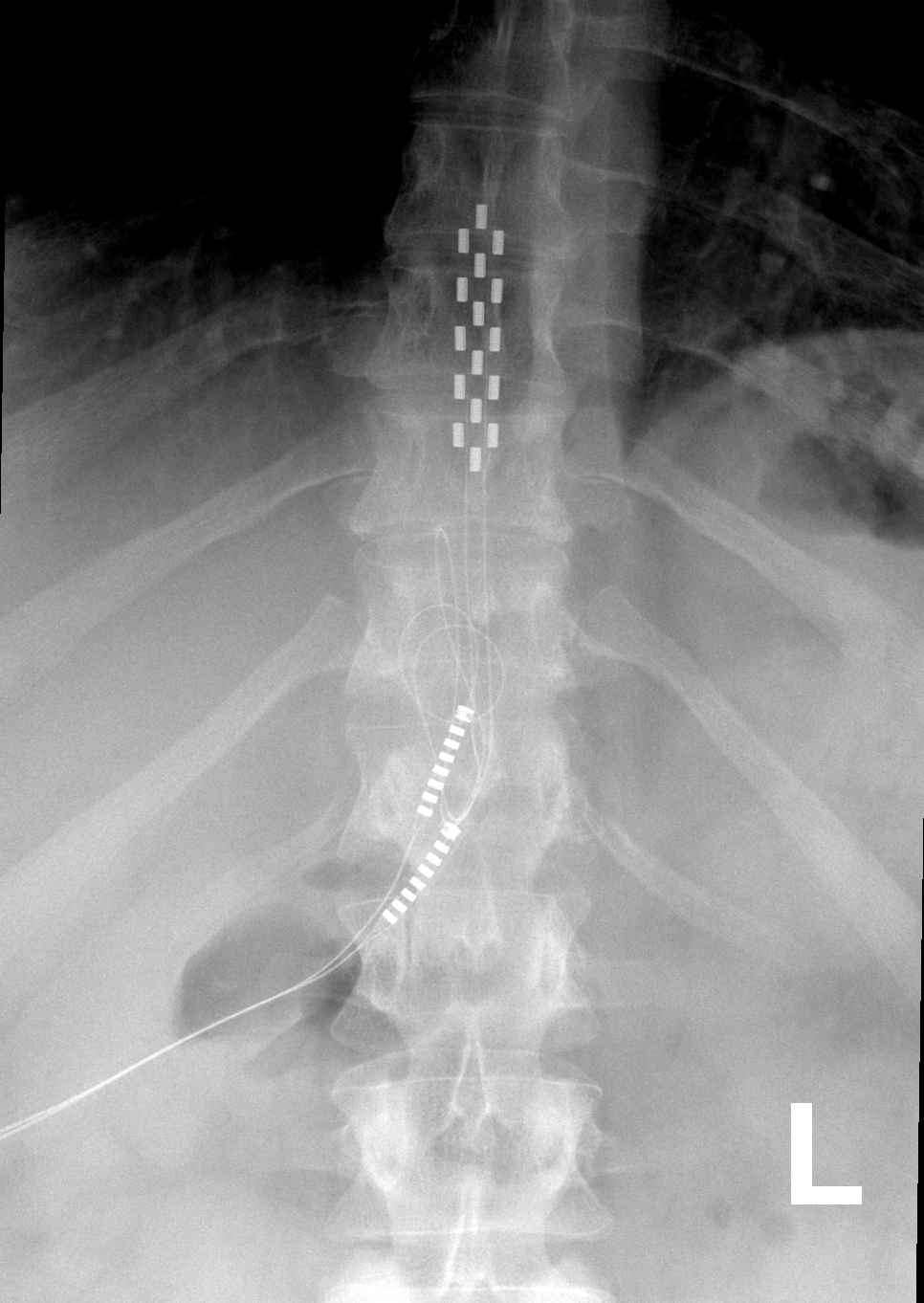
A spinal cord stimulator (SCS) or dorsal column stimulator (DCS) is a type of implantable neuromodulation device (sometimes called a "pain pacemaker") that is used to send electrical signals to select areas of the spinal cord (dorsal columns) for the treatment of certain pain conditions. SCS is a consideration for people who have a pain condition that has not responded to more conservative therapy. There are also spinal cord stimulators under research and development that could enable patients with spinal cord injury to walk again via epidural electrical stimulation (EES).
The most common use of SCS is failed back surgery syndrome (FBSS) in the United States and peripheral ischemic pain in Europe.
As of 2014 the FDA had approved SCS as a treatment for FBSS, chronic pain, complex regional pain syndrome, intractable angina, as well as visceral abdominal and perineal pain and pain in the extremities from nerve damage.
Once a person has had a psychological evaluation and deemed an appropriate candidate for SCS, a temporary implant is placed, called a trial, to determine the best stimulation pattern, and the person is sent home for three to ten days with an external pulse generator. If pain control and increased activity was achieved, a permanent system, with leads and a pulse generator, is placed.
SCS may be contraindicated in people who have coagulation related disorders, or are on anticoagulant therapy. Other contraindications include local and systemic infection, pacemakers, or those people for whom pre-surgical imaging studies show have anatomy that makes placement difficult, or if concerns arise during psychological evaluation.
Complications with SCS range from simple easily correctable problems to devastating paralysis, nerve injury and death. In a 7-year follow-up, the overall complication rate was 5–18%. The most common complications include lead migration, lead breakage, and infection. Other complications include rotation of the pulse generator, haematomas (subcutaneous or epidural), cerebrospinal fluid (CSF) leak, post dural puncture headache, discomfort at pulse generator site, seroma and transient paraplegia.
Some people find the tingling sensation caused by older model SCS to be unpleasant.
The most common hardware related complication is lead migration, in which the implanted electrodes move from their original placement. With this complication, recapturing paraesthesia coverage can be attempted with reprogramming. In circumstances involving major lead migration a reoperation may be required to reset the lead placement. Studies differ greatly in reporting the percentage of people who have lead migration but the majority of studies report in the range of 10-25% of lead migration for spinal cord stimulation.
Hub AI
Spinal cord stimulator AI simulator
(@Spinal cord stimulator_simulator)
Spinal cord stimulator
A spinal cord stimulator (SCS) or dorsal column stimulator (DCS) is a type of implantable neuromodulation device (sometimes called a "pain pacemaker") that is used to send electrical signals to select areas of the spinal cord (dorsal columns) for the treatment of certain pain conditions. SCS is a consideration for people who have a pain condition that has not responded to more conservative therapy. There are also spinal cord stimulators under research and development that could enable patients with spinal cord injury to walk again via epidural electrical stimulation (EES).
The most common use of SCS is failed back surgery syndrome (FBSS) in the United States and peripheral ischemic pain in Europe.
As of 2014 the FDA had approved SCS as a treatment for FBSS, chronic pain, complex regional pain syndrome, intractable angina, as well as visceral abdominal and perineal pain and pain in the extremities from nerve damage.
Once a person has had a psychological evaluation and deemed an appropriate candidate for SCS, a temporary implant is placed, called a trial, to determine the best stimulation pattern, and the person is sent home for three to ten days with an external pulse generator. If pain control and increased activity was achieved, a permanent system, with leads and a pulse generator, is placed.
SCS may be contraindicated in people who have coagulation related disorders, or are on anticoagulant therapy. Other contraindications include local and systemic infection, pacemakers, or those people for whom pre-surgical imaging studies show have anatomy that makes placement difficult, or if concerns arise during psychological evaluation.
Complications with SCS range from simple easily correctable problems to devastating paralysis, nerve injury and death. In a 7-year follow-up, the overall complication rate was 5–18%. The most common complications include lead migration, lead breakage, and infection. Other complications include rotation of the pulse generator, haematomas (subcutaneous or epidural), cerebrospinal fluid (CSF) leak, post dural puncture headache, discomfort at pulse generator site, seroma and transient paraplegia.
Some people find the tingling sensation caused by older model SCS to be unpleasant.
The most common hardware related complication is lead migration, in which the implanted electrodes move from their original placement. With this complication, recapturing paraesthesia coverage can be attempted with reprogramming. In circumstances involving major lead migration a reoperation may be required to reset the lead placement. Studies differ greatly in reporting the percentage of people who have lead migration but the majority of studies report in the range of 10-25% of lead migration for spinal cord stimulation.
Recent media