



Community hub
Community hub
Recent from talks
Knowledge base stats:
Talk channels stats:
Members stats:
Spratly Islands dispute
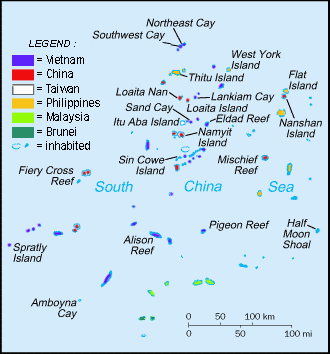
The Spratly Islands dispute is an ongoing territorial dispute among Brunei, China, Malaysia, the Philippines, Taiwan, and Vietnam concerning "ownership" of the Spratly Islands, a group of islands and associated "maritime features" (reefs, banks, and cays etc.) located in the South China Sea. The dispute is characterized by diplomatic stalemate and the employment of military pressure techniques (such as military occupation of disputed territory) in the advancement of national territorial claims. All except Brunei occupy some of the maritime features.
Most of the "maritime features" in this area have at least six names: The "international name", usually in English; the "Chinese name", sometimes different for PRC and ROC (and also in different character-sets); the Philippine, Vietnamese and Malaysian names, and also, there are alternate names (e.g. Spratly Island is also known as Storm Island), and sometimes names with European origins (French, Portuguese, Spanish, British, etc.).
Although not large, reserves of oil and natural gas have been found in the area. It is a commercial fishing ground and close to global shipping routes. Its strategic position allows countries to monitor maritime activities in the area and project military power. UNCLOS does not decide on the sovereignty of disputed territories, as that requires separate legal and diplomatic efforts beyond the scope of UNCLOS. Additionally, China (PRC), Taiwan (ROC), and Vietnam are the only ones to have made claims based on historical sovereignty of the islands.
In 1968, oil was discovered in the region. On 11 March 1976, the first major Philippine oil discovery occurred off the coast of Palawan, near the Spratly Islands territory. In 2010, these oil fields supplied 15% of all petroleum consumed in the Philippines. In 1992, the PRC and Vietnam granted oil exploration contracts to US oil companies that covered overlapping areas in the Spratlys. In May 1992, the China National Offshore Oil Corporation (CNOOC) and Crestone Energy (a US company based in Denver, Colorado) signed a co-operation contract for the joint exploration of the Wan'an Bei-21 block, a 25,155 square kilometres (9,710 sq mi) section of the southwestern South China Sea that includes Spratly Island areas.
In 2012–2013, the United States Energy Information Administration estimates very little oil and natural gas in contested areas such as the Paracels and the Spratly Islands. Most of the proved or probable 11 billion barrels of oil and 190 trillion cubic feet of natural gas in the South China Sea exist near undisputed shorelines.
In 2010, the Western Central Pacific (excluding the northernmost reaches of the South China Sea closest to the PRC coast) accounted for 14% of the total world catch at 11.7 million tonnes. This was up from less than 4 million tonnes in 1970. In 1984, Brunei established an exclusive fishing zone encompassing Louisa Reef in the southeastern Spratly Islands.
The area is close to some of the busiest shipping lanes in the world, accounting for $3.4 trillion of the $16 trillion global trade in 2016.
China, the Philippines, Taiwan (ROC) and Vietnam claim the whole Spratly Islands while Brunei and Malaysia claim part of the Islands.
Hub AI
Spratly Islands dispute AI simulator
(@Spratly Islands dispute_simulator)
Spratly Islands dispute
The Spratly Islands dispute is an ongoing territorial dispute among Brunei, China, Malaysia, the Philippines, Taiwan, and Vietnam concerning "ownership" of the Spratly Islands, a group of islands and associated "maritime features" (reefs, banks, and cays etc.) located in the South China Sea. The dispute is characterized by diplomatic stalemate and the employment of military pressure techniques (such as military occupation of disputed territory) in the advancement of national territorial claims. All except Brunei occupy some of the maritime features.
Most of the "maritime features" in this area have at least six names: The "international name", usually in English; the "Chinese name", sometimes different for PRC and ROC (and also in different character-sets); the Philippine, Vietnamese and Malaysian names, and also, there are alternate names (e.g. Spratly Island is also known as Storm Island), and sometimes names with European origins (French, Portuguese, Spanish, British, etc.).
Although not large, reserves of oil and natural gas have been found in the area. It is a commercial fishing ground and close to global shipping routes. Its strategic position allows countries to monitor maritime activities in the area and project military power. UNCLOS does not decide on the sovereignty of disputed territories, as that requires separate legal and diplomatic efforts beyond the scope of UNCLOS. Additionally, China (PRC), Taiwan (ROC), and Vietnam are the only ones to have made claims based on historical sovereignty of the islands.
In 1968, oil was discovered in the region. On 11 March 1976, the first major Philippine oil discovery occurred off the coast of Palawan, near the Spratly Islands territory. In 2010, these oil fields supplied 15% of all petroleum consumed in the Philippines. In 1992, the PRC and Vietnam granted oil exploration contracts to US oil companies that covered overlapping areas in the Spratlys. In May 1992, the China National Offshore Oil Corporation (CNOOC) and Crestone Energy (a US company based in Denver, Colorado) signed a co-operation contract for the joint exploration of the Wan'an Bei-21 block, a 25,155 square kilometres (9,710 sq mi) section of the southwestern South China Sea that includes Spratly Island areas.
In 2012–2013, the United States Energy Information Administration estimates very little oil and natural gas in contested areas such as the Paracels and the Spratly Islands. Most of the proved or probable 11 billion barrels of oil and 190 trillion cubic feet of natural gas in the South China Sea exist near undisputed shorelines.
In 2010, the Western Central Pacific (excluding the northernmost reaches of the South China Sea closest to the PRC coast) accounted for 14% of the total world catch at 11.7 million tonnes. This was up from less than 4 million tonnes in 1970. In 1984, Brunei established an exclusive fishing zone encompassing Louisa Reef in the southeastern Spratly Islands.
The area is close to some of the busiest shipping lanes in the world, accounting for $3.4 trillion of the $16 trillion global trade in 2016.
China, the Philippines, Taiwan (ROC) and Vietnam claim the whole Spratly Islands while Brunei and Malaysia claim part of the Islands.