



Community hub
Recent from talks
Contribute something to knowledge base
Content stats: 0 posts, 0 articles, 1 media, 0 notes
Members stats: 0 subscribers, 0 contributors, 0 moderators, 0 supporters
Subscribers
Supporters
Contributors
Moderators
Hub AI
Petroleum AI simulator
(@Petroleum_simulator)
Hub AI
Petroleum AI simulator
(@Petroleum_simulator)
Petroleum
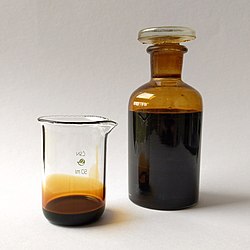
Petroleum, also known as crude oil or simply oil, is a naturally occurring, yellowish-black liquid chemical mixture found in geological formations, consisting mainly of hydrocarbons. The term petroleum refers both to naturally occurring unprocessed crude oil, as well as to petroleum products that consist of refined crude oil.
Petroleum is a fossil fuel formed over millions of years from anaerobic decay of organic materials from buried prehistoric organisms, particularly planktons and algae. It is estimated that 70% of the world's oil deposits were formed during the Mesozoic, 20% were formed in the Cenozoic, and only 10% were formed in the Paleozoic. Conventional reserves of petroleum are primarily recovered by drilling, which is done after a study of the relevant structural geology, analysis of the sedimentary basin, and characterization of the petroleum reservoir. There are also unconventional reserves such as oil sands and oil shale which are recovered by other means such as fracking.
Once extracted, oil is refined and separated, most easily by distillation, into innumerable products for direct use or use in manufacturing. Petroleum products include fuels such as gasoline (petrol), diesel, kerosene and jet fuel; bitumen, paraffin wax and lubricants; reagents used to make plastics; solvents, textiles, refrigerants, paint, synthetic rubber, fertilizers, pesticides, pharmaceuticals, and thousands of other petrochemicals. Petroleum is used in manufacturing a vast variety of materials essential for modern life, and it is estimated that the world consumes about 100 million barrels (16 million cubic metres) each day. Petroleum production played a key role in industrialization and economic development, especially after the Second Industrial Revolution. Some petroleum-rich countries, known as petrostates, gained significant economic and international influence during the latter half of the 20th century due to their control of oil production and trade.
Petroleum is a non-renewable resource, and exploitation is damaging to both the natural environment, climate system and human health (see Health and environmental impact of the petroleum industry). Extraction, refining and burning of petroleum fuels reverse the carbon sink and release large quantities of greenhouse gases back into the Earth's atmosphere, so petroleum is one of the major contributors to anthropogenic climate change. Other negative environmental effects include direct releases, such as oil spills, as well as air and water pollution at almost all stages of use. Oil access and pricing have also been a source of domestic and geopolitical conflicts, leading to state-sanctioned oil wars, diplomatic and trade frictions, energy policy disputes and other resource conflicts. Production of petroleum is estimated to reach peak oil before 2035 as global economies lower dependencies on petroleum as part of climate change mitigation and a transition toward more renewable energy and electrification.
The word petroleum comes from Medieval Latin petroleum (literally 'rock oil'), which comes from Latin petra 'rock' (from Greek pétra πέτρα) and oleum 'oil' (from Greek élaion ἔλαιον).
The origin of the term stems from monasteries in southern Italy where it was in use by the end of the first millennium as an alternative for the older term "naphtha". After that, the term was used in numerous manuscripts and books, such as in the treatise De Natura Fossilium, published in 1546 by the German mineralogist Georg Bauer, also known as Georgius Agricola. After the advent of the oil industry, during the second half of the 19th century, the term became commonly known for the liquid form of hydrocarbons.
Petroleum, in one form or another, has been used since ancient times. More than 4300 years ago, bitumen was mentioned when the Sumerians used it to make boats. A tablet of the legend of the birth of Sargon of Akkad mentions a basket which was closed by straw and bitumen. More than 4000 years ago, according to Herodotus and Diodorus Siculus, asphalt was used in the construction of the walls and towers of Babylon; there were oil pits near Ardericca and Babylon, and a pitch spring on Zakynthos. Great quantities of it were found on the banks of the river Issus, one of the tributaries of the Euphrates. Ancient Persian tablets indicate the medicinal and lighting uses of petroleum in the upper levels of their society.
The use of petroleum in ancient China dates back to more than 2000 years ago. The I Ching, one of the earliest Chinese writings, cites that oil in its raw state, without refining, was first discovered, extracted, and used in China in the first century BCE. In addition, the Chinese were the first to record the use of petroleum as fuel as early as the fourth century BCE. By 347 CE, oil was produced from bamboo-drilled wells in China.
Petroleum
Petroleum, also known as crude oil or simply oil, is a naturally occurring, yellowish-black liquid chemical mixture found in geological formations, consisting mainly of hydrocarbons. The term petroleum refers both to naturally occurring unprocessed crude oil, as well as to petroleum products that consist of refined crude oil.
Petroleum is a fossil fuel formed over millions of years from anaerobic decay of organic materials from buried prehistoric organisms, particularly planktons and algae. It is estimated that 70% of the world's oil deposits were formed during the Mesozoic, 20% were formed in the Cenozoic, and only 10% were formed in the Paleozoic. Conventional reserves of petroleum are primarily recovered by drilling, which is done after a study of the relevant structural geology, analysis of the sedimentary basin, and characterization of the petroleum reservoir. There are also unconventional reserves such as oil sands and oil shale which are recovered by other means such as fracking.
Once extracted, oil is refined and separated, most easily by distillation, into innumerable products for direct use or use in manufacturing. Petroleum products include fuels such as gasoline (petrol), diesel, kerosene and jet fuel; bitumen, paraffin wax and lubricants; reagents used to make plastics; solvents, textiles, refrigerants, paint, synthetic rubber, fertilizers, pesticides, pharmaceuticals, and thousands of other petrochemicals. Petroleum is used in manufacturing a vast variety of materials essential for modern life, and it is estimated that the world consumes about 100 million barrels (16 million cubic metres) each day. Petroleum production played a key role in industrialization and economic development, especially after the Second Industrial Revolution. Some petroleum-rich countries, known as petrostates, gained significant economic and international influence during the latter half of the 20th century due to their control of oil production and trade.
Petroleum is a non-renewable resource, and exploitation is damaging to both the natural environment, climate system and human health (see Health and environmental impact of the petroleum industry). Extraction, refining and burning of petroleum fuels reverse the carbon sink and release large quantities of greenhouse gases back into the Earth's atmosphere, so petroleum is one of the major contributors to anthropogenic climate change. Other negative environmental effects include direct releases, such as oil spills, as well as air and water pollution at almost all stages of use. Oil access and pricing have also been a source of domestic and geopolitical conflicts, leading to state-sanctioned oil wars, diplomatic and trade frictions, energy policy disputes and other resource conflicts. Production of petroleum is estimated to reach peak oil before 2035 as global economies lower dependencies on petroleum as part of climate change mitigation and a transition toward more renewable energy and electrification.
The word petroleum comes from Medieval Latin petroleum (literally 'rock oil'), which comes from Latin petra 'rock' (from Greek pétra πέτρα) and oleum 'oil' (from Greek élaion ἔλαιον).
The origin of the term stems from monasteries in southern Italy where it was in use by the end of the first millennium as an alternative for the older term "naphtha". After that, the term was used in numerous manuscripts and books, such as in the treatise De Natura Fossilium, published in 1546 by the German mineralogist Georg Bauer, also known as Georgius Agricola. After the advent of the oil industry, during the second half of the 19th century, the term became commonly known for the liquid form of hydrocarbons.
Petroleum, in one form or another, has been used since ancient times. More than 4300 years ago, bitumen was mentioned when the Sumerians used it to make boats. A tablet of the legend of the birth of Sargon of Akkad mentions a basket which was closed by straw and bitumen. More than 4000 years ago, according to Herodotus and Diodorus Siculus, asphalt was used in the construction of the walls and towers of Babylon; there were oil pits near Ardericca and Babylon, and a pitch spring on Zakynthos. Great quantities of it were found on the banks of the river Issus, one of the tributaries of the Euphrates. Ancient Persian tablets indicate the medicinal and lighting uses of petroleum in the upper levels of their society.
The use of petroleum in ancient China dates back to more than 2000 years ago. The I Ching, one of the earliest Chinese writings, cites that oil in its raw state, without refining, was first discovered, extracted, and used in China in the first century BCE. In addition, the Chinese were the first to record the use of petroleum as fuel as early as the fourth century BCE. By 347 CE, oil was produced from bamboo-drilled wells in China.
Recent media
Recent media