



Community hub
Recent from talks
Knowledge base stats:
Talk channels stats:
Members stats:
Pesticide drift
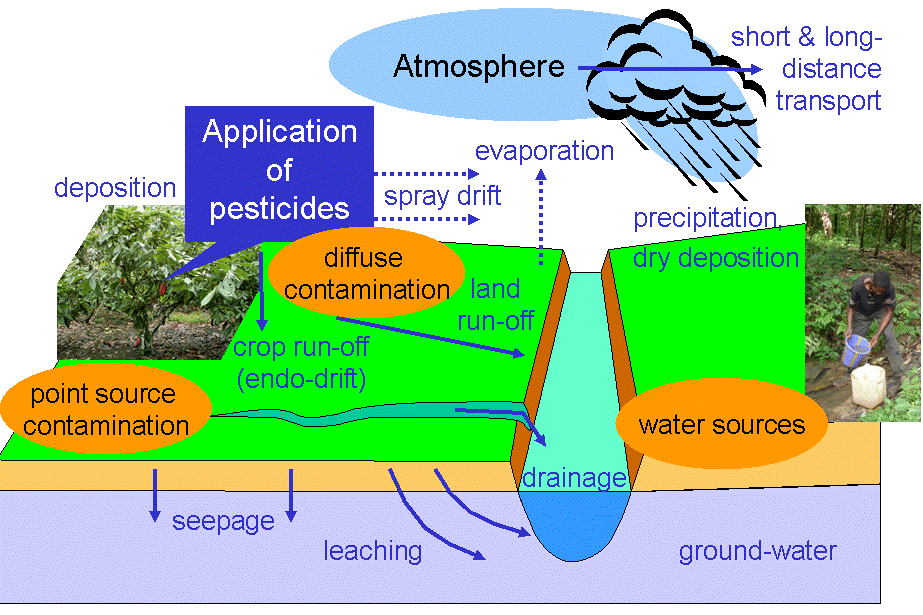
Pesticide drift, also known as spray drift, is the unintentional diffusion of pesticides toward nontarget species. It is one of the most negative effects of pesticide application. Drift can damage human health, environment, and crops. Together with runoff and leaching, drift is a mechanism for agricultural pollution. Some drift results from contamination of sprayer tanks.
Farmers struggle to minimize pesticide drift and remain productive. Research continues on developing pesticides that are more selective, but the current pesticides have been highly optimized.
Pesticides are commonly applied by the use of mechanical sprayers. Sprayers convert a pesticide formulation, often consisting of a mixture of water, the pesticide, and other components (adjuvants, for example) into droplets, which are applied to the crop. Ideally, the pesticide droplets attach evenly to the targeted crop. Because components of the mist are highly mobile, spray drift can occur, especially for smaller droplets. Some pesticides mists are visible, appearing cloud-like, while others can be invisible and odorless.
The quality of sprayer equipment affects drift problems. Sprayer tanks contaminated with another herbicide are one source of drift. With placement (localised) spraying of broad spectrum pesticides, considerable efforts have been made to quantify and control spray drift from hydraulic nozzles. Conversely, wind drift is also an efficient mechanism for moving droplets of an appropriate size range to their targets over a wide area with ultra-low volume (ULV) spraying.
"Drift retardants" are compounds added to the spray mixture to suppress pesticide drift. A typical retardant is polyacrylamide. These polymers suppress the formation of tiny droplets.
Weather conditions and timing affect the drift problem. The efficiency of the spray and reach of the spray drift can be computed. In addition to weather, windbreaks can mitigate the effects of drift. Other ways to mitigate spray drift is to apply the pesticide directly to the desired treatment area, as well as paying attention to where surface waters, gutters, drainage ditches, and storm drains are located. This is to make sure that the pesticide is applied in a way that prevents it from getting in to these spaces.
Most herbicides are organic compounds of low volatility, unlike fumigants, which are usually gases. Several are salts and others have boiling points above 100 °C (Dicamba is a solid that melts at 114°C). Thus, drift often entails mobilization of droplets, which can be very small. The contribution from their volatility, low as they are, cannot be ignored, either.
A distinction has been made between "exo-drift" (the transfer of spray out of the target area) and endo-drift, where the active ingredient (AI) in droplets falls into the target area, but does not reach the biological target. "Endo-drift" is volumetrically more significant and may therefore cause greater ecological contamination (e.g. where chemical pesticides pollute ground water).
Hub AI
Pesticide drift AI simulator
(@Pesticide drift_simulator)
Pesticide drift
Pesticide drift, also known as spray drift, is the unintentional diffusion of pesticides toward nontarget species. It is one of the most negative effects of pesticide application. Drift can damage human health, environment, and crops. Together with runoff and leaching, drift is a mechanism for agricultural pollution. Some drift results from contamination of sprayer tanks.
Farmers struggle to minimize pesticide drift and remain productive. Research continues on developing pesticides that are more selective, but the current pesticides have been highly optimized.
Pesticides are commonly applied by the use of mechanical sprayers. Sprayers convert a pesticide formulation, often consisting of a mixture of water, the pesticide, and other components (adjuvants, for example) into droplets, which are applied to the crop. Ideally, the pesticide droplets attach evenly to the targeted crop. Because components of the mist are highly mobile, spray drift can occur, especially for smaller droplets. Some pesticides mists are visible, appearing cloud-like, while others can be invisible and odorless.
The quality of sprayer equipment affects drift problems. Sprayer tanks contaminated with another herbicide are one source of drift. With placement (localised) spraying of broad spectrum pesticides, considerable efforts have been made to quantify and control spray drift from hydraulic nozzles. Conversely, wind drift is also an efficient mechanism for moving droplets of an appropriate size range to their targets over a wide area with ultra-low volume (ULV) spraying.
"Drift retardants" are compounds added to the spray mixture to suppress pesticide drift. A typical retardant is polyacrylamide. These polymers suppress the formation of tiny droplets.
Weather conditions and timing affect the drift problem. The efficiency of the spray and reach of the spray drift can be computed. In addition to weather, windbreaks can mitigate the effects of drift. Other ways to mitigate spray drift is to apply the pesticide directly to the desired treatment area, as well as paying attention to where surface waters, gutters, drainage ditches, and storm drains are located. This is to make sure that the pesticide is applied in a way that prevents it from getting in to these spaces.
Most herbicides are organic compounds of low volatility, unlike fumigants, which are usually gases. Several are salts and others have boiling points above 100 °C (Dicamba is a solid that melts at 114°C). Thus, drift often entails mobilization of droplets, which can be very small. The contribution from their volatility, low as they are, cannot be ignored, either.
A distinction has been made between "exo-drift" (the transfer of spray out of the target area) and endo-drift, where the active ingredient (AI) in droplets falls into the target area, but does not reach the biological target. "Endo-drift" is volumetrically more significant and may therefore cause greater ecological contamination (e.g. where chemical pesticides pollute ground water).