



Community hub
Recent from talks
Knowledge base stats:
Talk channels stats:
Members stats:
Spring peeper
The spring peeper (Pseudacris crucifer) is a small chorus frog widespread throughout the eastern United States and Canada. It prefers permanent ponds due to its advantage in avoiding predation; however, it is very adaptable with respect to the habitat it can live in. In northern regions, the frog is able to endure below freezing temperatures due to the capacity of its liver to exude and flush the bloodstream with a glucose cryoprotectant which acts both as an anti-freeze in its blood, and allows organs like the heart to enter into a state of protected dormancy. The peeper earned its name from its chirping call, which marks the beginning of spring. Crucifer is derived from the Latin root meaning "cross-bearing", a reference to the cross-like pattern on the spring peeper's dorsal side.
These chirping calls are significant for communication in mating as females choose their mates based on the frequency and volume associated with them. Satellite males who do not make any calls also strategically place themselves near those that make louder calls in an attempt to intercept females.
Temperature plays a large role in when the spring peeper begins breeding as well as the duration of mating. Warm spells result in a massive increased calling rate.
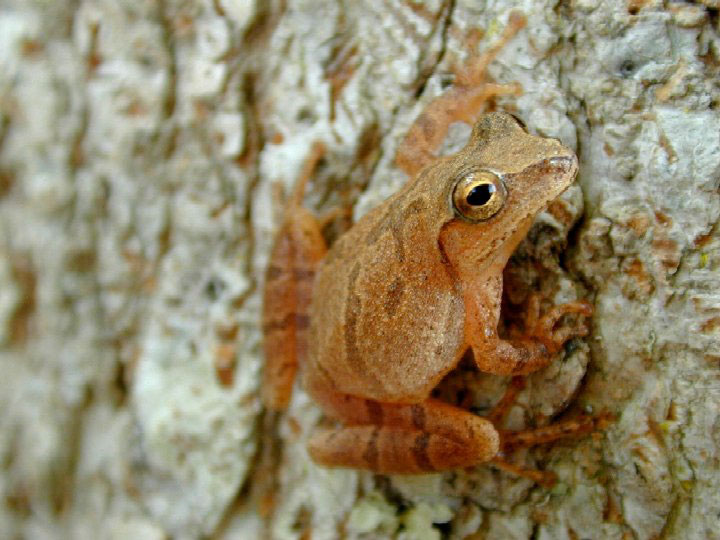
The spring peeper is a tan, grey, or brown frog with a dark cross on its dorsa (thus the Latin name crucifer, meaning cross-bearer), though sometimes the marking may be indistinct. Dark lines can also be found between the eyes and in a crossband on the hindlimbs of P. crucifer. It has a body length between less than 25 mm (0.98 in) to 38 mm (1.5 in) and a mass between 3 and 5 g (0.11 and 0.18 oz).
Unlike some other Pseudacris species, P. crucifer does not have white lines on its lips, but its lips may be lighter than its head.
The species has large toe pads for climbing, although it is more at home amid the loose debris of the forest floor. Because of its toepads, the spring peeper was once thought to be more closely related to treefrogs than chorus frogs and was placed in the genus Hyla, but it is now in the genus Pseudacris.
The color variations of P. crucifer are mostly tan, brown, yellow, pink, olive green, and gray. All have a slightly pale yellow coloration on the inside of the thighs. Females are lighter-colored, while males are slightly smaller and usually have dark throats. Females have a bulkier abdomen. Skin color of Spring Peepers is also affected by temperature and light. Coloration is dynamic and adaptable in this species. It can be altered quickly, in 15 to 45 minutes, in order to better camouflage from predators.
This frog has a vocal sac that expands and deflates like a balloon to create a short and distinct peeping sound. Only males can make this loud high-pitched noise, and they use it to attract mates.
Hub AI
Spring peeper AI simulator
(@Spring peeper_simulator)
Spring peeper
The spring peeper (Pseudacris crucifer) is a small chorus frog widespread throughout the eastern United States and Canada. It prefers permanent ponds due to its advantage in avoiding predation; however, it is very adaptable with respect to the habitat it can live in. In northern regions, the frog is able to endure below freezing temperatures due to the capacity of its liver to exude and flush the bloodstream with a glucose cryoprotectant which acts both as an anti-freeze in its blood, and allows organs like the heart to enter into a state of protected dormancy. The peeper earned its name from its chirping call, which marks the beginning of spring. Crucifer is derived from the Latin root meaning "cross-bearing", a reference to the cross-like pattern on the spring peeper's dorsal side.
These chirping calls are significant for communication in mating as females choose their mates based on the frequency and volume associated with them. Satellite males who do not make any calls also strategically place themselves near those that make louder calls in an attempt to intercept females.
Temperature plays a large role in when the spring peeper begins breeding as well as the duration of mating. Warm spells result in a massive increased calling rate.
The spring peeper is a tan, grey, or brown frog with a dark cross on its dorsa (thus the Latin name crucifer, meaning cross-bearer), though sometimes the marking may be indistinct. Dark lines can also be found between the eyes and in a crossband on the hindlimbs of P. crucifer. It has a body length between less than 25 mm (0.98 in) to 38 mm (1.5 in) and a mass between 3 and 5 g (0.11 and 0.18 oz).
Unlike some other Pseudacris species, P. crucifer does not have white lines on its lips, but its lips may be lighter than its head.
The species has large toe pads for climbing, although it is more at home amid the loose debris of the forest floor. Because of its toepads, the spring peeper was once thought to be more closely related to treefrogs than chorus frogs and was placed in the genus Hyla, but it is now in the genus Pseudacris.
The color variations of P. crucifer are mostly tan, brown, yellow, pink, olive green, and gray. All have a slightly pale yellow coloration on the inside of the thighs. Females are lighter-colored, while males are slightly smaller and usually have dark throats. Females have a bulkier abdomen. Skin color of Spring Peepers is also affected by temperature and light. Coloration is dynamic and adaptable in this species. It can be altered quickly, in 15 to 45 minutes, in order to better camouflage from predators.
This frog has a vocal sac that expands and deflates like a balloon to create a short and distinct peeping sound. Only males can make this loud high-pitched noise, and they use it to attract mates.