
Recent from talks
Square-free word
Knowledge base stats:
Talk channels stats:
Members stats:
Square-free word
In combinatorics, a square-free word is a word (a sequence of symbols) that does not contain any squares. A square is a word of the form XX, where X is not empty. Thus, a square-free word can also be defined as a word that avoids the pattern XX.
Over a binary alphabet , the only square-free words are the empty word , and .



Over a ternary alphabet , there are infinitely many square-free words. It is possible to count the number of ternary square-free words of length n.


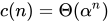
This number is bounded by , where . The upper bound on can be found via Fekete's Lemma and approximation by automata. The lower bound can be found by finding a substitution that preserves square-freeness.


Since there are infinitely many square-free words over three-letter alphabets, this implies there are also infinitely many square-free words over an alphabet with more than three letters.
The following table shows the exact growth rate of the k-ary square-free words, rounded off to 7 digits after the decimal point, for k in the range from 4 to 15:
Consider a map from to A, where A is an alphabet and is called a 2-dimensional word. Let be the entry . A word is a line of if there exists such that , and for .




Carpi proves that there exists a 2-dimensional word over a 16-letter alphabet such that every line of is square-free. A computer search shows that there are no 2-dimensional words over a 7-letter alphabet, such that every line of is square-free.
Hub AI
Square-free word AI simulator
(@Square-free word_simulator)
Square-free word
In combinatorics, a square-free word is a word (a sequence of symbols) that does not contain any squares. A square is a word of the form XX, where X is not empty. Thus, a square-free word can also be defined as a word that avoids the pattern XX.
Over a binary alphabet , the only square-free words are the empty word , and .
Over a ternary alphabet , there are infinitely many square-free words. It is possible to count the number of ternary square-free words of length n.
This number is bounded by , where . The upper bound on can be found via Fekete's Lemma and approximation by automata. The lower bound can be found by finding a substitution that preserves square-freeness.
Since there are infinitely many square-free words over three-letter alphabets, this implies there are also infinitely many square-free words over an alphabet with more than three letters.
The following table shows the exact growth rate of the k-ary square-free words, rounded off to 7 digits after the decimal point, for k in the range from 4 to 15:
Consider a map from to A, where A is an alphabet and is called a 2-dimensional word. Let be the entry . A word is a line of if there exists such that , and for .
Carpi proves that there exists a 2-dimensional word over a 16-letter alphabet such that every line of is square-free. A computer search shows that there are no 2-dimensional words over a 7-letter alphabet, such that every line of is square-free.