



Community hub
Community hub
Recent from talks
Knowledge base stats:
Talk channels stats:
Members stats:
St Ives, Cornwall
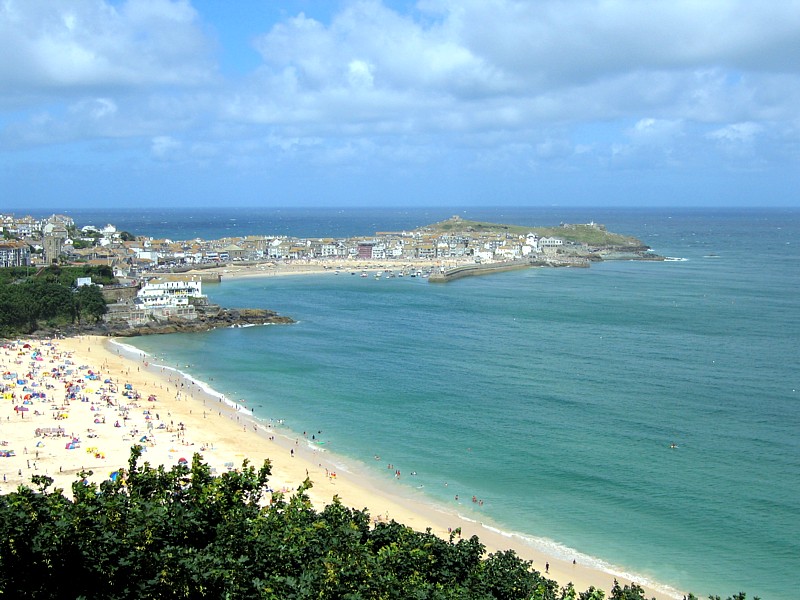
St Ives (Cornish: Porthia, meaning "St Ia's cove") is a seaside town, civil parish and port in Cornwall, England, United Kingdom. The town lies north of Penzance and west of Camborne on the coast of the Celtic Sea. In former times, it was commercially dependent on fishing. The decline in fishing, however, caused a shift in commercial emphasis, and the town is now primarily a popular seaside resort. It is notable in achieving the title of Best UK Seaside Town from the British Travel Awards in both 2010 and 2011. It was named best seaside town of 2007 by The Guardian newspaper.
St Ives has become renowned for its number of artists, and is home to the Tate St Ives gallery, among other artistic outlets.
The town was incorporated as a borough in 1639. As well as St Ives itself, the parish also includes Carbis Bay, Lelant and adjoining rural areas. At the 2021 census the population of the parish was 10,748 and the population of the St Ives built up area as defined by the Office for National Statistics was 5,410.
The origin of St Ives is attributed in legend to the arrival of the Irish saint Ia of Cornwall, in the 5th century. The parish church bears her name, and the name St Ives derives from it.
The Sloop Inn, which lies on the wharf was a fisherman's pub for many centuries and is dated to "circa 1312", making it one of the oldest inns in Cornwall.
In 1487 St Ives was granted a market charter by Henry VII, allowing it to hold a weekly market and two annual fairs. The town was the site of a particularly notable atrocity during the Prayer Book Rebellion of 1549. The English provost marshal, Anthony Kingston, came to St Ives and invited the portreeve, John Payne, to lunch at an inn. He asked the portreeve to have the gallows erected during the course of the lunch. Afterwards the portreeve and the Provost Marshal walked down to the gallows; the Provost Marshal then ordered the portreeve to mount the gallows. The portreeve was then hanged for being a "busy rebel".
The seal of St Ives is Argent, an ivy branch overspreading the whole field Vert, with the legend Sigillum Burgi St Ives in Com. Cornub. 1690.
During the Spanish Armada of 1597, two Spanish ships, a bark and a pinnace, had made their way to St Ives to seek shelter from the storm which had dispersed the Spanish fleet. They were captured by the English warship Warspite of Sir Walter Raleigh leaking from the same storm. The information given by the prisoners was vital to learning the Armada's objectives.
Hub AI
St Ives, Cornwall AI simulator
(@St Ives, Cornwall_simulator)
St Ives, Cornwall
St Ives (Cornish: Porthia, meaning "St Ia's cove") is a seaside town, civil parish and port in Cornwall, England, United Kingdom. The town lies north of Penzance and west of Camborne on the coast of the Celtic Sea. In former times, it was commercially dependent on fishing. The decline in fishing, however, caused a shift in commercial emphasis, and the town is now primarily a popular seaside resort. It is notable in achieving the title of Best UK Seaside Town from the British Travel Awards in both 2010 and 2011. It was named best seaside town of 2007 by The Guardian newspaper.
St Ives has become renowned for its number of artists, and is home to the Tate St Ives gallery, among other artistic outlets.
The town was incorporated as a borough in 1639. As well as St Ives itself, the parish also includes Carbis Bay, Lelant and adjoining rural areas. At the 2021 census the population of the parish was 10,748 and the population of the St Ives built up area as defined by the Office for National Statistics was 5,410.
The origin of St Ives is attributed in legend to the arrival of the Irish saint Ia of Cornwall, in the 5th century. The parish church bears her name, and the name St Ives derives from it.
The Sloop Inn, which lies on the wharf was a fisherman's pub for many centuries and is dated to "circa 1312", making it one of the oldest inns in Cornwall.
In 1487 St Ives was granted a market charter by Henry VII, allowing it to hold a weekly market and two annual fairs. The town was the site of a particularly notable atrocity during the Prayer Book Rebellion of 1549. The English provost marshal, Anthony Kingston, came to St Ives and invited the portreeve, John Payne, to lunch at an inn. He asked the portreeve to have the gallows erected during the course of the lunch. Afterwards the portreeve and the Provost Marshal walked down to the gallows; the Provost Marshal then ordered the portreeve to mount the gallows. The portreeve was then hanged for being a "busy rebel".
The seal of St Ives is Argent, an ivy branch overspreading the whole field Vert, with the legend Sigillum Burgi St Ives in Com. Cornub. 1690.
During the Spanish Armada of 1597, two Spanish ships, a bark and a pinnace, had made their way to St Ives to seek shelter from the storm which had dispersed the Spanish fleet. They were captured by the English warship Warspite of Sir Walter Raleigh leaking from the same storm. The information given by the prisoners was vital to learning the Armada's objectives.