Hubbry Logo
HangingHangingMain
Open search
Hanging
Community hub
Hanging
logo
8 pages, 0 posts
0 subscribers
Be the first to start a discussion here.
Contribute something
Hanging
Hanging
from Wikipedia

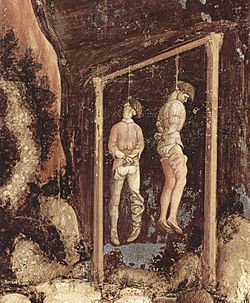
Detail from a painting by Pisanello, 1436–1438

Hanging is killing a person by suspending them from the neck with a noose or ligature. Hanging has been a standard method of capital punishment since the Middle Ages, and has been the primary execution method in numerous countries and regions. As a form of execution, it is commonly practiced at a structure called a gallows. The first known account of execution by hanging is in Homer's Odyssey.[1] Hanging is also a common method of suicide.

Methods of judicial hanging

[edit]

There are numerous methods of hanging in execution that instigate death either by cervical fracture or by strangulation.

Short drop

[edit]

The short drop is a method of hanging in which the condemned prisoner stands on a raised support, such as a stool, ladder, cart, horse, or other vehicle, with the noose around the neck. The support is then moved away, leaving the person dangling from the rope.[2][3] Suspended by the neck, the weight of the body tightens the noose around the neck, effecting strangulation and death. Loss of consciousness is typically rapid and death ensues in a few minutes.[4]

Before 1850, the short drop was the standard method of hanging, and it is still common in suicides and extrajudicial hangings (such as lynchings and summary executions) which lack the specialised equipment and drop-length calculation tables used in the newer methods.

Execution of guards and kapos of the Stutthof concentration camp on 4 July 1946 by short-drop hanging. In the foreground are the female overseers: Jenny-Wanda Barkmann, Ewa Paradies, Elisabeth Becker, Wanda Klaff, Gerda Steinhoff (left to right).

Pole method

[edit]
Mass execution using "pole-hanging" of Serbs by the Austro-Hungarian army in 1916

A short-drop variant is the Austro-Hungarian "pole" method, called Würgegalgen (literally: strangling gallows), in which the following steps take place:

  1. The condemned is made to stand before a specialized vertical pole or pillar, approximately 3 metres (9.8 ft) in height.
  2. A rope is attached around the condemned's feet and routed through a pulley at the base of the pole.
  3. The condemned is hoisted to the top of the pole by means of a sling running across the chest and under the arms.
  4. A narrow-diameter noose is looped around the prisoner's neck, then secured to a hook mounted at the top of the pole.
  5. The chest sling is released, and the prisoner is rapidly jerked downward by the assistant executioners via the foot rope, thus resulting in strangulation and death.

This method was later also adopted by the successor states, most notably by Czechoslovakia, where the "pole" method was used as the single type of execution from 1918 until 1954, when the prison hosting Czechoslovakia's executions, Pankrác Prison, constructed an indoor gallows that exclusively accommodated short-drop hangings to replace the pole method.[5] Nazi war criminal Karl Hermann Frank, executed in 1946 in Prague, was among approximately 1,000 condemned people executed by the pole hanging method in Czechoslovakia.[6]

Standard drop

[edit]
The execution of Henry Wirz in 1865; Wirz was given a standard drop, which did not break his neck

The standard drop involves a drop of between 4 and 6 feet (1.2–1.8 m) and came into use from 1866, when the scientific details were published by Irish doctor Samuel Haughton. Its use rapidly spread to English-speaking countries and those with judicial systems of English origin.

It was considered a humane improvement on the short drop because it was intended to be enough to break the person's neck, causing immediate unconsciousness and rapid brain death.[7][8]

This method was used to execute condemned Nazis under United States jurisdiction after the Nuremberg Trials, including Joachim von Ribbentrop and Ernst Kaltenbrunner.[9][not specific enough to verify] In the execution of Ribbentrop, historian Giles MacDonogh records that: "The hangman botched the execution and the rope throttled the former foreign minister for 20 minutes before he expired."[10] A Life magazine report on the execution merely says: "The trap fell open and with a sound midway between a rumble and a crash, Ribbentrop disappeared. The rope quivered for a time, then stood tautly straight."[11]

Long drop

[edit]
1901 postcard showing Tom Ketchum's decapitated body following a botched execution by long-drop hanging. Caption reads "Body of Black Jack after the hanging showing head snapped off."
Execution of an unidentified Nazi war criminal after World War II

The long-drop process, also known as the measured drop, was introduced to Britain in 1872 by William Marwood as a scientific advance on the standard drop, and further refined by his successor James Berry. Instead of everyone falling the same standard distance, the person's height and weight[12] were used to determine how much slack would be provided in the rope so that the distance dropped would be enough to ensure that the neck was broken, but not so much that the person was decapitated. Careful placement of the eye or knot of the noose (so that the head was jerked back as the rope tightened) contributed to breaking the neck.

Prior to 1892, the drop was in the range of 4–10 ft (1.2–3.0 m), depending on the weight of the body, and was calculated to deliver an energy of 1,260 foot-pounds force (1,710 J), which fractured the neck at either the 2nd and 3rd or 4th and 5th cervical vertebrae. This force resulted in some decapitations, such as the infamous case of Black Jack Ketchum in New Mexico Territory in 1901, owing to a significant weight gain while in custody not having been factored into the drop calculations. Between 1892 and 1913, the length of the drop was shortened to avoid decapitation. After 1913, other factors were also taken into account, and the energy delivered was reduced to about 1,000 foot-pounds force (1,400 J). The record speed for a British long-drop hanging was seven seconds from the executioner entering the cell to the drop. Speed was considered to be important in the British system as it reduced the condemned's mental distress.[13]

Long-drop hanging is still practiced as the method of execution in a few countries, including Japan and Singapore.[14][15]

As suicide

[edit]
A sixteenth-century fresco from Tarzhishte Monastery, Strupets, Bulgaria, showing Judas Iscariot hanging himself

Hanging is a common suicide method. The materials necessary for suicide by hanging are readily available to the average person, compared with firearms or poisons. Full suspension is not required, and for this reason, hanging is especially commonplace among suicidal prisoners (see: Suicide watch). A type of hanging comparable to full suspension hanging may be obtained by self-strangulation using a ligature around the neck and the partial weight of the body (partial suspension) to tighten the ligature. When a suicidal hanging involves partial suspension the deceased is found to have both feet touching the ground, e.g., they are kneeling, crouching or standing. Partial suspension or partial weight-bearing on the ligature is sometimes used, particularly in prisons, mental hospitals or other institutions, where full suspension support is difficult to devise, because high ligature points (e.g., hooks or pipes) have been removed.[16]

In Canada, hanging is the most common method of suicide,[17] and in the U.S., hanging is the second most common method, after self-inflicted gunshot wounds.[18] In the United Kingdom, where firearms are less easily available, in 2001 hanging was the most common method among men and the second most commonplace among women (after poisoning).[19]

Those who survive a suicide-via-hanging attempt, whether due to breakage of the cord or ligature point, or being discovered and cut down, face a range of serious injuries, including cerebral anoxia (which can lead to permanent brain damage), laryngeal fracture, cervical spine fracture (which may cause paralysis), tracheal fracture, pharyngeal laceration, and carotid artery injury.[20]

As human sacrifice

[edit]

There are some suggestions that the Vikings practised hanging as human sacrifices to Odin, to honour Odin's own sacrifice of hanging himself from Yggdrasil.[21] In Northern Europe, it is widely speculated that the Iron Age bog bodies, many of which show signs of having been hanged, were examples of human sacrifice to the gods.[22]

Medical effects

[edit]
Anoxic brain injury following a hanging—both the loss of visible differentiation between grey and white matter and the reduced ventricle size due to brain swelling are visible

A hanging may induce one or more of the following medical conditions, some leading to death:

The cause of death in hanging depends on the conditions related to the event. When the body is released from a relatively high position, the major cause of death is severe trauma to the upper cervical spine. The injuries produced are highly variable. One study showed that only a small minority of a series of judicial hangings produced fractures to the cervical spine (6 out of 34 cases studied), with half of these fractures (3 out of 34) being the classic "hangman's fracture" (bilateral fractures of the pars interarticularis of the C2 vertebra).[24]

The side, or subaural knot, has been shown to produce other, more complex injuries, with one thoroughly studied case producing only ligamentous injuries to the cervical spine and bilateral vertebral artery disruptions, but no major vertebral fractures or crush injuries to the spinal cord.[25]

John Ogilvie, who in 1615 was hanged and disembowelled after torture for his refusal to give up the Catholic faith and convert to Protestantism

In the absence of fracture and dislocation, occlusion of blood vessels becomes the major cause of death, rather than asphyxiation. Obstruction of venous drainage of the brain via occlusion of the internal jugular veins leads to cerebral oedema and then cerebral ischemia. The face will typically become engorged and cyanotic (turned blue through lack of oxygen). Compromise of the cerebral blood flow may occur by obstruction of the carotid arteries, even though their obstruction requires far more force than the obstruction of jugular veins, since they are seated deeper and they contain blood in much higher pressure compared to the jugular veins.[26]

Notable practices across the globe

[edit]
La Pendaison (The Hanging), a plate from French artist Jacques Callot's 1633 series The Great Miseries of War.

Hanging has been a method of capital punishment in many countries, and is still used by many countries to this day. Long-drop hanging is mainly used by former British colonies, while short-drop and suspension hanging is common elsewhere, in countries including Iran and Afghanistan.

Afghanistan

[edit]

Hanging is the most used form of capital punishment in Afghanistan.[citation needed]

Australia

[edit]

Capital punishment was a part of the legal system of Australia from the establishment of New South Wales as a British penal colony, until 1985, by which time all Australian states and territories had abolished the death penalty.[27] In practice, the last execution in Australia was the hanging of Ronald Ryan on 3 February 1967, in Victoria.[28]

During the 19th century, crimes that could carry a death sentence included burglary, sheep theft, forgery, sexual assaults, murder and manslaughter. During the 19th century, there were roughly eighty people hanged every year throughout the Australian colonies for these crimes.[citation needed]

Bahamas

[edit]

The Bahamas employs hanging to execute the condemned, but no executions have been conducted in the country since 2000.[29] As of 2023, there have been some inmates on death row but their sentences have been commuted.[citation needed]

Bangladesh

[edit]

Hanging is the only method of execution in Bangladesh, ever since its independence.[citation needed]

Brazil

[edit]

Death by hanging was the customary method of capital punishment in Brazil throughout its history. Some important national heroes like Tiradentes (1792) were killed by hanging. The last man executed in Brazil was the slave Francisco, in 1876.[30] The death penalty was abolished for all crimes, except for those committed under extraordinary circumstances such as war or military law, in 1890.[31]

Bulgaria

[edit]

Bulgaria's national hero, Vasil Levski, was executed by hanging by the Ottoman court in Sofia in 1873. Every year since Bulgaria's liberation, thousands come with flowers on the date of his death, 19 February, to his monument where the gallows stood. The last execution was in 1989, and the death penalty was abolished for all crimes in 1998.[31]

Canada

[edit]

Historically, hanging was the only method of execution used in Canada and was in use as possible punishment for all murders until 1961, when murders were reclassified into capital and non-capital offences. The death penalty was restricted to apply only for certain offences to the National Defence Act in 1976 and was completely abolished in 1998.[32] The last hangings in Canada took place on 11 December 1962.[31]

Egypt

[edit]

In 1955, Egypt hanged three Israelis on charges of spying.[33] In 1982 Egypt hanged three civilians convicted of the assassination of Anwar Sadat.[34] In 2004, Egypt hanged five militants on charges of trying to kill the Prime Minister.[35][not specific enough to verify] To this day, hanging remains the standard method of capital punishment in Egypt, which executes more people each year than any other African country.

Germany

[edit]
Public execution of Polish civilians by the Nazi Germans in German occupied Kraków in 1942
Alleged Soviet partisans hanged by the Nazis in January 1943

In the territories occupied by Nazi Germany from 1939 to 1945, strangulation hanging was a preferred means of public execution, although more criminal executions were performed by guillotine than hanging. The most commonly sentenced were partisans and black marketeers, whose bodies were usually left hanging for long periods. There are also numerous reports of concentration camp inmates being hanged. Hanging was continued in post-war Germany in the British and US Occupation Zones under their jurisdiction, and for Nazi war criminals, until well after (western) Germany itself had abolished the death penalty by the Basic Law (constitution) as adopted in 1949. West Berlin was not subject to the Basic Law and abolished the death penalty in 1951. The German Democratic Republic abolished the death penalty in 1987. The last execution ordered by a West German court was carried out by guillotine in Moabit prison in 1949. The last hanging in Germany was the one ordered of several war criminals in Landsberg am Lech on 7 June 1951. The last known execution in East Germany was in 1981 by a pistol shot to the neck.[27]

Hong Kong

[edit]

Even though Hong Kong is now part of China, it has no capital punishment; it is a special administrative region of China. When Hong Kong was still a part of the British Empire, it had hanging as the method of execution. The last person who was executed was a Chinese Vietnamese man who attacked a security guard and another person. This execution occurred in 1966.[36]

Hungary

[edit]

The prime minister of Hungary, during the 1956 Revolution, Imre Nagy, was secretly tried, executed by hanging, and buried unceremoniously by the new Soviet-backed Hungarian government, in 1958. Nagy was later publicly exonerated by Hungary.[37] Capital punishment was abolished for all crimes in 1990.[27]

India

[edit]
The hanging of two participants in British India (Indian Rebellion of 1857)

Hanging was introduced by the British. All executions in India since independence have been carried out by hanging, although the law provides for military executions to be carried out by firing squad. In 1949, Nathuram Godse, who had been sentenced to death for the assassination of Mahatma Gandhi, was the first person to be executed by hanging in independent India.[38]

The Supreme Court of India has suggested that capital punishment should be given only in the "rarest of rare cases".[39]

Since 2001, eight people have been executed in India.

Iran

[edit]

Hanging is the most used form of capital punishment in Iran.[41]

Iraq

[edit]

Hanging was used under the regime of Saddam Hussein,[42][self-published source] but was suspended along with capital punishment on 10 June 2003, when a coalition led by the United States invaded and overthrew the previous regime. The death penalty was reinstated on 8 August 2004.[43]

In September 2005, three murderers were the first people to be executed since the restoration. Then on 9 March 2006, an official of Iraq's Supreme Judicial Council confirmed that Iraqi authorities had executed the first insurgents by hanging.[44]

Saddam Hussein was sentenced to death by hanging for crimes against humanity[45] on 5 November 2006, and was executed on 30 December 2006 at approximately 6:00 a.m. local time. During the drop, there was an audible crack indicating that his neck was broken, a successful example of a long-drop hanging.[46]

Barzan Ibrahim, the head of the Mukhabarat, Saddam's security agency, and Awad Hamed al-Bandar, former chief judge, were executed on 15 January 2007, also by the long-drop method, but Barzan was decapitated by the rope at the end of his fall.[47][48]

Former vice-president Taha Yassin Ramadan had been sentenced to life in prison on 5 November 2006, but the sentence was changed to death by hanging on 12 February 2007.[49] He was the fourth and final man to be executed for the 1982 crimes against humanity on 20 March 2007. The execution went smoothly.[50]

At the Anfal genocide trial, Saddam's cousin Ali Hassan al-Majid (nicknamed Chemical Ali by Iraqis), former defence minister Sultan Hashim Ahmed al-Tay, and former deputy Hussein Rashid Mohammed were sentenced to hang for their role in the Al-Anfal Campaign against the Kurds on 24 June 2007.[51] Al-Majid was sentenced to death three more times: once for the 1991 suppression of a Shi'a uprising along with Abdul-Ghani Abdul Ghafur on 2 December 2008;[52] once for the 1999 crackdown in the assassination of Grand Ayatollah Mohammad al-Sadr on 2 March 2009;[53] and once on 17 January 2010 for the gassing of the Kurds in 1988;[54] he was hanged on 25 January.[55]

On 26 October 2010, Saddam's top minister Tariq Aziz was sentenced to hang for persecuting the members of rival Shi'a political parties.[56] His sentence was commuted to indefinite imprisonment after Iraqi president Jalal Talabani did not sign his execution order and he died in prison in 2015.

On 14 July 2011, US forces transferred condemned prisoners Sultan Hashim Ahmad al-Tai and two of Saddam's half-brothers, Sabawi Ibrahim al-Tikriti and Watban Ibrahim al-Tikriti, to Iraqi authorities for execution.[57] The Iraqi High Tribunal had sentenced Saddam's half-brothers to death on 11 March 2009 for their roles in the executions of 42 traders who were accused of manipulating food prices.[58] None of the three men were executed.[59][60][61]

It is alleged that Iraq's government keeps the execution rate secret, and hundreds may be carried out every year. In 2007, Amnesty International stated that 900 people were at "imminent risk" of execution in Iraq.

Israel

[edit]

Israel has provisions in its criminal law to use the death penalty for extraordinary crimes. It has been used only twice for Israelis, and only one of those executions was by hanging. On 31 May 1962, Nazi leader Adolf Eichmann was executed by hanging after having been captured in Argentina in May 1960, taken to Israel and tried and sentenced to death.[31][62]

Japan

[edit]

All executions in Japan are carried out by hanging.

On 23 December 1948, Hideki Tojo, Kenji Doihara, Akira Mutō, Iwane Matsui, Seishirō Itagaki, Kōki Hirota, and Heitaro Kimura were hanged at Sugamo Prison by the U.S. occupation authorities in Ikebukuro in Allied-occupied Japan for war crimes, crimes against humanity, and crimes against peace during the Asian-Pacific theatre of World War II.[63][unreliable source?][64][self-published source]

On 27 February 2004, the mastermind of the Sarin gas attack on the Tokyo subway, Shoko Asahara, was found guilty and sentenced to death by hanging. On 25 December 2006, serial killer Hiroaki Hidaka and three others were hanged in Japan. Long-drop hanging is the method of carrying out judicial capital punishment on civilians in Japan, as in the cases of Norio Nagayama,[65] Mamoru Takuma,[66] and Tsutomu Miyazaki.[67] In 2018 Shoko Asahara and several of his cult members were hanged for committing the 1995 sarin gas attack.

Jordan

[edit]

Hanging is the traditional method of capital punishment in Jordan. On 14 August 1993, Jordan hanged two Jordanians convicted of spying for Israel.[68] Sajida al-Rishawi, the "4th bomber" of the 2005 Amman bombings, was executed by hanging alongside Ziad al-Karbouly on 4 February 2015, while she was in the process of appealing her sentence for terrorism offences, in retribution for the immolation of Jordanian pilot Muath Al-Kasasbeh.

Kuwait

[edit]

Kuwait has always used hanging for execution. During the Gulf War, Iraqi government officials executed different people for different reasons. After the war, Kuwait hanged Iraqi collaborators.[69][full citation needed] Sometimes the executions are in public. The most recent executions were in 2022.[70]

Lebanon

[edit]

Lebanon hanged two men in 1998 for murdering a man and his sister.[71] However, capital punishment ended up being altogether suspended in Lebanon, as a result of staunch opposition by activists and some political factions.[72]

Liberia

[edit]
The Hanging of the Harper Seven, Liberia – 16 February 1979

On 16 February 1979, seven men convicted of the ritual killing of Kru traditional singer Moses Tweh were publicly hanged at dawn in Harper.[73][74]

Malaysia

[edit]

Hanging is the traditional method of capital punishment in Malaysia and has been used to execute people convicted of murder, drug trafficking and waging war against the government. The Barlow and Chambers execution was carried out as a result of new tighter drug regulations.

Pakistan

[edit]

In Pakistan, hanging is the most common form of execution.

Portugal

[edit]

The last person executed by hanging in Portugal was Francisco Matos Lobos on 16 April 1842. Before that, it had been a common death penalty.

Russia

[edit]

Hanging was commonly practised in the Russian Empire during the rule of the Romanov dynasty as an alternative to impalement, which was used in the 15th and 16th centuries.

Hanging was abolished in 1868 by Alexander II after serfdom,[clarification needed] but was restored by the time of his death and his assassins were hanged. While those sentenced to death for murder were usually pardoned and sentences commuted to life imprisonment, those guilty of high treason were usually executed. This also included the Grand Duchy of Finland and Kingdom of Poland under the Russian crown. Taavetti Lukkarinen became the last Finn to be executed this way. He was hanged for espionage and high treason in 1916.

The hanging was usually performed by short drop in public. The gallows were usually either a stout nearby tree branch, as in the case of Lukkarinen, or a makeshift gallows constructed for the purpose.

After the October Revolution in 1917, capital punishment was, on paper, abolished, but continued to be used unabated against people perceived to be enemies of the regime. Under the Bolsheviks, most executions were performed by shooting, either by firing squad or by a single firearm. In 1943, hanging was restored primarily for German servicemen and native collaborators for atrocities committed against Soviet POWs and civilians. The last to be hanged were Andrey Vlasov and his companions in 1946.

Singapore

[edit]

In Singapore, long-drop hanging[14] is currently used as a mandatory punishment for crimes such as drug trafficking, murder and some types of kidnapping. It was introduced by the British, when they occupied Singapore and neighbouring Malaysia. It has also been used for punishing those convicted of unauthorised discharging of firearms.[75]

Sri Lanka

[edit]

Hanging was abolished in Sri Lanka in 1956, but in 1959 it was brought back and later halted in 1978. In 1975, the day before the execution of Maru Sira, he had been overdosed by the prison guards to prevent him from escaping. On the day of his execution he was unconscious, so when he was brought to the gallows, he was slumped over on the trapdoor with a noose around his neck, and when the executioner pulled the lever, his execution was botched and he strangled.

Syria

[edit]
Eli Cohen, publicly hanged by Syria on 18 May 1965

Syria has publicly hanged people, such as two individuals in 1952, Israeli spy Eli Cohen in 1965, and a number of Jews accused of spying for Israel in 1969.[76][77][78]

According to a 19th-century report, members of the Alawite sect centred on Lattakia in Syria had a particular aversion towards being hanged, and the family of the condemned was willing to pay "considerable sums" to ensure its relations were impaled, instead of being hanged. As far as Burckhardt could make out, this attitude was based upon the Alawites' idea that the soul ought to leave the body through the mouth, rather than leave it in any other fashion.[79]

The Islamic State also used hanging post-mortem, after they executed alleged spies for the western-backed coalition in Deir ez-Zor by cutting their throats in a slaughterhouse, during the Islamic holiday of Eid al-Adha in 2016. They also used shooting, beheading, fire and other methods to execute people during their rule.[citation needed]

United Kingdom

[edit]

As a form of judicial execution in England, hanging is thought to date from the Anglo-Saxon period.[80] Records of the names of British hangmen begin with Thomas de Warblynton in the 1360s;[citation needed] complete records extend from the 16th century to the last hangmen, Robert Leslie Stewart and Harry Allen, who conducted the last British executions in 1964.

Until 1868 hangings were performed in public. In London, the traditional site was at Tyburn, a settlement west of the City on the main road to Oxford, which was used on eight hanging days a year, though before 1865, executions had been transferred to the street outside Newgate Prison, Old Bailey, now the site of the Central Criminal Court.

Three British subjects were hanged after World War II after having been convicted of having helped Nazi Germany in its war against Britain. John Amery, the son of prominent British politician Leo Amery, became an expatriate in the 1930s, moving to France. He became involved in pre-war fascist politics, remained in what became Vichy France following France's defeat by Germany in 1940 and eventually went to Germany and later the German puppet state in Italy headed by Benito Mussolini. Captured by Italian partisans at the end of the war and handed over to British authorities, Amery was accused of having made propaganda broadcasts for the Nazis and of having attempted to recruit British prisoners of war for a Waffen SS regiment later known as the British Free Corps. Amery pleaded guilty to treason charges on 28 November 1945[81] and was hanged at Wandsworth Prison on 19 December 1945. William Joyce, an American-born Irishman who had lived in Britain and possessed a British passport, had been involved in pre-war fascist politics in the UK, fled to Nazi Germany just before the war began to avoid arrest by British authorities and became a naturalised German citizen. He made propaganda broadcasts for the Nazis, becoming infamous under the nickname Lord Haw-Haw. Captured by British forces in May 1945, he was tried for treason later that year. Although Joyce's defence argued that he was by birth American and thus not subject to being tried for treason, the prosecution successfully argued that Joyce's pre-war British passport meant that he was a subject of the British Crown and he was convicted. After his appeals failed, he was hanged at Wandsworth Prison on 3 January 1946.[82] Theodore Schurch, a British soldier captured by the Nazis who then began working for the Italian and German intelligence services by acting as a spy and informer who would be placed among other British prisoners, was arrested in Rome in March 1945 and tried under the Treachery Act 1940. After his conviction, he was hanged at HM Prison Pentonville on 4 January 1946.

The Homicide Act 1957 created the new offence of capital murder, punishable by death, with all other murders being punishable by life imprisonment.

In 1965, Parliament passed the Murder (Abolition of Death Penalty) Act, temporarily abolishing capital punishment for murder for five years. The Act was renewed in 1969, making the abolition permanent. With the passage of the Crime and Disorder Act 1998 and the Human Rights Act 1998, the death penalty was officially abolished for all crimes in both civilian and military cases. Following its complete abolition, the gallows were removed from Wandsworth Prison, where they remained in full working order until that year.

The last woman to be hanged was Ruth Ellis on 13 July 1955, by Albert Pierrepoint who was a prominent hangman in the 20th century in England. The last hangings in Britain took place in 1964, when Peter Anthony Allen was executed at Walton Prison in Liverpool. Gwynne Owen Evans was executed by Harry Allen at Strangeways Prison in Manchester. Both were executed for the murder of John Alan West.[83]

Hanging was also the method used in many colonies and overseas territories.[84]

Silken rope

[edit]

In the UK, some felons are traditionally said to have been executed by hanging with a silken rope:

United States

[edit]
The execution of Mary Surratt, Lewis Powell, David Herold, and George Atzerodt, who were all convicted by a military tribunal for being involved in the assassination of Abraham Lincoln, 7 July 1865

Hanging was one means by which Puritans of the Massachusetts Bay Colony enforced religious and intellectual conformity on the whole community.[89] The best known hanging carried out by the Puritans, Mary Dyer, was one of the four executed Quakers known as the Boston martyrs.[90]

The United States is the only Western democracy[clarification needed] that still allows the government to execute people. However, the use of capital punishment in the U.S. varies widely from state to state; it is outlawed in nearly half of the states but used in several others along with the federal system. The death penalty under federal law is applicable in every state, and the Donald Trump administration since 2019 has been unswerving in its desire to carry out as many federal executions as possible and federalize capital crimes to cover even state-level offenses in states without a death penalty of their own (such as New York). However, no federal hangings have taken place yet. Hanging is only used at the state level in Florida as of 2025. Previously, the last state to allow hanging as a method of execution, New Hampshire, abolished the death penalty in 2019.

In July 2025, Florida enacted legislation that further expands the state's already extensive capital punishment laws to allow "any execution method not explicitly deemed unconstitutional," which includes hanging. This makes the United States the only country in the Western world that currently allows executions via hanging.[91][92]

When African American pastor Denmark Vesey of the Emanuel African Methodist Episcopal Church was suspected of plotting to launch a slave rebellion in Charleston, South Carolina in 1822, 35 people, including Vesey, were judged guilty by a city-appointed court and were subsequently hanged, and the church was burned down.[93]

The Dakota War of 1862, also known as the Dakota uprising, led to the largest mass execution in the United States when 38 Sioux Indians, who were facing starvation and displacement, attacked white settlers, for which they were sentenced to death via hanging in Mankato, Minnesota in December 1862.[94] Originally, 303 had been sentenced to hang, but the convictions were reviewed by President Abraham Lincoln and the sentences of all but 38 were commuted.[95] In 2019, Governor Tim Walz issued an historic apology to the Dakota people for the mass hanging and the "trauma inflicted on Native people at the hands of state government".[94]

A total of 40 suspected Unionists were hanged in Gainesville, Texas, in October 1862.[96] On 7 July 1865, four people involved in the assassination of President Abraham LincolnMary Surratt, Lewis Powell, David Herold, and George Atzerodt—were hanged at Fort McNair in Washington, D.C.

Men pose for a photograph of the 1920 Duluth, Minnesota lynchings. Two of the black victims are still hanging while the third is on the ground.

While relatively uncommon, hanging in chains has also been practiced (mainly during the colonial era), the first being a slave after the New York Slave Revolt of 1712. The last hanging in chains was in 1913, of John Marshall in West Virginia for murder.[97] The last public hanging in the United States (not including lynching, one of the last of which was Michael Donald in 1981) took place on 14 August 1936, in Owensboro, Kentucky. Rainey Bethea was executed for the rape and murder of 70-year-old Lischa Edwards. The execution was presided over by the first female sheriff in Kentucky, Florence Shoemaker Thompson.[98][99]

In California, Clinton Duffy, who served as warden of San Quentin State Prison between 1940 and 1952, presided over ninety executions.[100] He began to oppose the death penalty, and after his retirement, wrote a memoir entitled Eighty-Eight Men and Two Women in support of the movement to abolish the death penalty. The book documents several hangings gone wrong and describes how they led his predecessor, Warden James B. Holohan, to persuade the California Legislature to replace hanging with the gas chamber in 1937.[101][102]

Various methods of capital punishment have been replaced by lethal injection in most states and the federal government. Many states that offered hanging as an option have since eliminated the method. Condemned murderer Victor Feguer became the last inmate to be executed by hanging in the state of Iowa on 15 March 1963. Hanging was the preferred method of execution for capital murder cases in Iowa until 1965, when the death penalty was abolished and replaced with life imprisonment without parole. Barton Kay Kirkham was the last person to be hanged in Utah, preferring it over execution by firing squad. Laws in Delaware were changed in 1986 to specify lethal injection, except for those convicted before 1986 (who were still allowed to choose hanging). If a choice was not made, or the convict refused to choose injection, then hanging would become the default method. This was the case in the 1996 execution of Billy Bailey, the most recent hanging in American history; since then, no Delaware prisoner fit the category, and the state's gallows were later dismantled.

Upright jerker

[edit]

The upright jerker is a method of hanging that originated in the United States in the late 19th century. The person to be hanged is jerked into the air by weights and pulleys. It proved to be ineffective at breaking the neck of the condemned, and death by asphyxiation often occurred instead. In the United States, use of the method ceased in the late 1930s.

Inverted hanging, the "Jewish" punishment

[edit]
Woodcut by Johann Stumpf, who witnessed this type of execution in 1553

A completely different principle of hanging is to hang the convicted person from their legs, rather than from their neck, either as a form of torture, or as an execution method. In late medieval Germany, this came to be primarily associated with Jews accused of being thieves, called the Judenstrafe (lit.'Jewish punishment'). The jurist Ulrich Tengler, in his Layenspiegel from 1509, describes the procedure as follows, in the section "Von Juden straff" ("On the punishment of Jews"):[103]

To drag the Jew to the ordinary execution place between two angry or biting dogs. After dragging, to hang him from his feet by rope or chain at a designated gallows between the dogs, so that he is directed from life to death[104]

Guido Kisch [de] showed that originally, this type of inverted hanging between two dogs was not a punishment specifically for Jews. Esther Cohen writes:[105]

The inverted hanging with the accompaniment of two dogs, originally reserved for traitors, was identified from the fourteenth century as the "Jewish execution", being practised in the later Middle Ages in both northern and Mediterranean Europe. The Jewish execution in Germany has been thoroughly studied by G. Kisch, who has argued convincingly that neither the inverted hanging nor the stringing up of dogs or wolves beside the victim were particularly Jewish punishments during the High Middle Ages. They first appeared as Jewish punishments in Germany only towards the end of the thirteenth century, never being recognized as exclusively Jewish penalties.

In France the inverted, animal-associated hanging came to be connected with Jews by the later Middle Ages. The inverted hanging of Jews is specifically mentioned in the old customs of Burgundy in the context of animal hanging. The custom, dogs and all, was still in force in Paris shortly before the final expulsion of the Jews in 1394.

In Spain 1449, during a mob attack against the Marranos (Jews nominally converted to Christianity), the Jews resisted, but lost and several of them were hanged up by the feet.[106] The first attested German case for a Jew being hanged by the feet is from 1296, in present-day Soultzmatt.[107] Some other historical examples of this type of hanging within the German context are one Jew in Hennegau 1326, two Jews hanged in Frankfurt in 1444,[108] one in Halle in 1462,[109] one in Dortmund in 1486,[110] one in Hanau in 1499,[108] one in Breslau in 1505,[111] one in Württemberg in 1553,[112] one in Bergen in 1588,[108] one in Öttingen in 1611,[113] one in Frankfurt in 1615 and again in 1661,[108] and one condemned to this punishment in Prussia in 1637.[114]

The details of the cases vary widely: In the 1444 Frankfurt cases and the 1499 Hanau case, the dogs were dead prior to being hanged, and in the late 1615 and 1661 cases in Frankfurt, the Jews (and dogs) were merely kept in this manner for half an hour, before being garroted from below. In the 1588 Bergen case, all three victims were left hanging till they were dead, ranging from 6 to 8 days after being hanged. In the Dortmund 1486 case, the dogs bit the Jew to death while hanging. In the 1611 Öttingen case, the Jew "Jacob the Tall" thought to blow up the Deutsche Ordenhaus with gunpowder after having burgled it. He was strung up between two dogs, and a large fire was made close by, and he expired after half an hour under this torture. In the 1553 Württemberg case, the Jew chose to convert to Christianity after hanging like this for 24 hours; he was then given the mercy to be hanged in the usual manner, from the neck, and without the dogs beside him. In the 1462 Halle case, the Jew Abraham also converted after 24 hours hanging upside down, and a priest ascended a ladder to baptise him. For two more days, Abraham was left hanging, while the priest argued with the city council that a true Christian should not be punished in this way. On the third day, Abraham was granted a reprieve, taken down, but died 20 days later in the local hospital having meanwhile suffered in extreme pain. In the 1637 case, where the Jew had murdered a Christian jeweller, the appeal to the empress was successful, and out of mercy, the Jew was condemned to be merely pinched with glowing pincers, have hot lead dripped into his wounds, and then be broken alive on the wheel.

Some of the reported cases may be myths, or wandering stories. The 1326 Hennegau case, for example, deviates from the others in that the Jew was not a thief, but was suspected (though he was a convert to Christianity) of having struck a fresco of the Virgin Mary, so that blood seeped down the wall from the painting. Even under all degrees of judicial torture, the Jew denied performing this sacrilegious act, and was therefore exonerated. Then a brawny smith demanded from him a trial by combat, claiming he dreamt the Virgin herself had urged him to do so. The court accepted the smith's challenge, and he easily won the combat against the Jew, who was duly hanged up by the feet between two dogs. To add to the injury, one let him be slowly roasted as well as hanged.[115] This is a very similar story to one told in France, in which a young Jew threw a lance at the head of a statue of the Virgin, so that blood spurted out of it. There was inadequate evidence for a normal trial, but a frail old man asked for trial by combat, and bested the young Jew. The Jew confessed his crime, and was hanged by his feet between two mastiffs.[116]

The features of the earliest attested case, that of a Jewish thief hanged by the feet in Soultzmatt in 1296 are also rather divergent from the rest. The Jew managed somehow, after he had been left to die, to twitch his body in such a manner that he could hoist himself up on the gallows and free himself. At that time, his feet were so damaged that he was unable to escape, and when he was discovered 8 days after he had been hanged, he was strangled to death by the townspeople.[117]

As late as in 1699 in Celle, the courts were sufficiently horrified at how the Jewish leader of a robber gang (condemned to be hanged in the normal manner) declared blasphemies against Christianity, that they made a ruling on the post mortem treatment of Jonas Meyer. After three days, his corpse was cut down, his tongue cut out, and his body was hanged up again, but this time from its feet.[118]

Punishment for traitors

[edit]

Guido Kisch writes that the first instance he knows where a person in Germany was hanged up by his feet between two dogs until he died occurred about 1048, some 250 years earlier than the first attested Jewish case. This was a knight called Arnold, who had murdered his lord; the story is contained in Adam of Bremen's History of the Archbishops of Hamburg-Bremen.[119] Another example of a non-Jew who suffered this punishment as a torture, in 1196 Richard, Count of Acerra, was one of those executed by Henry VI in the suppression of the rebelling Sicilians:[120]

He [Henry VI] held a general court in Capua, at which he ordered that the count first be drawn behind a horse through the squares of Capua, and then hanged alive head downwards. The latter was still alive after two days when a certain German jester called Leather-Bag [Follis], hoping to please the emperor, tied a large stone to his neck and shamefully put him to death

A couple of centuries earlier, in France in 991, a certain viscount Walter nominally owing his allegiance to the French King Hugh Capet chose, on instigation of his wife, to join the rebellion under Odo I, Count of Blois. When Odo found out he had to abandon Melun after all, Walter was duly hanged before the gates, whereas his wife, the fomentor of treason, was hanged by her feet, causing much merriment and jeers from Hugh's soldiers as her clothes fell downwards revealing her naked body, although it is not wholly clear if she died in that manner.[121]

Elizabethan maritime law

[edit]

During Queen Elizabeth I's reign, the following was written concerning those who stole a ship from the Royal Navy:[122]

If anye one practysed to steale awaye anye of her Majesty's shippes, the captaine was to cause him to be hanged by the heels untill his braines were beaten out against the shippe's sides, and then to be cutt down and lett fall intoe the sea.

Translation into modern English: If anyone practised to steal away any of Her Majesty's ships, the captain was to cause him [the thief] to be hanged by the heels until his brains were beaten out against the ship's sides, and then to be cut down and let fall into the sea.

Hanging by the ribs

[edit]
A Negro Hung Alive by the Ribs to a Gallows by William Blake. Originally published in Stedman's Narrative.

In 1713, Juraj Jánošík, a semi-legendary Slovak outlaw and folk hero, was sentenced to be hanged from his left rib. He was left to slowly die.[123]

The German physician Gottlob Schober (1670–1739),[124] who worked in Russia from 1712, noted that a person could hang from the ribs for about three days prior to dying, with his primary pain being that of extreme thirst. He thought this degree of insensitivity was something peculiar to the Russian mentality.[125]

The Dutch in Suriname were also in the habit of hanging a slave from the ribs, a custom amongst the African tribes from whom they were originally purchased. John Gabriel Stedman stayed in South America from 1772 to 1777 and described the method as told by a witness:[126]

"Not long ago," (continued he) "I saw a black man suspended alive from a gallows by the ribs, between which, with a knife, was first made an incision, and then clinched an iron hook with a chain: in this manner he kept alive three days, hanging with his head and feet downwards, and catching with his tongue the drops of water (it being in the rainy season) that were flowing down his bloated breast. Notwithstanding all this, he never complained, and even upbraided a negro for crying while he was flogged below the gallows, by calling out to him: 'You man?—Da boy fasy? Are you a man? you behave like a boy.' Shortly after which he was knocked on the head by the commiserating sentry, who stood over him, with the butt end of his musket."

William Blake was specially commissioned to make illustrations to Stedman's narrative.[127]

Grammar

[edit]

The standard past tense and past participle form of the verb "hang", in the sense of this article, is "hanged",[128][129][130] although some dictionaries give "hung" as an alternative.[131][132]

See also

[edit]

References

[edit]

Further reading

[edit]
[edit]
Revisions and contributorsEdit on WikipediaRead on Wikipedia
from Grokipedia
Hanging is a method of that involves suspending a condemned person by a or ligature fastened around the , resulting in death through mechanical compression of the that disrupts flow to the and oxygen supply, or, with a properly calculated long drop, via of the cervical spine and transection of the . In judicial hangings designed for , the drop length is determined by the individual's to generate sufficient for rapid decapitation-like severance of neurological function, minimizing prolonged , though short-drop variants or botched procedures often lead to slower asphyxiation. Historically, this technique originated with Germanic tribes such as the Angles, , and during their fifth-century invasions of Britain and persisted as the primary execution method in Anglo-American jurisdictions until the adoption of alternatives like in the late . Notable for its simplicity requiring minimal apparatus—a , , and —hanging has been applied across diverse legal contexts for crimes ranging from to murder, yet it carries inherent risks of , incomplete suspension, or with severe , underscoring the empirical challenges in achieving consistent lethality without advanced forensic calibration.

Mechanics and Physiology

Mechanism of Death

In , death results from of the by a ligature, with the constricting force derived from the gravitational effect of the suspended body's weight, distinguishing it from strangulation, where external manual or non-gravitational force is applied without full body suspension. In suspension or short-drop hangings, where the body remains partially supported or falls a short distance, the primary mechanism is through vascular occlusion rather than airway compression alone. The ligature compresses the carotid arteries and jugular veins, rapidly reducing cerebral blood flow and inducing hypoxia, which manifests in characteristic signs such as the suspended hanging state; protruding tongue due to muscle relaxation and venous congestion; eyes rolled back or half-open and lifeless, with possible bulging and petechiae; head tilted by the ligature; incontinence evidenced by urine and fecal stains; and no response to stimuli. These signs typically appear minutes to hours after death. indicates that pressures as low as 11 pounds on both carotids can cause within 10 seconds, with full body weight in suspension accelerating this to near-immediate cerebral ischemia and neuronal within 4-5 minutes if uninterrupted. In long-drop hangings, designed for judicial execution, death occurs via biomechanical disruption of the cervical spine. The abrupt deceleration from a calculated drop distance generates forces sufficient to produce a —a bilateral fracture of the C2 —often with anterior and transection, effectively severing neural pathways and causing instantaneous and cardiorespiratory . Empirical forensic data from such executions confirm cervical fractures as the dominant lethal when drop parameters align with body weight and length to exceed 1,000-2,000 pounds of transient at the .

Drop Variations and Their Effects

In judicial hangings, the short drop method predominated prior to the mid-19th century, involving suspension from a of typically 1-2 feet, which relied on gradual asphyxiation through compression of the carotid arteries and trachea rather than immediate cervical disruption. This approach frequently resulted in incomplete or absent neck fractures, prolonging the process of and death to 10-20 minutes or more due to sustained and venous congestion. The long drop emerged as an engineering refinement in the 19th century, first systematically applied in Ireland around the 1850s and refined in Britain by executioners such as William Marwood, who executed over 100 individuals using calculated falls starting in 1872. Drop lengths were determined via body weight to generate sufficient kinetic energy—targeting approximately 1,260 foot-pounds—for a clean break at the upper cervical vertebrae, typically producing the "hangman's fracture" involving bilateral pedicle fractures of the C2 axis vertebra with anterior displacement relative to C3. Early formulas, such as Samuel Haughton's "standard drop" from 1866, prescribed lengths in feet as 2240 divided by the subject's weight in pounds, yielding drops of 5-9 feet for adults weighing 100-200 pounds, though later revisions by figures like John Berry in the 1880s-1890s adjusted for rope elasticity and submental knot placement to enhance precision. This mechanism aimed to transect the spinal cord, inducing immediate loss of consciousness via neurogenic shock and rapid cardiorespiratory arrest within 15 seconds. Post-1850s implementation of drop tables correlated with findings indicating higher rates of successful cervical disruption compared to short drops, where s occurred in fewer than 10% of cases; long drops achieved vertebral separation or severe trauma in up to 70-80% of examined judicial executions by the late , though inconsistencies arose from factors like slippage, inaccurate weight assessments, or atypical body compositions. Variability persisted, with miscalculations sometimes yielding insufficient force for —resulting in partial strangulation—or excessive energy causing partial , as evidenced in select British and American cases where post-mortem examinations revealed inconsistent C2-C3 disruptions despite standardized protocols.

Potential Complications and Botched Executions

In long-drop hanging executions, excessive force from miscalculated drop distances can result in , where the head separates from the body due to the rope severing the tissues. This occurred in the 1901 execution of Thomas "Black Jack" Ketchum in , where officials used a drop length intended for a shorter man, causing his upon impact. Similarly, in 1930, executed by hanging, and the drop led to her , with her head rolling away from the body, prompting witnesses to vomit from the gruesome scene. Such incidents highlight the precision required in long-drop calculations, factoring in the condemned's weight, musculature, and strength to achieve without excessive . Rope breakage or detachment represents another mode, potentially allowing or necessitating re-execution. Historical accounts cases where ropes under strain, as in multiple 19th-century British executions requiring second attempts after breakage. , equipment malfunctions like loose s or faulty traps contributed to botches, though specific 1990s rope s in judicial hangings are scarce given the rarity of the method post-1960s; however, analogous issues persisted in retained jurisdictions. Poor knot placement, often the subaural or submental slipping due to improper positioning, or prisoner convulsions altering body dynamics during the drop, frequently prolonged strangulation rather than enabling swift spinal severance. Short-drop hangings, common before standardized long-drop protocols, exhibited higher risks of incomplete lethality, enabling post-execution revivals. In 1724 , Margaret "Half-Hangit" Dickson was hanged for but regained consciousness en route to burial, her chest movement alerting the cart driver; she was pardoned and lived another 40 years. Surgeons in 18th- and early 19th-century Britain occasionally attempted on freshly hanged bodies for anatomical study, succeeding in cases where had not progressed to irreversible damage, underscoring the method's variability in short drops. Analysis of U.S. executions from to indicates a botched rate of 3.1% for hangings, lower than (5.4%) but attributable to factors like equipment flaws and procedural errors in transitioning to long-drop systems. Historical records from earlier long-drop adoptions suggest rates approached 5% in unrefined implementations, often from inconsistent drop tables or executioner inexperience.

Historical Development

Origins in Ancient Societies

One of the earliest documented uses of suspension as a form of execution in ancient Near Eastern societies appears in Assyrian royal inscriptions from the 9th to 7th centuries BCE, where kings such as described impaling or hanging the bodies of defeated enemies and traitors on stakes or trees to serve as public deterrents against rebellion and to affirm imperial dominance. These acts, often detailed in annals and depicted in palace reliefs from and , emphasized visibility and prolonged exposure to instill fear, with punishments targeting rebels by suspending corpses for days to symbolize divine and royal retribution. Such practices prioritized causal deterrence through spectacle, linking to the graphic enforcement of loyalty. In the Achaemenid Persian Empire of the 5th century BCE, suspension continued as a punitive measure for high , with historical accounts indicating traitors were hanged or affixed to poles, often leaving bodies displayed to prolong humiliation and warn against disloyalty. This method, applied selectively to maintain hierarchical stability amid vast territorial control, reflected pragmatic realism in governance, where empirical terror suppressed potential uprisings more effectively than less visible punishments. By the 5th century CE, Germanic tribes, including Angles, Saxons, and Jutes invading Roman Britain, introduced hanging as a standard execution for theft, rebellion, and treason, drawing from tribal customs documented in Roman ethnographies like Tacitus' Germania, which records hanging traitors from trees as a shameful deterrent. Archaeological evidence from early Anglo-Saxon sites, combined with saga traditions, supports its role in enforcing communal order, transitioning from ad-hoc tree suspensions to more formalized gallows precursors amid post-Roman fragmentation. These applications underscored hanging's utility in small-scale societies for swift, resource-efficient punishment that reinforced kinship-based causality in maintaining deterrence.

Evolution in European and Common Law Traditions

Hanging emerged as the predominant form of capital punishment for common felons in medieval England, replacing beheading or other methods reserved for higher-status offenders, with felony convictions—typically for homicide, rape, or theft exceeding a shilling's value—mandating execution by the thirteenth century. This institutionalization aligned with the development of common law under Henry II's assizes from 1166, where royal justices enforced uniform penalties to centralize authority and deter feudal disorder, as evidenced by eyre rolls documenting hundreds of hangings annually for property crimes. Public executions, such as those at Tyburn starting in 1196, functioned as ritualized spectacles to reinforce social norms, with contemporary chroniclers attributing urban stability in London to the visible terror of the gallows, though causal deterrence remains debated absent systematic pre-modern crime statistics. The practice codified further in statutes like the 1275 Statute of Westminster, which expanded definitions and affirmed as the penalty for offenses undermining the king's peace, exemplified by the 1279 execution of 289 individuals for coin clipping, a threatening economic order. By the fourteenth century, the "" prototype emerged, applying to over 200 offenses, primarily property-related, on the rationale that swift corporal penalties preserved communal stability more effectively than fines or banishment in agrarian societies with limited incarceration infrastructure. English exported hanging to colonies, where it enforced property rights amid frontier vulnerabilities; in America, the 1641 Capital Laws of prescribed hanging for , , and , mirroring metropolitan statutes to secure settler economies against indigenous and internal threats. In from 1788, colonial governors invoked hanging for armed robbery and , as in the January 1789 execution of a for repeated thefts, with records indicating such measures curbed chaos in penal settlements by prioritizing rapid enforcement over resource-intensive alternatives. In the eighteenth century, Cesare Beccaria's 1764 treatise critiqued hanging as an ineffective deterrent, arguing it neither prevented crime better than perpetual slavery nor aligned with utilitarian principles, influencing reformist thought across . Proponents countered that in jurisdictions, hanging's immediacy and low cost—versus the fiscal strain of maintaining prisoners—sustained order by exploiting human fear of death, as articulated in parliamentary defenses of the , which claimed empirical reductions in highway robbery through gallows visibility despite rising urban populations.

19th-20th Century Reforms and Abolitions

In the mid-19th century, British executioners sought to render hanging more efficient and less protracted by transitioning from short-drop strangulation to the long-drop method, which aimed to induce rapid death through . , appointed as executioner in Lincoln in 1872, pioneered this approach by calculating drop lengths based on the condemned's weight and physique—typically 1,260 foot-pounds of force to dislocate the neck—replacing haphazard short drops of 4-6 feet that often resulted in slow asphyxiation. This reform was formalized in the issued by the in 1888, prescribing distances from 4 feet 7 inches for a 120-pound individual to 8 feet 8 inches for heavier prisoners, with sub-variations for robustness. Despite these calculations, long-drop hangings frequently botched due to imprecise anthropometric data, rope elasticity, or prisoner struggles, leading to outcomes ranging from incomplete to prolonged strangulation. Notable failures included the 1888 execution of Israel Lipski, where the drop failed to break the neck, and multiple 20th-century cases in Britain and colonies where drops exceeded tables yet caused survival for minutes via carotid occlusion rather than instant spinal severance. Such incidents, documented in prison records and contemporary reports, undermined claims of "humane" precision, as empirical variances in often defeated the mechanical intent. By the , European jurisdictions increasingly abolished hanging amid humanitarian campaigns, with Britain suspending for murder via the Murder (Abolition of Death Penalty) Act 1965—following the last executions on August 13, 1964—and confirming abolition in 1969. Comparable reforms swept the continent: guillotined its final convict in 1977 before full abolition in 1981, while ended executions post-1949. Post-abolition data in the UK revealed spikes, with recorded murders rising from 325 in 1965 to over 700 annually by the mid-1970s and peaking near 1,000 by the , doubling the rate when adjusted for population—trends that econometric analyses attribute partly to diminished perceived risks for premeditated violence, challenging assertions of null deterrence from mainstream criminological panels. Retention persisted in former British nations, where hanging remained the primary method into the late ; , for instance, conducted its last routine executions by this means into the 2010s, enforcing strict protocols under the Official Table's lineage for and offenses. Proponents cite lower in capital-eligible crimes there—homicide rates under 0.3 per 100,000 versus the UK's 1.2— as evidence of sustained deterrent efficacy, contrasting abolitionist jurisdictions' upward trajectories and underscoring causal links between certainty of severe penalty and offense suppression in high-stakes violence. These patterns, drawn from longitudinal , suggest reforms prioritized procedural optics over verifiable incapacitative or preventive impacts, with empirical post-abolition rises in select datasets refuting blanket skepticism of capital sanctions' .

Judicial Applications

Traditional Methods

Traditional judicial hangings primarily relied on suspension from rudimentary structures such as trees, gibbets, or basic wooden scaffolds, where was hoisted by a around the neck, resulting in gradual strangulation. These methods emphasized prolonged visibility of the execution to maximize public exposure, with early European often erected on elevated "gallows hills" for landscape prominence and accessibility to onlookers. Permanent sites like those in medieval or featured simple frames or crosses from which multiple bodies could be displayed post-execution, reinforcing communal awareness of punishment. By the , designs evolved to include platforms with trapdoors or short drops, allowing the body to fall a limited distance for added dramatic effect and spectacle, as seen in English practices at . This shift facilitated executions of multiple prisoners simultaneously—up to 20 at once in some cases—heightening the event's theatricality while maintaining the short-drop suspension characteristic of pre-modern techniques. Ropes were commonly crafted from , valued for its strength and availability, with the knotted to tighten under body weight. Public executions predominated in traditional systems, particularly in 18th-century , where they were staged at sites like to draw mass audiences as a deliberate strategy for deterrence through collective witnessing of retribution. Contemporary records and accounts describe crowds numbering in the thousands for routine hangings, underscoring the state's intent to leverage spectacle for , though the actual reduction in rates remains empirically contested among historians. Private executions were rare, reserved for or contexts, as public display aligned with traditions prioritizing communal reinforcement of legal authority over secluded finality.

Modern Protocols in Retaining Jurisdictions

In , judicial hanging is prescribed by law for capital crimes, including murder under Section 302 of the , with execution carried out via a long-drop mechanism designed to cause rapid death through by calculating the drop distance based on the convict's weight and build. The process occurs inside high-security prisons such as Tihar Jail, where convicts are bound at the wrists and ankles, hooded, and positioned on a platform; a medical officer verifies death post-drop, typically within 10-15 minutes via strangulation or fracture if the drop fails to sever the spine instantly. The most recent executions took place on March 20, 2020, when four men convicted in the 2012 Nirbhaya gang rape and murder case were hanged simultaneously at 5:30 a.m., following pre-dawn preparation including dummy trials to test and calibration. In , hanging serves as the primary execution method under Sharia-based penal code, particularly for (retributive) offenses like intentional , where victims' families may demand execution as blood money alternative; procedures often involve public spectacles using mobile cranes to hoist the , allowing the body to drop a short distance for asphyxiation, with death confirmed by lack of pulse after several minutes of suspension. Post-1979 Islamic Revolution, this method emphasizes deterrence and retribution, with executions frequently broadcast or conducted in urban squares; in 2025 alone, authorities carried out over 1,000 hangings, including numerous for convictions, amid a surge tied to internal repression and drug offenses. Singapore mandates hanging for non-discretionary capital crimes such as trafficking over 15 grams of , conducted indoors at Prison's on designated Fridays at dawn, with protocols including judicial confirmation of the sentence, a final medical examination, and a hood-and-noose setup yielding a controlled drop for neck breakage, followed by to certify as . Executions resumed actively in the , with 11 hangings in 2025 primarily for drug trafficking, including Malaysian nationals convicted of importing quantities exceeding mandatory thresholds. retains hanging as the legal method for similar offenses like drug trafficking and , involving a prison with calculated drop and official witnessing, though a moratorium has halted executions since 2018 despite ongoing death sentences. Japan employs hanging exclusively for death sentences, executed secretly in facilities where prisoners receive only hours' notice, are hooded and noosed on a , and dropped a calibrated for spinal severance, with staff and officials present but no public disclosure until after . This protocol, unchanged since the , prioritizes administrative efficiency over transparency, with three executions recorded in and ongoing use into 2025 for aggravated murders.

Extrajudicial and Wartime Uses

Extrajudicial hangings in the United States, particularly lynchings from the 1880s to the 1940s, resulted in over 4,000 documented cases, with the Tuskegee Institute recording 4,743 lynchings between 1882 and 1968, of which 3,446 targeted individuals and 1,297 individuals. These incidents peaked in the 1890s to 1920s and were frequently responses to allegations of , , or other felonies in Southern states where judicial systems were strained or distrusted by local populations. Contemporaneous accounts, including reports, often portrayed lynchings as measures to deter crime in high-offense areas lacking prompt , though modern analyses emphasize their role in racial control rather than verified deterrence. During , occupying forces such as utilized summary hangings to quell partisan activities in , conducting public executions to instill fear and suppress resistance networks. For instance, in occupied on , 1941, German authorities hanged members of the Communist underground, displaying placards accusing them of shooting German soldiers, as part of operations that documented thousands of such reprisal killings to dismantle guerrilla operations. German military records and post-war testimonies indicate these extrajudicial methods contributed to temporary reductions in partisan actions in targeted regions by prioritizing rapid, visible punishment over formal trials. In post-colonial settings like the during the 1960s, amid civil unrest and weak central authority following in , mobs resorted to hangings and other extrajudicial killings to address perceived criminality or accusations, compensating for collapsed judicial mechanisms during crises such as the . Such practices echoed broader patterns in unstable regions, where informal enforcements filled governance voids, often targeting individuals suspected of offenses without , as reported in historical accounts of mob violence in newly independent African states. These hangings underscored the causal role of state fragility in enabling vigilante justice, with empirical outcomes including localized deterrence but also cycles of retaliation.

Non-Judicial Uses

Suicide Statistics and Methods

Hanging is the most common method of suicide globally, accounting for approximately 48% of all suicide deaths when including strangulation and suffocation, according to data from the (a regional office of the ). This prevalence stems from the accessibility of ligatures such as belts, ropes, bedsheets, and clothing, which require minimal preparation and can be performed in private settings. In low- and middle-income countries, where pesticides and firearms may be restricted, hanging predominates even more sharply, comprising over 50% of cases in regions like and . In custodial environments, hanging rates have risen due to the persistence of ligature points in cells and common areas, despite known risks; for instance, in , over 90% of prison suicides in 2019 involved ligatures like bedsheets or clothing tied to fixtures. suicide rates exceed those in the general population by factors of 3 to 5 times across multiple jurisdictions, with facilitating rapid lethality through available materials. Preventable factors include such as ligature-resistant fixtures and regular removal of potential anchors, which have demonstrably reduced incidents in facilities implementing them rigorously. Mechanically, suicidal hangings typically employ partial suspension, where the individual kneels, stands on a precarious support, or leans forward to apply body weight against a fixed ligature around the , compressing carotid arteries and jugular veins to induce cerebral anoxia within seconds to minutes. Full suspension, involving complete body drop, is rarer in non-judicial contexts due to setup complexity but accelerates death via potential or vascular occlusion. Airway obstruction contributes secondarily, but hypoxia from blood flow restriction is primary; survival hinges on prompt interruption, with interventions yielding neurological recovery in 57-77% of rescued cases at discharge, though long-term deficits like anoxic persist in many. Post-2000 trends in Western nations show rising overall rates, with 's share increasing amid stable or declining use of firearms and poisons; , total suicides climbed nearly 40% from 2000 levels, driven partly by hanging among youth and middle-aged males. This uptick occurred despite substantial growth in expenditures—exceeding $200 billion annually in the U.S. by the —and to counseling, indicating limited impact from such interventions on method-specific . prioritizes means restriction over therapeutic escalation, as removing ligature access correlates with fewer attempts and completions without substituting equally fatal alternatives.

Ritual and Sacrificial Practices

In ancient Germanic and Norse traditions, hanging functioned as a ritual form of , often dedicated to (Óðinn), the linked to war, poetry, and esoteric knowledge. Odin's mythological self-suspension from the cosmic tree for nine nights without food or drink, as recounted in the stanzas 138–145 of the , exemplified a transformative ordeal yielding of power and served as a paradigm for cultic practices where victims were hanged to emulate divine sacrifice, potentially invoking favor in battle or . Archaeological evidence from Viking-era , such as a depiction on a Gotland picture stone showing a figure with a noose suspended from a tree branch under a bird of prey (possibly Odin's raven), supports the use of hanging in sacrificial contexts to offer high-status captives to the gods. This method contrasted with other Norse killings like throat-slitting or bludgeoning, emphasizing suspension's symbolic elevation toward the divine or aerial realms associated with Odin. Pre-Viking examples, including bog bodies like the (c. 405–380 BCE, discovered in ), reveal victims strangled by braided leather nooses in settings, with bodies deposited in wetlands as offerings, likely for fertility or appeasement tied to agricultural cycles, as evidenced by pollen analysis indicating springtime execution during planting seasons. Such practices persisted into the , where hanging prisoners was a culturally specific dedication to or Wotan equivalents among Germanic tribes, distinct from judicial strangulation by reflecting intentional theater to channel spiritual causality—ensuring the victim's life force ascended to patron deities for communal benefit. In later European contexts, witch hangings during the (c. 1450–1750) occasionally blended punitive execution with folkloric residues of pre-Christian rituals, such as beliefs in witches' affinity for trees or winds, but empirical records from trial documents attribute the method primarily to legal precedents in English rather than sacrificial intent, functioning as to enforce amid economic stressors like crop failures. Ethnographic interpretations positing deeper ritual layers lack direct corroboration in primary sources, overshadowed by prosecutorial incentives and community documented in assize records. African tribal practices yielded scant verified instances of neck-hanging for or curses, with ethnographic reports favoring other ordeals like , underscoring hanging's relative rarity outside Indo-European contexts.

Lynching and Mob Justice

Lynching in the United States, particularly in the South from the 1870s to the 1950s, constituted extralegal mob executions, often by hanging, undertaken by groups responding to perceived inadequacies in the formal justice system, such as delayed trials, lenient sentencing, or outright refusal to prosecute serious crimes amid post-Reconstruction law enforcement challenges. These acts predominantly targeted African Americans accused of offenses against whites, including homicide and sexual assault, reflecting frustrations with judicial processes hampered by political intimidation and resource shortages. The Tuskegee Institute's archival records document 4,743 lynchings from 1882 to 1968, with 3,446 Black victims and 1,297 white, the latter often for crimes like theft or intra-racial disputes in frontier contexts. Among Black victims, alleged causes included 1,937 homicides (40.84 percent) and 912 rapes (19.22 percent), indicating that many incidents followed reports of verifiable felonies in regions where official conviction rates for such interracial crimes remained low due to evidentiary biases and jury nullification. Proponents of at the time, including some local newspapers and community leaders, contended that it restored order in high-crime areas by swiftly punishing offenders evading capture or , pointing to anecdotal drops in reported assaults in lynching-prevalent counties as per period-specific sheriff logs and vital records. Empirical reviews of these claims, however, reveal mixed outcomes: while short-term deterrence may have occurred in isolated locales with sparse policing, broader historical analyses link sustained eras to escalated cycles and retaliatory violence rather than enduring crime suppression, as weak institutional trust perpetuated extralegal reliance over . Globally, analogous mob justice via hanging emerged in colonial and settings as alternatives to distant or corrupt authorities. In British India during the 1857 revolt, crowds executed suspected collaborators through impromptu hangings, bypassing imperial courts seen as favoring Europeans, though such acts blurred into revolutionary reprisals rather than targeted retribution for individual crimes. Similar patterns appeared in and , where Anglo or settler mobs hanged Mexican or Indigenous suspects for banditry or theft when federal law lagged, as in 1850s incidents documented in mining camp records. These practices underscore a recurring causal dynamic: mobs filling voids left by state incapacity, yet often amplifying disorder through unchecked power and ethnic targeting.

Global Practices

Asia and Middle East

In , hanging is the standard method of execution, with authorities conducting over 1,000 such procedures in 2025, the highest annual total in three decades, predominantly for drug-related offenses, , and violent crimes. Public hangings, often in urban squares, are justified by officials as a deterrent against narcotics trafficking and threats to , though human rights monitors report many convictions rely on coerced confessions. Iraq employs hanging for terrorism and murder convictions, executing 21 individuals on such charges in September 2024 alone, contributing to a regional uptick in capital punishment. Earlier in the year, 10 were hanged in Nassiriya for similar offenses, reflecting judicial emphasis on suppressing insurgent networks post-ISIS. In India, hanging persists as the sole execution method under the Code of Criminal Procedure, reserved for "rarest of rare" cases like aggravated murder and terrorism; the most recent occurred on March 20, 2020, involving four convicts in the 2012 Delhi gang rape and murder. As of late 2024, 564 prisoners awaited hanging, the highest death row population since 2000, with sentences increasingly issued for sexual violence and terror acts to maintain public order. Pakistan retains hanging for capital offenses including murder and terrorism, though executions have declined sharply since a post-2015 moratorium lift; the last recorded was November 24, 2019, amid claims of reduced militant activity. In Bangladesh, hanging is mandated for terrorism and heinous murders, with courts upholding death sentences in 2020s cases like the 2015 killing of blogger , where eight Islamists received the penalty in 2021 to counter extremist violence. Japan conducts executions exclusively by long-drop hanging in secret facilities, with three in December 2021—the first since 2019—and one in June 2025 for , convicted of murdering and dismembering nine individuals. Officials cite the practice's role in addressing grave societal threats, noting no executions in 2023. Singapore enforces rigorously for drug trafficking exceeding specified thresholds and certain , executing at least 10 individuals in 2025, including low-level narcotics offenders, as part of a framework credited with sustaining one of the world's lowest rates at 0.16 per 100,000 in 2024. statements link the penalty's certainty to deterrence, underpinning the city-state's overall reduction.

Americas and Caribbean

In the United States, hanging persisted as a legal method of execution into the late in select states, despite a broader shift toward prompted by concerns over decapitations and prolonged strangulation in botched cases. The final such execution took place on January 25, 1996, when convicted murderer was hanged at the Delaware Correctional Center in Smyrna for the 1979 killings of an elderly couple during a . The preceding U.S. hanging occurred on January 5, 1993, with serial child killer executed at the in Walla Walla for the 1989 murders and sexual assaults of three boys, marking the first legal hanging in the nation since 1965. States including and Washington authorized hanging as an inmate-elected alternative until their recent executions ceased or laws changed, while others like discontinued it after early 20th-century uses amid reliability issues, though statutes in a few jurisdictions nominally retained it as a backup. Hanging remains a statutory method for in several nations, with sporadic judicial applications reflecting colonial legacies and resistance to international abolition pressures. In , the last execution by this means was conducted on January 6, 2000, when David Mitchell was hanged at in Nassau for the 1992 stabbing deaths of a German tourist couple, despite appeals from groups citing procedural flaws. retains hanging under its Offences Against the Person Act for aggravated murder, but the most recent use was on February 18, 1988, when Nathan Foster was executed at St. Catherine District Prison following a conviction for killing a woman during a ; a moratorium has held since amid rulings on delays and conditions. In , hanging featured in imperial-era executions for crimes like and until the mid-19th century, after which the penalty was suspended for ordinary offenses under II's influence, with the last recorded state execution—a —in 1876 before formal abolition for peacetime civil crimes in 1890. Extrajudicial hangings endure in rural and urban vigilante incidents, often targeting suspected thieves or child abusers, as seen in mob lynchings documented since the , where communities bypass police due to perceived inefficacy.

Africa and Other Regions

In , hanging remains the primary method of execution for capital offenses, including those related to and . Authorities carried out at least 49 executions in October 2020 alone, many for cases, marking a surge amid efforts. , while documenting these events, has been criticized for selective emphasis on state actions over insurgent violence in its reporting. Botswana continues to employ hanging for aggravated , as the sole Southern African nation conducting executions in recent years. In , two individuals were hanged following convictions for , with the government maintaining secrecy around execution dates to prevent protests. Further hangings occurred in 2020 and 2019, reflecting persistent application despite regional abolition trends. South Sudan has utilized hanging for executions, including a spike in where seven men, some from the same family, were hanged for amid . In January 2025, a Sudanese trader convicted of defilement and was executed by hanging in Aweil. These acts blur judicial and extrajudicial lines in a context of ongoing instability. In Liberia, the 1979 public hanging of the "Harper Seven" for ritual murders in Maryland County exemplified judicial response to local crimes, with the executions conducted on February 16 before crowds in Harper. Civil wars in the 1990s and 2000s involved reported summary executions, though specific hangings were less documented amid widespread atrocities. In other regions, has hanged numerous since 2006, with 38 executed in a single mass hanging for terrorism offenses tied to insurgency. Syria's civil war featured systematic hangings at Saydnaya prison, where estimates at least 13,000 extrajudicial executions occurred between 2011 and 2015, often without trials, blending state and wartime practices. Australia's last hanging took place on February 3, 1967, when was executed for murdering a . Abolition proceeded state-by-state through the and , amid debates linking de facto suspension to rising ; empirical analyses indicate rates rose in the five years post-abolition compared to pre-abolition periods across states.

Debates and Efficacy

Humaneness and Ethical Concerns

![Anoxic brain injury resulting from prolonged strangulation in hanging executions][float-right] In judicial long-drop hanging, the method is engineered to produce a hangman's fracture at the second cervical vertebra, severing the and causing immediate and unconsciousness, with death ensuing within seconds due to . This mechanism, refined in the through empirical adjustments to drop length based on the condemned's weight, aims to minimize by ensuring rapid cessation of function, potentially faster than uncomplicated lethal injections, which can involve several minutes of chemical-induced and . Proponents of the method's humaneness cite forensic analyses confirming spinal transection as the primary in successful long-drop cases, arguing it avoids the prolonged reported in some alternative protocols. Critics contend that short-drop or botched long-drop hangings result in death by strangulation, involving compression of carotid arteries and jugular veins, leading to and potential conscious suffering for up to 10-20 minutes, evidenced by findings of petechial hemorrhages, laryngeal fractures, and involuntary convulsions observed by witnesses. In such scenarios, the individual may experience air hunger, panic, and somatic distress before unconsciousness, raising ethical questions about dignity in execution. In , a 2025 Supreme Court hearing on a public interest litigation challenging Section 354(5) of the Code of Criminal Procedure highlighted these concerns, with petitioners arguing hanging inflicts "cruel and barbaric" strangulation incompatible with evolving standards of decency, though the government opposed substitution with , prompting judicial remarks on societal readiness to reform execution practices. Empirical data on execution reliability tempers claims of inherent inhumanity in hanging compared to modern alternatives; the reports lethal botch rates as high as 15% overall and 35% in certain years (e.g., 7 of 20 attempts in ), often involving visible agony from vein access failures or drug reactions, whereas properly calibrated long-drop hangings historically exhibit lower failure rates when submental knot placement and drop calculations are adhered to. This comparative reliability underscores debates on whether hanging's risks stem more from procedural lapses than the method itself, with ethical scrutiny extending to the unintended spectacles of in botched alternatives that purportedly prioritize humaneness.

Deterrent Effects and Empirical Evidence

Empirical investigations into the deterrent effects of , as a primary method of in various jurisdictions, largely overlap with broader analyses of executions' impact on rates, given hanging's historical prevalence in retentionist systems. Econometric studies using from U.S. states and counties provide evidence of a marginal deterrent effect; for example, an analysis of 3,054 counties from 1977 to 1996 estimated that each execution averts approximately 18 murders, with robust results across specifications controlling for factors like and rates. Similarly, time-series models incorporating execution probabilities have found reductions in rates attributable to executions, with estimates ranging from 3 to 5 fewer murders per execution in some datasets. Cross-national and temporal comparisons yield mixed but suggestive patterns. , which mandates for and certain drug offenses, sustains a homicide rate of about 0.3 per 100,000 population, among the lowest globally, amid consistent application of . In contrast, following the UK's suspension of for in —when the rate stood at 0.68 per 100,000—homicides rose steadily, exceeding 1 per 100,000 by the and peaking above 1.5 in the early , though other variables like improved reporting and socioeconomic shifts complicate attribution. Historical records from 18th-century under the document over 200 capital offenses punishable by public , with contemporaries citing reduced felony incidences in areas of frequent executions, though quantitative court data reveal ambiguous correlations amid rising prosecutions for property crimes. Many meta-analyses and reviews, often conducted within academic frameworks skeptical of punitive measures, assert no reliable causal deterrence, emphasizing confounders over isolated execution effects and dismissing positive findings as artifacts of model specification. Such conclusions warrant scrutiny given systemic biases in social sciences and advocacy-influenced research, which prioritize rehabilitation narratives and may underweight evidence from econometric approaches less prone to ideological filtering. From causal reasoning rooted in human response to incentives, the irreversible finality of hanging enforces a higher perceived cost than finite incarceration—where offenders anticipate release or mitigation—potentially amplifying general deterrence through credible threat of elimination, even if specific quantification eludes consensus amid data limitations.

Comparisons with Alternative Execution Methods

Hanging exhibits higher reliability than , which has recorded a botch rate of 7.1% from 1890 to 2010, the highest among major methods due to issues like vein access failures and adverse reactions to drugs. protocols have been hampered by persistent drug shortages since the 2000s, as European manufacturers refused exports for use in executions, forcing states to source untested compounds and resulting in prolonged procedures, such as the 2022 cases where over one-third of U.S. executions were deemed botched. Hanging circumvents these vulnerabilities, requiring only a , , and drop calculation based on the condemned's weight—equipment readily available without international supply constraints. In comparison to , hanging avoids the graphic physical trauma of burning flesh, convulsions, and post-execution cleanup demands, which characterized many pre-2000s U.S. executions and contributed to higher complication rates. Firing squads, revived in states like amid injection failures, offer speed but carry risks of inaccuracy; a March 2025 execution there missed the target's heart, leading to extended suffering before death, as confirmed by . Historically, hanging's low material costs—estimated far below the millions spent on injection setups or electrical —have sustained its use in under-resourced jurisdictions, prioritizing procedural simplicity over technological complexity. Internationally, 's frequent public hangings, often conducted in urban squares for maximum visibility, contrast with 's beheadings, where both methods are justified by authorities as deterrents to trafficking and , though no rigorous cross-national isolates their relative in reducing rates. In 2025, accounted for over 240 executions, predominantly by hanging, while executed around 50, many by sword, reflecting preferences for methods aligning with cultural and logistical norms rather than proven superior outcomes.

Unusual Variants

Inverted and Suspension Techniques

Inverted hanging, a rare variant of suspension execution, involved binding the condemned individual's feet and suspending them head downward, often resulting in prolonged agony prior to death. This method was employed in later medieval as a form of torture and execution, particularly for those accused of or , symbolizing the inversion of natural order. Biomechanically, the head-down position facilitated gravitational accumulation of blood in the , elevating and promoting cerebral congestion, which delayed lethality compared to upright suspension where rapid carotid occlusion typically induces swift hypoxia. Death often ensued from vascular rupture, hemorrhage, or compounded after extended durations, with gravitational forces exacerbating diaphragmatic compression and impeding respiration. In Elizabethan , such techniques were referenced in contexts of maritime law and traitor punishments, intended not only to kill but to humiliate through visible , though primary accounts remain sparse and largely literary or judicial allusions rather than widespread practice. By the , these inefficient methods waned in favor of more expeditious forms of hanging, aligning with shifts toward procedural uniformity in . Suspension techniques, distinct from drop-induced executions, relied on ligature-induced strangulation without significant vertical force, but punitive variants incorporated elements like partial suspension or added weights to extend torment, though empirical records of their frequency are limited. These approaches prioritized demonstrable deterrence via observable distress over rapid cessation.

Hanging by Ribs and Other Anatomical Methods

![A Negro hung alive by the ribs to a gallows, illustration by William Blake after John Gabriel Stedman][float-right] Hanging by the ribs involved inserting a sharpened iron through the ribcage of , typically from the side or back, and suspending the body from a or beam, resulting in prolonged death from blood loss, shock, dehydration, or asphyxiation. This method was employed as an exemplary to instill terror, particularly against escaped slaves in colonial settings, where the visible agony served as a deterrent through direct observation of suffering. Primary accounts describe the victim's survival for hours or days, with the hook piercing between to avoid immediate fatal damage to vital organs, allowing slow and organ failure. A documented instance occurred in the Dutch colony of Surinam during the 1770s, as recorded by mercenary officer , who witnessed the execution of an escaped slave. Stedman detailed the procedure in his 1796 narrative, noting the man was hoisted alive and left to die over several days, with attempts to feed him to prolong torment. This event, illustrated by , exemplifies the method's use in suppressing slave revolts, where colonial authorities prioritized psychological impact over swift dispatch. Stedman's account, while firsthand, has been critiqued for embellishment in abolitionist publications, yet aligns with contemporary reports of hook-based suspensions in plantation discipline. Similar anatomical suspensions, involving hooks through flesh or sinews rather than the neck, appeared sporadically in other regions for heinous crimes. In early modern under , rib hanging was noted for military deserters or religious offenders, emphasizing public display to enforce obedience through visceral fear. These variants prioritized causal deterrence via prolonged visibility, but their rarity stemmed from inefficiency; they required individual attention and delayed processing, leading to replacement by faster neck-based for judicial scalability. from execution logs indicates such methods were reserved for exemplary cases, yielding high compliance through terror without broad applicability.

References

  1. https://commons.wikimedia.org/wiki/File:ASC_Leiden_-_F._van_der_Kraaij_Collection_-_The_Hanging_of_the_Harper_Seven%2C_Liberia_-_16_February_1979_-_03.jpg
Add your contribution
Related Hubs
Contribute something
User Avatar
No comments yet.