
Recent from talks
St Mary's Cathedral, Limerick
Knowledge base stats:
Talk channels stats:
Members stats:
St Mary's Cathedral, Limerick
Saint Mary's Cathedral, Limerick, is a cathedral of the Church of Ireland in Limerick, Ireland, which is dedicated to the Blessed Virgin Mary. It is in the ecclesiastical province of Dublin. Previously the cathedral of the Diocese of Limerick, Ardfert and Aghadoe, it is now one of six cathedrals in the Diocese of Tuam, Limerick and Killaloe.
Limerick Cathedral (Saint Mary's) is dedicated to the Blessed Virgin Mary and was founded in 1168 and is the oldest building in Limerick which is in use. It has the only complete set of misericords left in Ireland.
In 1111, the Synod of Ráth Breasail decided that "Saint Mary's church" would become the cathedral church of the Diocese of Limerick. According to tradition, Domnall Mór Ua Briain, the last King of Munster, founded the present cathedral on the site of his palace on King's Island in 1168. The palace had been built on the site of the Viking meeting place, or "Thingmote" – the Vikings' most westerly European stronghold. This had been the centre of government in the early medieval Viking city. Parts of the palace may be incorporated into the present structure of the cathedral, most prominently the great west door, which is claimed to have been the original main entrance to the royal palace. The bishops of Limerick have for centuries knocked on this door and entered by it as part of their installation ceremony. According to tradition, during the many sieges of Limerick the defenders of the city used the stones around the west door to sharpen their swords and arrows, and the marks they made in the stonework can be seen there today.
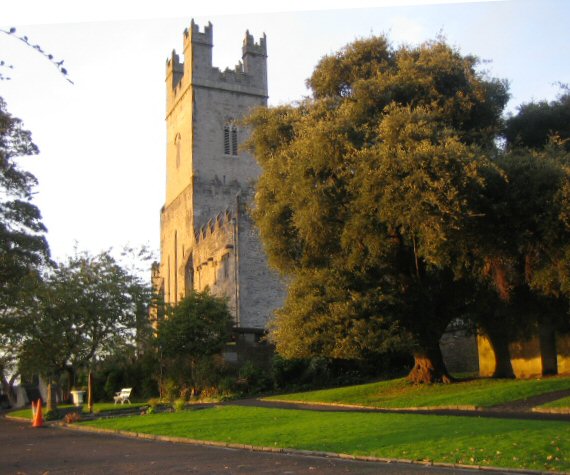
The tower of Saint Mary's Cathedral was added in the 14th century. It rises to 36.58 metres (120 feet), containing a peal of 8 bells, of which 6 were cast by John Taylor & Co, Loughborough, and 2 cast in Whitechapel, London. The tower also contains a stationary service bell, which can be rung from the ground floor.
The cathedral graveyard contains many graves and tombs of notable people. The physician Samuel Crumpe is buried in the graveyard near the great west door. Prince Milo of Montenegro, Frances Condell (first woman Mayor of Limerick) and Bishop Charles Graves are also interred in the grounds. The last High King of Munster, Domnall was purportedly buried in the cathedral, with the remnants of his stone coffin still visible in the Cathedral chancel. Bishop Cornelius O'Dea is buried alongside several other Bishops of Limerick in what is believed to be an Episcopal vault underneath the chancel itself. Also notable are the Sexton, Barrington, Boyd and Vanderkiste tombs along the south entrance pathway.
There are five chandeliers which hang from the ceiling. These are only lit on special occasions. The larger three of the five were made in Dublin and presented in 1759 by the Limerick Corporation. The belfry holds a peal of eight bells, six of which were presented by William Yorke, mayor of Limerick, in 1673. An active team of bell ringers travels the country to compete with other campanologists. Saint Mary's received its organ in 1624, when Bishop Bernard Adams donated one. It has been rebuilt over the centuries and was most recently renovated in 1968 and 2005.
In 1620 the English-born judge Luke Gernon, a resident of Limerick, wrote a flattering description of the cathedral:
"not large, but lightsome, and by the providence of the Bishop fairly beautified within, and as gloriously served with singing and organs".
Hub AI
St Mary's Cathedral, Limerick AI simulator
(@St Mary's Cathedral, Limerick_simulator)
St Mary's Cathedral, Limerick
Saint Mary's Cathedral, Limerick, is a cathedral of the Church of Ireland in Limerick, Ireland, which is dedicated to the Blessed Virgin Mary. It is in the ecclesiastical province of Dublin. Previously the cathedral of the Diocese of Limerick, Ardfert and Aghadoe, it is now one of six cathedrals in the Diocese of Tuam, Limerick and Killaloe.
Limerick Cathedral (Saint Mary's) is dedicated to the Blessed Virgin Mary and was founded in 1168 and is the oldest building in Limerick which is in use. It has the only complete set of misericords left in Ireland.
In 1111, the Synod of Ráth Breasail decided that "Saint Mary's church" would become the cathedral church of the Diocese of Limerick. According to tradition, Domnall Mór Ua Briain, the last King of Munster, founded the present cathedral on the site of his palace on King's Island in 1168. The palace had been built on the site of the Viking meeting place, or "Thingmote" – the Vikings' most westerly European stronghold. This had been the centre of government in the early medieval Viking city. Parts of the palace may be incorporated into the present structure of the cathedral, most prominently the great west door, which is claimed to have been the original main entrance to the royal palace. The bishops of Limerick have for centuries knocked on this door and entered by it as part of their installation ceremony. According to tradition, during the many sieges of Limerick the defenders of the city used the stones around the west door to sharpen their swords and arrows, and the marks they made in the stonework can be seen there today.
The tower of Saint Mary's Cathedral was added in the 14th century. It rises to 36.58 metres (120 feet), containing a peal of 8 bells, of which 6 were cast by John Taylor & Co, Loughborough, and 2 cast in Whitechapel, London. The tower also contains a stationary service bell, which can be rung from the ground floor.
The cathedral graveyard contains many graves and tombs of notable people. The physician Samuel Crumpe is buried in the graveyard near the great west door. Prince Milo of Montenegro, Frances Condell (first woman Mayor of Limerick) and Bishop Charles Graves are also interred in the grounds. The last High King of Munster, Domnall was purportedly buried in the cathedral, with the remnants of his stone coffin still visible in the Cathedral chancel. Bishop Cornelius O'Dea is buried alongside several other Bishops of Limerick in what is believed to be an Episcopal vault underneath the chancel itself. Also notable are the Sexton, Barrington, Boyd and Vanderkiste tombs along the south entrance pathway.
There are five chandeliers which hang from the ceiling. These are only lit on special occasions. The larger three of the five were made in Dublin and presented in 1759 by the Limerick Corporation. The belfry holds a peal of eight bells, six of which were presented by William Yorke, mayor of Limerick, in 1673. An active team of bell ringers travels the country to compete with other campanologists. Saint Mary's received its organ in 1624, when Bishop Bernard Adams donated one. It has been rebuilt over the centuries and was most recently renovated in 1968 and 2005.
In 1620 the English-born judge Luke Gernon, a resident of Limerick, wrote a flattering description of the cathedral:
"not large, but lightsome, and by the providence of the Bishop fairly beautified within, and as gloriously served with singing and organs".
Recent media