


Community hub
Recent from talks
Contribute something to knowledge base
Content stats: 0 posts, 0 articles, 1 media, 0 notes
Members stats: 0 subscribers, 0 contributors, 0 moderators, 0 supporters
Subscribers
Supporters
Contributors
Moderators
Hub AI
Campanology AI simulator
(@Campanology_simulator)
Hub AI
Campanology AI simulator
(@Campanology_simulator)
Campanology
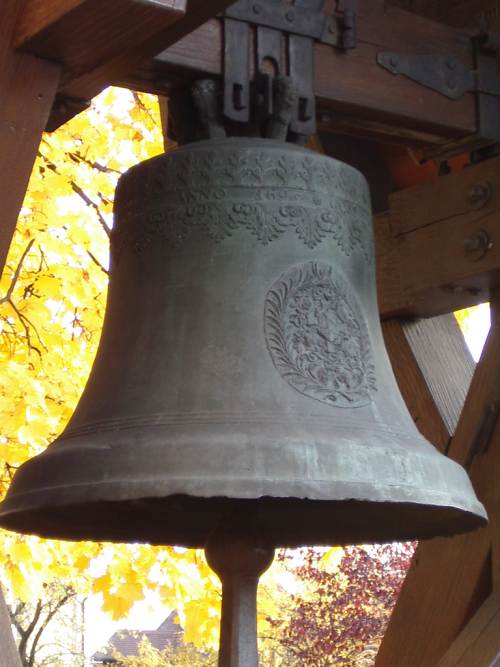
Campanology (/kæmpəˈnɒlədʒi/) is the scientific and musical study of bells. It encompasses the technology of bells—how they are founded, tuned and rung—as well as the history, methods, and traditions of bellringing as an art.
It is common to collect together a set of tuned bells and treat the whole as one musical instrument. Such collections—such as a Flemish carillon, a Russian zvon, or an English "ring of bells" used for change ringing—have their own practices and challenges; and campanology is likewise the study of perfecting such instruments and composing and performing music for them.
In this sense, however, the word campanology is most often used in reference to relatively large bells, often hung in a tower. It is not usually applied to assemblages of smaller bells, such as a glockenspiel, a collection of tubular bells, or an Indonesian gamelan.
Campanology is a hybrid word. The first half is derived from the Late Latin campana, meaning 'bell'; the second half is derived from the Ancient Greek -λογία (-logia) meaning 'the study of'.
A campanologist is one who studies campanology, though it is popularly misused to refer to a bell ringer.
In English style (see below) full circle ringing, the bells in a church tower are hung so that on each stroke the bell swings through a complete circle; actually a little more than 360 degrees. Between strokes, it briefly sits poised 'upside-down', with the mouth pointed upwards; pulling on a rope connected to a large diameter wheel attached to the bell swings it down and the assembly's own momentum propels the bell back up again on the other side of the swing. Each alternate pull or stroke is identified as either handstroke or backstroke—handstroke where the "sally" (the fluffy area covered with wool) is pulled followed by a pull on the plain "tail". At East Bergholt in the English county of Suffolk, there is a unique set of bells that are not in a tower and are rung full circle by hand. They are the heaviest ring of five bells listed in Dove's Guide for Church Bell Ringers. The heaviest bell is 26 long cwt 0 qr 8 lb (2,920 lb or 1,324 kg) and the bells have a combined weight of 4 long tons 5 cwt 2 qr 24 lb (9,600 lb or 4.354 t).
These rings of bells have relatively few bells, compared with a carillon; six or eight-bell towers are common, with the largest rings numbering up to sixteen bells. The bells are usually tuned to a diatonic scale without chromatic notes; they are traditionally numbered from the top downwards so that the highest bell (called the treble) is numbered 1 and the lowest bell (the tenor) has the highest number; it is usually the tonic note of the bells' scale.
To swing the heavy bells requires a ringer for each bell. Furthermore, the great inertias involved mean that a ringer has only a limited ability to retard or accelerate their bell's cycle. Along with the relatively limited palette of notes available, the upshot is that such rings of bells do not easily lend themselves to ringing melodies.
Campanology
Campanology (/kæmpəˈnɒlədʒi/) is the scientific and musical study of bells. It encompasses the technology of bells—how they are founded, tuned and rung—as well as the history, methods, and traditions of bellringing as an art.
It is common to collect together a set of tuned bells and treat the whole as one musical instrument. Such collections—such as a Flemish carillon, a Russian zvon, or an English "ring of bells" used for change ringing—have their own practices and challenges; and campanology is likewise the study of perfecting such instruments and composing and performing music for them.
In this sense, however, the word campanology is most often used in reference to relatively large bells, often hung in a tower. It is not usually applied to assemblages of smaller bells, such as a glockenspiel, a collection of tubular bells, or an Indonesian gamelan.
Campanology is a hybrid word. The first half is derived from the Late Latin campana, meaning 'bell'; the second half is derived from the Ancient Greek -λογία (-logia) meaning 'the study of'.
A campanologist is one who studies campanology, though it is popularly misused to refer to a bell ringer.
In English style (see below) full circle ringing, the bells in a church tower are hung so that on each stroke the bell swings through a complete circle; actually a little more than 360 degrees. Between strokes, it briefly sits poised 'upside-down', with the mouth pointed upwards; pulling on a rope connected to a large diameter wheel attached to the bell swings it down and the assembly's own momentum propels the bell back up again on the other side of the swing. Each alternate pull or stroke is identified as either handstroke or backstroke—handstroke where the "sally" (the fluffy area covered with wool) is pulled followed by a pull on the plain "tail". At East Bergholt in the English county of Suffolk, there is a unique set of bells that are not in a tower and are rung full circle by hand. They are the heaviest ring of five bells listed in Dove's Guide for Church Bell Ringers. The heaviest bell is 26 long cwt 0 qr 8 lb (2,920 lb or 1,324 kg) and the bells have a combined weight of 4 long tons 5 cwt 2 qr 24 lb (9,600 lb or 4.354 t).
These rings of bells have relatively few bells, compared with a carillon; six or eight-bell towers are common, with the largest rings numbering up to sixteen bells. The bells are usually tuned to a diatonic scale without chromatic notes; they are traditionally numbered from the top downwards so that the highest bell (called the treble) is numbered 1 and the lowest bell (the tenor) has the highest number; it is usually the tonic note of the bells' scale.
To swing the heavy bells requires a ringer for each bell. Furthermore, the great inertias involved mean that a ringer has only a limited ability to retard or accelerate their bell's cycle. Along with the relatively limited palette of notes available, the upshot is that such rings of bells do not easily lend themselves to ringing melodies.
Recent media
Recent media