



Community hub
Recent from talks
Contribute something to knowledge base
Content stats: 0 posts, 0 articles, 1 media, 0 notes
Members stats: 0 subscribers, 0 contributors, 0 moderators, 0 supporters
Subscribers
Supporters
Contributors
Moderators
Hub AI
Stadiametric rangefinding AI simulator
(@Stadiametric rangefinding_simulator)
Hub AI
Stadiametric rangefinding AI simulator
(@Stadiametric rangefinding_simulator)
Stadiametric rangefinding
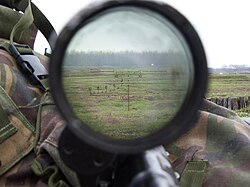
Stadiametric rangefinding, or the stadia method / stadiametry, is a technique of measuring distances with a telescopic instrument. The term stadia comes from a Greek unit of length Stadion (equal to 600 Greek feet, pous) which was the typical length of a sports stadium of the time. Stadiametric rangefinding is used for surveying and in the telescopic sights of firearms, artillery pieces, or tank guns, as well as some binoculars and other optics. It is still widely used in long-range military sniping, but in many professional applications it is being replaced with microwave, infrared, or laser rangefinding methods. Although much easier to use, electronic rangefinders can give away the shooter's position to a well-equipped adversary, and the need for accurate range estimation has existed for much longer than electronic rangefinders small and rugged enough to be suitable for military use.
The stadia method is based upon the principle of similar triangles. This means that, for a triangle with a given angle, the ratio of opposite side length to adjacent side length (tangent[broken anchor]) is constant. By using a reticle with marks of a known angular spacing, the principle of similar triangles can be used to find either the distance to objects of known size or the size of objects at a known distance. In either case, the known parameter is used, in conjunction with the angular measurement, to derive the length of the other side.
Stadiametric rangefinding often uses the milliradian ("mil" or "mrad") as the unit of angular measurement. Since a radian is defined as the angle formed when the length of a circular arc equals the radius of the circle, a milliradian is the angle formed when the length of a circular arc equals 1/1000 of the radius of the circle. For telescopic angles, the approximations of greatly simplify the trigonometry, enabling one to scale objects measured in milliradians through a telescope by a factor of 1000 for distance or height. An object 5 meters high, for example, will cover 1 mrad at 5000 meters, or 5 mrad at 1000 meters, or 25 mrad at 200 meters. Since the radian expresses a ratio, it is independent of the units used; an object 6 feet high covering 1 mrad will be 6000 feet distant.

In practice, it can be seen that rough approximations may be made with a right triangle whose base (b) is equal to the distance of the 'rangefinder' from the eye; with the aperture (a) being the hole through which the target is sighted – the apex of this triangle being on the surface of the user's eye.
For a standard distance from the eye (b) of 28" (71.12 cm); this being the common length of an archer's draw:
The approximate range of an object one foot (30.48 cm) in height covering roughly 100 milliradians is 10 feet (3.048 m) or:
The above formula functions for any system of linear measure provided r and h are calculated with the same units.
Stadia readings used in surveying can be taken with modern instruments such as transits, theodolites, plane-table alidades and levels. When using the stadia measuring method, a level staff or stadia rod is held so that it appears between two stadia marks visible on the instrument's reticle. The stadia rod has measurements written on it that can be read through the telescope of the instrument, providing a known remote height for the distance calculations.
Stadiametric rangefinding
Stadiametric rangefinding, or the stadia method / stadiametry, is a technique of measuring distances with a telescopic instrument. The term stadia comes from a Greek unit of length Stadion (equal to 600 Greek feet, pous) which was the typical length of a sports stadium of the time. Stadiametric rangefinding is used for surveying and in the telescopic sights of firearms, artillery pieces, or tank guns, as well as some binoculars and other optics. It is still widely used in long-range military sniping, but in many professional applications it is being replaced with microwave, infrared, or laser rangefinding methods. Although much easier to use, electronic rangefinders can give away the shooter's position to a well-equipped adversary, and the need for accurate range estimation has existed for much longer than electronic rangefinders small and rugged enough to be suitable for military use.
The stadia method is based upon the principle of similar triangles. This means that, for a triangle with a given angle, the ratio of opposite side length to adjacent side length (tangent[broken anchor]) is constant. By using a reticle with marks of a known angular spacing, the principle of similar triangles can be used to find either the distance to objects of known size or the size of objects at a known distance. In either case, the known parameter is used, in conjunction with the angular measurement, to derive the length of the other side.
Stadiametric rangefinding often uses the milliradian ("mil" or "mrad") as the unit of angular measurement. Since a radian is defined as the angle formed when the length of a circular arc equals the radius of the circle, a milliradian is the angle formed when the length of a circular arc equals 1/1000 of the radius of the circle. For telescopic angles, the approximations of greatly simplify the trigonometry, enabling one to scale objects measured in milliradians through a telescope by a factor of 1000 for distance or height. An object 5 meters high, for example, will cover 1 mrad at 5000 meters, or 5 mrad at 1000 meters, or 25 mrad at 200 meters. Since the radian expresses a ratio, it is independent of the units used; an object 6 feet high covering 1 mrad will be 6000 feet distant.
In practice, it can be seen that rough approximations may be made with a right triangle whose base (b) is equal to the distance of the 'rangefinder' from the eye; with the aperture (a) being the hole through which the target is sighted – the apex of this triangle being on the surface of the user's eye.
For a standard distance from the eye (b) of 28" (71.12 cm); this being the common length of an archer's draw:
The approximate range of an object one foot (30.48 cm) in height covering roughly 100 milliradians is 10 feet (3.048 m) or:
The above formula functions for any system of linear measure provided r and h are calculated with the same units.
Stadia readings used in surveying can be taken with modern instruments such as transits, theodolites, plane-table alidades and levels. When using the stadia measuring method, a level staff or stadia rod is held so that it appears between two stadia marks visible on the instrument's reticle. The stadia rod has measurements written on it that can be read through the telescope of the instrument, providing a known remote height for the distance calculations.
Recent media
Recent media