Hubbry Logo
logo
Stadiametric rangefinding
Community hub

Stadiametric rangefinding

logo
0 subscribers
Read side by side
from Wikipedia
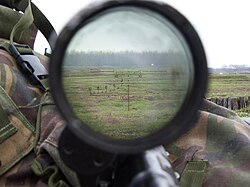
Soldier observed at 400 m: The stadiametric rangefinder in the bottom-left corner of the PSO-1 telescopic sight reticle can be used to determine the distance from a 1.70-meter (5 ft 7 in) tall person or object from 200 m (bracket number 2 to the right) to 1,000 m (bracket number 10 to the left).

Stadiametric rangefinding, or the stadia method / stadiametry, is a technique of measuring distances with a telescopic instrument. The term stadia comes from a Greek unit of length Stadion (equal to 600 Greek feet, pous) which was the typical length of a sports stadium of the time. Stadiametric rangefinding is used for surveying and in the telescopic sights of firearms, artillery pieces, or tank guns, as well as some binoculars and other optics. It is still widely used in long-range military sniping, but in many professional applications it is being replaced with microwave, infrared, or laser rangefinding methods. Although much easier to use, electronic rangefinders can give away the shooter's position to a well-equipped adversary, and the need for accurate range estimation has existed for much longer than electronic rangefinders small and rugged enough to be suitable for military use.

Principle

[edit]
Table for range estimation showing target sizes, distances and corresponding angular measurements. Angular sizes are given in milliradians (mil), ranges in meters, and target sizes are shown in both in centimeters, millimeters and inches.
• If the helmeted head of a man (≈ 0.25 m tall) fits between the fourth bar and the horizontal line, the man is at approximately 100 meters distance.
• When the upper part of the body of a man (≈ 1 m tall) fits under the first line, he stands at approximately 400 meters distance.
Targeting reticle of the M67 recoilless rifle, correctly ranging a tank at 275 m range. Antitank weapons of the 1940–70s used stadiametric range estimation based on the average sizes of armoured fighting vehicles

The stadia method is based upon the principle of similar triangles. This means that, for a triangle with a given angle, the ratio of opposite side length to adjacent side length (tangent[broken anchor]) is constant. By using a reticle with marks of a known angular spacing, the principle of similar triangles can be used to find either the distance to objects of known size or the size of objects at a known distance. In either case, the known parameter is used, in conjunction with the angular measurement, to derive the length of the other side.

Stadiametric rangefinding often uses the milliradian ("mil" or "mrad") as the unit of angular measurement. Since a radian is defined as the angle formed when the length of a circular arc equals the radius of the circle, a milliradian is the angle formed when the length of a circular arc equals 1/1000 of the radius of the circle. For telescopic angles, the approximations of greatly simplify the trigonometry, enabling one to scale objects measured in milliradians through a telescope by a factor of 1000 for distance or height. An object 5 meters high, for example, will cover 1 mrad at 5000 meters, or 5 mrad at 1000 meters, or 25 mrad at 200 meters. Since the radian expresses a ratio, it is independent of the units used; an object 6 feet high covering 1 mrad will be 6000 feet distant.

In practice, it can be seen that rough approximations may be made with a right triangle whose base (b) is equal to the distance of the 'rangefinder' from the eye; with the aperture (a) being the hole through which the target is sighted – the apex of this triangle being on the surface of the user's eye.

For a standard distance from the eye (b) of 28" (71.12 cm); this being the common length of an archer's draw:

28" × 1 milliradian ≈ 0.028" (0.071 cm) -- stadia factor 1000
10 milliradians ≈ 0.280" (0.711 cm) -- stadia factor x 100
100 milliradians ≈ 2.80" (7.112 cm) -- stadia factor x10

The approximate range of an object one foot (30.48 cm) in height covering roughly 100 milliradians is 10 feet (3.048 m) or:

Range (r) = approximate height of object (h) × (1000 ÷ aperture in milliradians (a))
r = h(1000/a) → where r and h are identical units, and a is in milliradians.
r = h/a → where r and h are identical units, and a is in radians

The above formula functions for any system of linear measure provided r and h are calculated with the same units.

Surveying

[edit]

Stadia readings used in surveying can be taken with modern instruments such as transits, theodolites, plane-table alidades and levels. When using the stadia measuring method, a level staff or stadia rod is held so that it appears between two stadia marks visible on the instrument's reticle. The stadia rod has measurements written on it that can be read through the telescope of the instrument, providing a known remote height for the distance calculations.

An instrument equipped for stadia work has two horizontal stadia marks spaced equidistant from the center crosshair of the reticle. The interval between stadia marks in most surveying instruments is 10 mrad and gives a stadia interval factor of 100. The distance between the instrument and a stadia rod can be determined simply by multiplying the measurement between the stadia hairs (known as the stadia interval) by 100.

The instrument must be level for this method to work directly. If the instrument line of sight is inclined relative to the staff, the horizontal and vertical distance components must be determined. Some instruments have additional graduations on a vertical circle to assist with these inclined measurements. These graduated circles, known as stadia circles, provide the value of the horizontal and the vertical measurements as a percentage of the inclined stadia measurement.

This system is sufficiently precise for locating topographic details such as rivers, bridges, buildings, and roads when an accuracy of 1/500 (0.2%, 2000ppm) is acceptable. Stadia readings are also used to provide repeated, independent observations for improved accuracy and to provide error checking against blunders in levelling.

The stadia method of distance measurement is primarily historical for surveying purposes, as distance nowadays is mostly measured by electronic or taping methods. Total station instruments do not have stadia lines marked on the reticle. Traditional methods are still used in areas where modern instruments are not common or by aficionados to antique surveying methods.

See also

[edit]

References

[edit]
[edit]
Revisions and contributorsEdit on WikipediaRead on Wikipedia
from Grokipedia
Stadiametric rangefinding, also known as the stadia method, is a technique for estimating distances to a target using a telescopic instrument, where the observer measures the angular size subtended by a known dimension of the target—such as its height, width, or length—against a calibrated reticle or scale in the eyepiece.[1] This method relies on the principle of similar triangles and the small-angle approximation, where the range $ R $ is calculated as $ R \approx \frac{h}{\theta} $, with $ h $ as the known target size and $ \theta $ as the measured angular subtense in radians (the reticle scale is calibrated using the optics' focal length for practical use).[1] The term "stadia" derives from the ancient Greek unit of length, the stadion, reflecting its historical roots in surveying and measurement.[2] The origins of stadiametric rangefinding trace back to the mid-19th century in naval gunnery, with early developments including depression rangefinders proposed by Sir Howard Douglas in 1855 and devices like the Liuzhol rangefinder of 1882 and the Handgërat of 1893.[3] A notable advancement was U.S. Navy Lieutenant Bradley A. Fiske's 1890 invention of the stadimeter, a portable instrument used effectively in the 1898 Battle of Manila Bay.[2] Post-World War II refinements, such as the U.S. Army's T45 stadia rangefinder initiated in 1951, provided monocular optics and logarithmic scales for infantry use, achieving accuracies within 2% at 1,000 yards for targets 4–30 feet wide.[4] In operation, the observer sights the target through the instrument and aligns its known dimension with stadia lines or a graduated reticle, reading the range directly from calibrated markings.[1] For example, in military applications, tank gunners might use a tank's standard width (e.g., 3.63 meters for an M60) to bracket the target between reticle lines, deriving range from the corresponding scale.[1] This passive optical approach requires no external illumination or emission, making it suitable for stealthy operations, though accuracy is limited by factors such as target orientation, reticle line thickness, and observer skill, often resulting in errors of 10–20% at typical engagement ranges.[1] Stadiametric rangefinding has been widely applied in military contexts, including naval artillery, antitank weapons like the M72 LAW, and tank fire-control systems such as earlier Soviet T-64 models.[2][1] It remains relevant as of 2025 in telescopic sights for firearms and surveying tools, offering a low-cost, reliable alternative to active ranging methods in environments where electronics may fail or be impractical.[1] Despite displacement by advanced technologies like pulsed laser systems, its simplicity and effectiveness continue to inform training and backup procedures in optical sighting.[5]

Fundamentals

Definition and Principle

Stadiametric rangefinding is a technique for estimating the distance to a target by measuring the angular subtended size of an object with known physical dimensions, as viewed through an optical instrument such as a telescope, theodolite, or sighting reticle, without requiring physical contact or electronic assistance.[1][6] The basic principle relies on the geometry of similar triangles formed between the instrument's focal plane, the reticle markings, and the distant target. For a target of known real size S at distance D, the angular size θ (in radians) subtended at the instrument approximates θ = S / D under the small-angle assumption where tan θθ. This trigonometric relationship allows range computation as DS / θ, with θ determined by aligning the target's edges with calibrated reticle lines spaced at fixed angular intervals. In practice, this is adapted for field use through stadia constants, such as a horizontal multiplier of 100, simplifying calculations for surveying and targeting.[1][7][6] Key equations in stadiametric applications, particularly the stadia method, express distances in terms of observed intervals. The horizontal distance H is given by
H=100×s H = 100 \times s
where s is the stadia interval (difference between upper and lower reticle readings on a leveled target). The vertical distance V is
V=100×i V = 100 \times i
where i is the inclination reading, accounting for the vertical angle of sight. These formulas assume a standard stadia constant derived from the instrument's focal length and reticle spacing, enabling rapid optical measurement.[6][7] The method operates under assumptions of parallax-free observation (achieved via aligned optics), precise knowledge of the target's dimensions, and minimal atmospheric or curvature effects for ranges under several kilometers. A direct line of sight is essential to resolve the angular measurement accurately.[1][6] Accuracy diminishes as the subtended angular size deviates from optimal resolvability, with best performance typically at 1–10 milliradians where the target spans multiple reticle divisions for precise estimation; very small angles risk resolution errors, while larger ones exceed practical subtended limits. Clear visibility is mandatory, as obstructions or poor contrast degrade interval readings.[1][6]

Historical Development

The origins of stadiametric rangefinding lie in ancient tools for angular measurements that enabled distance estimation through known target sizes and observed angles. In ancient Greece around the 3rd century BCE, the dioptra emerged as a sophisticated surveying instrument capable of measuring horizontal, vertical, and angular distances for engineering and astronomical purposes, laying foundational principles for later rangefinding techniques.[8] Medieval advancements built on these foundations, particularly in the Islamic world where astrolabes incorporated angular scales to compute heights and distances, evolving from Greek designs into versatile tools for navigation and surveying by the 8th century CE.[9] By the 16th century, English mathematician Leonard Digges advanced the field with his 1571 invention of the theodolite, an instrument for precise angular measurements that served as a direct precursor to telescopic systems used in stadiametric applications. The stadia method for tacheometric surveying was developed in the early 19th century, with Georg Reichenbach incorporating distance-measuring cross-wires into telescopes around 1812.[10][11] In the 19th century, the stadia method gained prominence in European surveying through integration with improved theodolites and dedicated stadia rods, facilitating rapid tacheometric measurements over varied terrain without chaining.[6] Military adoption accelerated during World War I, where stadiametric techniques were widely employed in artillery spotting and naval gunnery for estimating ranges based on target dimensions, including in German optical systems produced by firms like Zeiss.[2] The U.S. Army incorporated stadiametric rangefinding into field artillery training and equipment by 1917, enhancing indirect fire accuracy amid wartime demands.[1] By World War II, refinements extended to tank periscopes and rifle scopes, where etched reticles allowed gunners to compute ranges from known target heights or widths under combat conditions.[12] Postwar developments saw a decline in stadiametric reliance starting in the 1970s with the advent of laser rangefinders, which offered greater precision and speed for professional surveying and military uses, though the method endured in resource-limited settings.[13] Into the 2000s, digital reticles in optical devices revived stadiametric principles, combining traditional angular estimation with electronic aids for enhanced accuracy in hybrid systems.[14]

Measurement Techniques

Stadia Tacheometry

Stadia tacheometry employs a theodolite or total station fitted with a stadia reticle, consisting of an upper and lower horizontal stadia line spaced equally above and below the central horizontal crosshair, typically with a multiplying constant k=100k = 100.[6][7] The instrument is precisely leveled and centered over a survey point, allowing the optical system to measure the angular subtense of a known linear interval on a distant target.[6] In the measurement procedure, a stadia rod is held vertically and plumb at the target location by an assistant.[15] The surveyor sights the rod through the telescope, records the upper and lower intercept readings where the stadia lines align with the rod's graduations to determine the interval ss, and measures the vertical angle α\alpha if needed.[7] For horizontal lines of sight, the horizontal distance is calculated as H=k×s+cH = k \times s + c; for inclined lines of sight, H=(k×s+c)cosαH = (k \times s + c) \cos \alpha and the vertical distance as V=(k×s+c)sinαV = (k \times s + c) \sin \alpha, where cc is the additive constant (often 0 m with anallactic lenses).[6][15] These steps are repeated for multiple points to establish control networks, with constants kk and the additive constant cc (often near 1 m) calibrated in the field by measuring a baseline of known length.[7] The stadia rod is a specialized graduated leveling staff, usually 3 to 5 meters long with bold, high-contrast markings at 1-meter intervals for visibility up to several hundred meters.[6][15] For inclined sightings on slopes, the rod is often inverted to position the zero mark higher, ensuring the intercepted interval falls within the visible graduations and maintaining vertical alignment.[15] Some designs incorporate targets or levels at the rod's base to aid precise plumbing.[15] Common error sources include instrumental inaccuracies in the stadia interval factor kk or additive constant cc, staff graduation defects, non-vertical rod tilt, parallax from improper focusing, and atmospheric refraction, which can cause random variations in readings.[16][6] Corrections involve field calibration of constants, using anallactic lenses to nullify cc, employing a rod level for verticality, eliminating parallax through careful eyepiece adjustment, and scheduling observations during stable atmospheric conditions to minimize refraction.[7][16] Typical accuracy achieves a relative precision of 1:500 to 1:10,000, around 1:1,000 for distances up to 100 meters under controlled conditions.[6][17] Variants adapt the method to terrain: horizontal stadia maintains a level line of sight for flat areas, using H=k×s+cH = k \times s + c without angle correction.[6] Vertical stadia focuses on elevation differences using inclined sights on slopes, while inclined stadia generally incorporates the vertical angle for both horizontal and vertical components in undulating terrain.[6]

Reticle-Based Methods

Reticle-based methods employ etched patterns, known as reticles, within the optical field of view of telescopes, scopes, or binoculars to measure the angular size of a target, enabling distance estimation through stadiametric principles. These reticles consist of calibrated marks, such as lines, dots, or scales, that subtend known angular units when viewed through the instrument. By comparing the target's known physical size to its apparent angular extent against the reticle, the observer calculates range without external aids like rods. This approach relies on the trigonometric relationship where the angular measurement θ approximates the target's linear size S divided by the range R, allowing rearrangement to solve for R.[18] Common reticle types for stadiametric rangefinding include milliradian (mil) dots, which use a metric system where the range in meters equals the target height in meters multiplied by 1000 divided by the mils subtended. Minute of Angle (MOA) reticles apply an imperial system, yielding range in yards as the target height in inches multiplied by 100 divided by the MOA subtended (using the approximation of 1 MOA as 1 inch at 100 yards). For close-range applications, Inch of Angle (IOA) reticles simplify calculations by assuming 1 IOA subtends 1 inch at 100 yards, though they are less common due to historical preferences for mil and MOA systems.[19][18] The calculation process involves aligning the target with the reticle to measure its angular size θ in the chosen units, then applying the general formula R = (S × C) / θ, where S is the known target size and C is a system-specific constant—such as 1000 for mils in meters or approximately 95.5 for exact MOA in yards-to-inches conversions. Observers typically select a recognizable feature, like a person's height (1.7 meters) or vehicle width, to ensure accuracy within 5-10% under field conditions. This method supports quick mental arithmetic or precomputed tables for efficiency.[19][18] In instrument integration, fixed reticles are prevalent in rifle scopes, with the mil-dot system standardized in the U.S. military during the late 1980s for the M24 sniper rifle to facilitate precise ranging in tactical scenarios. Adjustable reticles appear in binoculars, often with illuminated or focusable scales for applications like birding or navigation, where users align horizon lines or graticules to estimate distances to landmarks or wildlife. Calibration occurs through focal plane adjustments, ensuring reticle subtensions remain consistent across magnifications in first focal plane designs.[20][21] Compared to rod-based methods, reticle systems offer key advantages: they require no second observer or external target, enabling solitary use in dynamic environments; their compact integration suits handheld devices like binoculars; and focal plane calibration allows versatility without mechanical repositioning.[22][23] Historically, reticle-based rangefinding evolved from simple crosshairs in 19th-century telescopes, which provided basic angular references, to more advanced duplex reticles introduced by Leupold in 1962 for improved target acquisition in low-light conditions, as seen in postwar sniper scopes.[24][25]

Applications

Surveying Practices

In topographic surveys, stadiametric rangefinding, particularly through the stadia method, forms a core workflow for establishing control points and mapping terrain features. Surveyors begin by setting up benchmarks using a stadia-equipped theodolite or transit at a known position, then traverse the site by sighting a graduated stadia rod held vertically at target points. The rod interval intercepted by the instrument's stadia crosshairs—typically two horizontal lines spaced above and below the central crosshair—is measured to compute the slope distance as the product of the interval and the instrument's stadia constant (often 100). Vertical angles, read from the theodolite's circle, enable trigonometric reduction to horizontal distances and elevations, allowing contours to be plotted by connecting points of equal elevation. This process integrates with leveling techniques, where stadia readings supplement differential leveling to generate elevation profiles along traverse lines, ensuring comprehensive topographic data for site analysis.[6] Historically, stadiametric methods supported large-scale land measurement under the U.S. Public Land Survey System (PLSS), established by the 1785 Land Ordinance proposed by Thomas Jefferson, a surveyor who used a Ramsden theodolite in his personal boundary work. While primary measurements relied on chains for distances and compasses for bearings, theodolites with stadia capabilities were employed for angular control and topographic reconnaissance. In the PLSS's implementation, teams traversed meridians and base lines, using stadia readings to sketch terrain features and locate natural boundaries, facilitating the survey of over 1.5 billion acres by the early 20th century. In modern construction, such as road and dam projects, stadia workflows aid site layout by rapidly mapping alignments and elevations; for instance, preliminary traverses establish cut-and-fill profiles for highway grading or reservoir boundaries in dam construction, where rod readings guide earthwork volume estimates.[26][27][28] Stadiametric rangefinding offers key advantages in field work, especially in remote or undeveloped areas lacking GPS infrastructure, as it requires only optical instruments and a stadia rod, making it cost-effective for initial reconnaissance without reliance on power sources or satellites. The method enables rapid setups, with horizontal distances measured up to 300-400 feet per observation, ideal for preliminary traverses in rugged terrain like forested regions or mountainous sites.[6][28] Integration with electronic distance measurement (EDM) enhances accuracy in hybrid systems, where stadia provides quick optical backups during EDM signal interruptions, such as in dense vegetation. By the 1990s, the transition to total stations—combining theodolites with integrated EDM—largely supplanted pure stadia use, as these instruments automate distance and angle computations while retaining stadia crosshairs for verification, improving efficiency in chained measurements for civil projects.[6][29] Despite these benefits, challenges persist, including weather dependency, where atmospheric refraction from heat or humidity distorts readings, necessitating operations on overcast days or in cooler conditions to minimize errors. Skilled operators are essential to avoid personal errors in rod alignment or angle reading, and chained measurements can propagate inaccuracies, with horizontal precision limited to about one foot and vertical to 0.01 feet at short ranges, degrading over multiple setups in extended traverses.[6][30]

Military and Ballistics

Stadiametric rangefinding played a critical role in World War II artillery applications, particularly through integration into tank and gun sights where operators compared target dimensions against etched scales to estimate distances. In British systems, stereoscopic rangefinders adapted for anti-tank ranging enabled accurate measurements up to approximately 5 km by leveraging angular subtension for vehicle targets, supporting fire control in dynamic combat environments. Post-war, stadiametric techniques persisted in towed artillery, with mil reticles in panoramic telescopes allowing gunners to compute ranges for indirect fire by measuring target height in milliradians against known averages, such as 2.5 meters for personnel.[31][32][1] In firearms, stadiametric rangefinding was integrated into sniper scopes via mil-dot reticles, facilitating holdover adjustments for ballistic trajectories. The U.S. M24 sniper rifle, equipped with a Leupold M3A scope featuring a mil-dot reticle, allowed shooters to estimate ranges to targets up to 800 meters by dividing known target heights (e.g., 1.7 meters for a standing figure) by the subtended mils, then applying range-height tables for elevation compensation under varying environmental conditions. This approach ensured precise shots in reconnaissance and counter-sniper roles, where rapid manual calculation outweighed electronic alternatives.[33][18] For tanks and armored vehicles, stadiametric methods were embedded in periscope and gunsight optics, using silhouette scales calibrated to standard enemy profiles. In the Soviet T-34 tank during the 1940s, the TMFD-7 sight incorporated a stadiametric rangefinder scale where gunners aligned vehicle silhouettes—such as a 2.4-meter-high T-34 hull—against graduated marks to determine ranges from 400 to 2,000 meters, enabling effective engagement without mechanical rangefinders. Stadiametric modes serve as passive backups in some modern fire control and protection systems, allowing manual ranging in electronic denial scenarios.[34][35] Tactically, stadiametric rangefinding offered key advantages as a passive, jam-resistant method immune to electronic countermeasures, preserving operator stealth compared to active laser systems that could reveal positions. Military training emphasized recognition ranging, where soldiers practiced estimating distances by mentally scaling familiar objects against mil reticles, achieving proficiency for quick assessments in low-visibility or high-stress engagements.[36][37][38] By the 1990s, stadiametric rangefinding largely declined in frontline military use, supplanted by laser and electro-optical systems providing sub-meter accuracy and automation in fire control. However, its legacy endures in low-intensity conflicts, such as the Afghan wars, where legacy optics on small arms and vehicles retained mil reticles for reliable, low-tech ranging amid electronic vulnerabilities and supply constraints.[13][39][40]

Contemporary Uses

In archery and hunting, stadiametric rangefinding is incorporated into specialized bow sights like the EZ V Sight, which employs a V-shaped reticle calibrated to the vital zone dimensions of common game animals, such as a deer's vital zone width of approximately 13.5 inches. This allows archers to estimate distances from 20 to 50 yards by aligning the reticle with the target's vitals, eliminating the need for electronic rangefinders and enabling quick adjustments during hunts.[41] The system relies on known angular subtenses to compute range, providing consistent shot placement in dynamic field conditions, as demonstrated in 3D archery courses where users achieve vital-zone hits across 10- to 50-yard targets without dialing adjustments.[42] In aviation and drone operations, stadiametric rangefinding supports visual navigation through handheld binoculars equipped with stadia reticles, which pilots use to estimate distances to landmarks or terrain features during low-altitude flight or visual flight rules scenarios.[43] For unmanned aerial vehicles, computer vision algorithms integrate stadiametric principles by processing bounding boxes around detected objects in camera feeds to calculate landing distances, achieving precise ranging for autonomous operations without laser hardware. Photography and videography leverage stadiametric rangefinding via reticles in telephoto lenses and scopes for subject distancing, particularly in wildlife and sports filming where estimating animal or athlete proximity aids composition and focus. Devices like the Sightmark Wraith 4K night vision scope feature built-in stadiametric tools that measure target heights against mil-dot scales, facilitating distance calculations up to several hundred yards for low-light video capture.[44] In digital editing, mobile applications such as Theodolite overlay rangefinder reticles on camera views during photo or video modes, allowing post-capture distance annotations based on captured angular measurements for enhanced spatial analysis in wildlife documentaries.[45] In gaming and simulation environments, stadiametric rangefinding is simulated through virtual reticles in military training software like Steel Beasts, where users apply mil-based estimation to gauge distances to virtual targets, mirroring real-world optics for crew procedure drills.[46] This approach fosters conceptual understanding of angular subtenses in STEM education tools, enabling learners to practice ranging without physical equipment while emphasizing accuracy in tactical scenarios.[47] Emerging technologies hybridize stadiametric rangefinding with AI in smart scopes for augmented reality overlays, as seen in Pulsar Thermion series thermal devices that use built-in stadiametric calculators to display real-time distance data alongside AI-enhanced target identification.[48] In developing regions, the method persists in affordable surveying due to its reliance on low-cost theodolites and basic optics, providing decimeter-level accuracy for land mapping where advanced GPS tools are inaccessible, as noted in evaluations of traditional instruments for public GIS applications.[49] Apps like Theodolite further extend this by integrating AR rangefinders on smartphones, offering cost-effective alternatives for terrain assessment in resource-limited areas.[50]

References

User Avatar
No comments yet.