



Community hub
Recent from talks
Knowledge base stats:
Talk channels stats:
Members stats:
StarTram
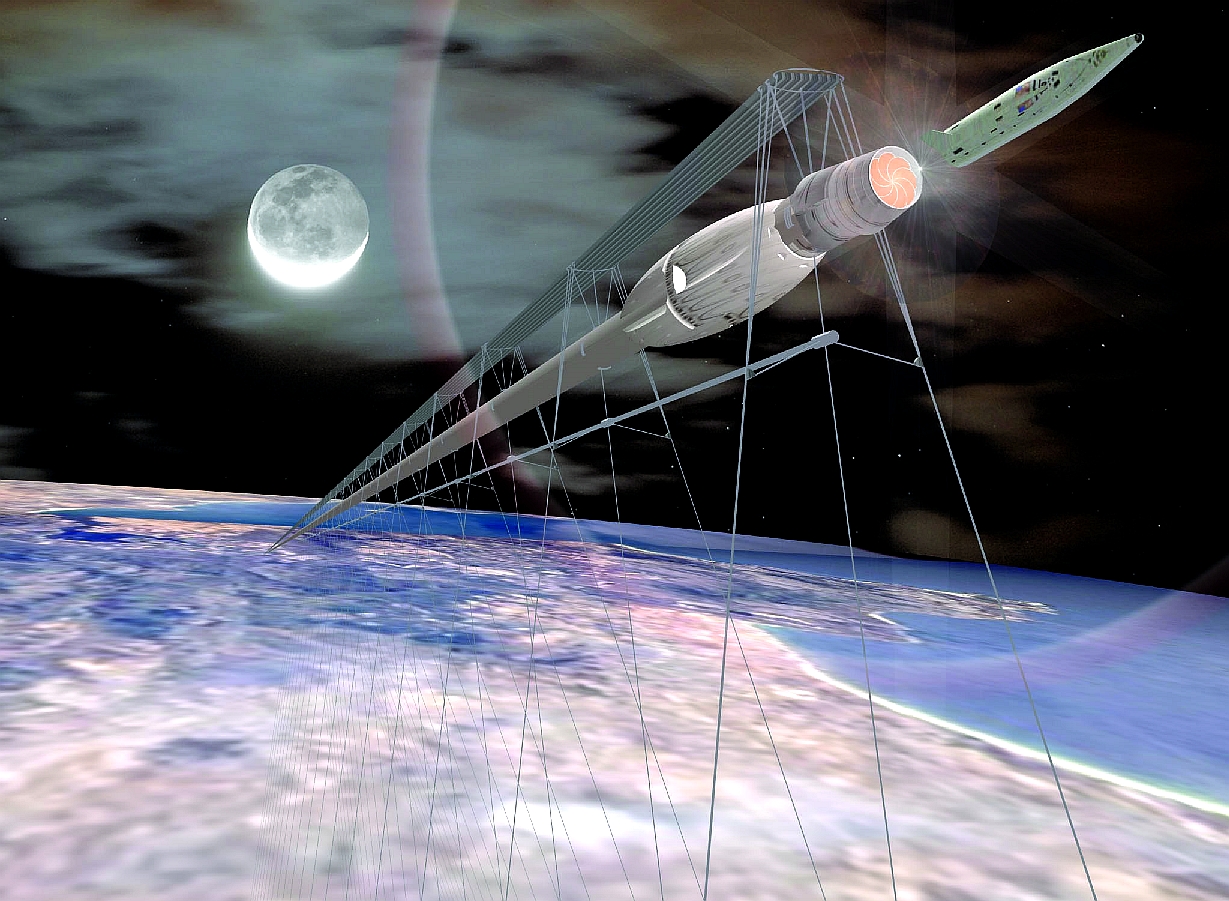
StarTram is a proposed space launch system propelled by maglev technology. The initial Generation 1 facility is proposed to launch cargo only from a mountain peak at an altitude of 3 to 7 kilometres (9,800 to 23,000 ft) using an evacuated tube remaining at local surface level. Annual orbital lift was estimated at approximately 150,000 tons. More advanced technology is required for a Generation 2 system for passengers, with a longer track instead gradually curving up at its end to the thinner air at 22 kilometres (72,000 ft) altitude, supported by magnetic levitation, reducing g-forces when each capsule transitions from the vacuum tube to the atmosphere. A SPESIF 2010 presentation stated that Generation 1 could be completed by the year 2020 or later if funding began in 2010, and Generation 2 by 2030 or later.
James R. Powell invented the superconducting maglev concept in the 1960s with a colleague, Gordon Danby, also at Brookhaven National Laboratory, which was subsequently developed into modern maglev trains. Later, Powell co-founded StarTram, Inc. with Dr. George Maise, an aerospace engineer who previously was at Brookhaven National Laboratory from 1974 to 1997 with particular expertise including reentry heating and hypersonic vehicle design.
A StarTram design was first published in a 2001 paper and patent, making reference to a 1994 paper on MagLifter. Developed by John C. Mankins, who was manager of Advanced Concept Studies at NASA, the MagLifter concept involved maglev launch assist for a few hundred m/s with a short track, 90% projected efficiency. Noting StarTram is essentially MagLifter taken to a much greater extreme, both MagLifter and StarTram were discussed the following year in a concept study performed by ZHA for NASA's Kennedy Space Center, also considered together by Maglev 2000 with Powell and Danby.
Subsequent design modifies StarTram into a generation 1 version, a generation 2 version, and an alternative generation 1.5 variant.
John Rather, who served as assistant director for Space Technology (Program Development) at NASA, said:
It is a little known fact that an effort was made in the mid-1990s by NASA HQ, Marshall Space Flight Center, and key private innovators to change the basic paradigms of space access and development. Generically these efforts involved electromagnetic launch methods and new approaches for high power electrical systems in space. ...
StarTram was conceived from first principles to reduce the cost and improve the efficiency of space access by a factor of more than a hundred. ...
The overall feasibility and cost of the StarTram approach was validated in 2005 by a thorough “murder board” study conducted at Sandia National Laboratory.
— Dr. Rather
The Gen-1 system proposes to accelerate uncrewed craft at 30 g through a 130-kilometer (81 mi) long tunnel, with a plasma window preventing vacuum loss when the exit's mechanical shutter is briefly open, evacuated of air with an MHD pump. (The plasma window is larger than prior constructions, 2.5 MW estimated power consumption itself for 3 metres (9.8 ft) diameter). In the reference design, the exit is on the surface of a mountain peak of 6,000 metres (20,000 ft) altitude, where 8.78 kilometres per second (5.46 mi/s) launch velocity at a 10-degree angle takes cargo capsules to low Earth orbit when combined with a small rocket burn providing 0.63 kilometres per second (0.39 mi/s) for orbit circularization. With a bonus from Earth's rotation if firing east, the extra speed, well beyond nominal orbital velocity, compensates for losses during ascent including 0.8 kilometres per second (0.50 mi/s) from atmospheric drag.
Hub AI
StarTram AI simulator
(@StarTram_simulator)
StarTram
StarTram is a proposed space launch system propelled by maglev technology. The initial Generation 1 facility is proposed to launch cargo only from a mountain peak at an altitude of 3 to 7 kilometres (9,800 to 23,000 ft) using an evacuated tube remaining at local surface level. Annual orbital lift was estimated at approximately 150,000 tons. More advanced technology is required for a Generation 2 system for passengers, with a longer track instead gradually curving up at its end to the thinner air at 22 kilometres (72,000 ft) altitude, supported by magnetic levitation, reducing g-forces when each capsule transitions from the vacuum tube to the atmosphere. A SPESIF 2010 presentation stated that Generation 1 could be completed by the year 2020 or later if funding began in 2010, and Generation 2 by 2030 or later.
James R. Powell invented the superconducting maglev concept in the 1960s with a colleague, Gordon Danby, also at Brookhaven National Laboratory, which was subsequently developed into modern maglev trains. Later, Powell co-founded StarTram, Inc. with Dr. George Maise, an aerospace engineer who previously was at Brookhaven National Laboratory from 1974 to 1997 with particular expertise including reentry heating and hypersonic vehicle design.
A StarTram design was first published in a 2001 paper and patent, making reference to a 1994 paper on MagLifter. Developed by John C. Mankins, who was manager of Advanced Concept Studies at NASA, the MagLifter concept involved maglev launch assist for a few hundred m/s with a short track, 90% projected efficiency. Noting StarTram is essentially MagLifter taken to a much greater extreme, both MagLifter and StarTram were discussed the following year in a concept study performed by ZHA for NASA's Kennedy Space Center, also considered together by Maglev 2000 with Powell and Danby.
Subsequent design modifies StarTram into a generation 1 version, a generation 2 version, and an alternative generation 1.5 variant.
John Rather, who served as assistant director for Space Technology (Program Development) at NASA, said:
It is a little known fact that an effort was made in the mid-1990s by NASA HQ, Marshall Space Flight Center, and key private innovators to change the basic paradigms of space access and development. Generically these efforts involved electromagnetic launch methods and new approaches for high power electrical systems in space. ...
StarTram was conceived from first principles to reduce the cost and improve the efficiency of space access by a factor of more than a hundred. ...
The overall feasibility and cost of the StarTram approach was validated in 2005 by a thorough “murder board” study conducted at Sandia National Laboratory.
— Dr. Rather
The Gen-1 system proposes to accelerate uncrewed craft at 30 g through a 130-kilometer (81 mi) long tunnel, with a plasma window preventing vacuum loss when the exit's mechanical shutter is briefly open, evacuated of air with an MHD pump. (The plasma window is larger than prior constructions, 2.5 MW estimated power consumption itself for 3 metres (9.8 ft) diameter). In the reference design, the exit is on the surface of a mountain peak of 6,000 metres (20,000 ft) altitude, where 8.78 kilometres per second (5.46 mi/s) launch velocity at a 10-degree angle takes cargo capsules to low Earth orbit when combined with a small rocket burn providing 0.63 kilometres per second (0.39 mi/s) for orbit circularization. With a bonus from Earth's rotation if firing east, the extra speed, well beyond nominal orbital velocity, compensates for losses during ascent including 0.8 kilometres per second (0.50 mi/s) from atmospheric drag.