
Recent from talks
Statistical hypothesis test
Knowledge base stats:
Talk channels stats:
Members stats:
Statistical hypothesis test
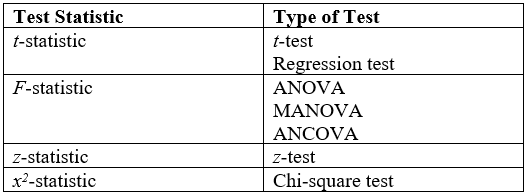
A statistical hypothesis test is a method of statistical inference used to decide whether the data provide sufficient evidence to reject a particular hypothesis. A statistical hypothesis test typically involves a calculation of a test statistic. Then a decision is made, either by comparing the test statistic to a critical value or equivalently by evaluating a p-value computed from the test statistic. Roughly 100 specialized statistical tests are in use and noteworthy.
While hypothesis testing was popularized early in the 20th century, early forms were used in the 1700s. The first use is credited to John Arbuthnot (1710), followed by Pierre-Simon Laplace (1770s), in analyzing the human sex ratio at birth; see § Human sex ratio.
Paul Meehl has argued that the epistemological importance of the choice of null hypothesis has gone largely unacknowledged. When the null hypothesis is predicted by theory, a more precise experiment will be a more severe test of the underlying theory. When the null hypothesis defaults to "no difference" or "no effect", a more precise experiment is a less severe test of the theory that motivated performing the experiment. An examination of the origins of the latter practice may therefore be useful:
1778: Pierre Laplace compares the birthrates of boys and girls in multiple European cities. He states: "it is natural to conclude that these possibilities are very nearly in the same ratio". Thus, the null hypothesis in this case that the birthrates of boys and girls should be equal given "conventional wisdom".
1900: Karl Pearson develops the chi squared test to determine "whether a given form of frequency curve will effectively describe the samples drawn from a given population." Thus the null hypothesis is that a population is described by some distribution predicted by theory. He uses as an example the numbers of five and sixes in the Weldon dice throw data.
1904: Karl Pearson develops the concept of "contingency" in order to determine whether outcomes are independent of a given categorical factor. Here the null hypothesis is by default that two things are unrelated (e.g. scar formation and death rates from smallpox). The null hypothesis in this case is no longer predicted by theory or conventional wisdom, but is instead the principle of indifference that led Fisher and others to dismiss the use of "inverse probabilities".
Modern significance testing is largely the product of Karl Pearson (p-value, Pearson's chi-squared test), William Sealy Gosset (Student's t-distribution), and Ronald Fisher ("null hypothesis", analysis of variance, "significance test"), while hypothesis testing was developed by Jerzy Neyman and Egon Pearson (son of Karl). Ronald Fisher began his life in statistics as a Bayesian (Zabell 1992), but Fisher soon grew disenchanted with the subjectivity involved (namely use of the principle of indifference when determining prior probabilities), and sought to provide a more "objective" approach to inductive inference.
Fisher emphasized rigorous experimental design and methods to extract a result from few samples assuming Gaussian distributions. Neyman (who teamed with the younger Pearson) emphasized mathematical rigor and methods to obtain more results from many samples and a wider range of distributions. Modern hypothesis testing is an inconsistent hybrid of the Fisher vs Neyman/Pearson formulation, methods and terminology developed in the early 20th century.
Hub AI
Statistical hypothesis test AI simulator
(@Statistical hypothesis test_simulator)
Statistical hypothesis test
A statistical hypothesis test is a method of statistical inference used to decide whether the data provide sufficient evidence to reject a particular hypothesis. A statistical hypothesis test typically involves a calculation of a test statistic. Then a decision is made, either by comparing the test statistic to a critical value or equivalently by evaluating a p-value computed from the test statistic. Roughly 100 specialized statistical tests are in use and noteworthy.
While hypothesis testing was popularized early in the 20th century, early forms were used in the 1700s. The first use is credited to John Arbuthnot (1710), followed by Pierre-Simon Laplace (1770s), in analyzing the human sex ratio at birth; see § Human sex ratio.
Paul Meehl has argued that the epistemological importance of the choice of null hypothesis has gone largely unacknowledged. When the null hypothesis is predicted by theory, a more precise experiment will be a more severe test of the underlying theory. When the null hypothesis defaults to "no difference" or "no effect", a more precise experiment is a less severe test of the theory that motivated performing the experiment. An examination of the origins of the latter practice may therefore be useful:
1778: Pierre Laplace compares the birthrates of boys and girls in multiple European cities. He states: "it is natural to conclude that these possibilities are very nearly in the same ratio". Thus, the null hypothesis in this case that the birthrates of boys and girls should be equal given "conventional wisdom".
1900: Karl Pearson develops the chi squared test to determine "whether a given form of frequency curve will effectively describe the samples drawn from a given population." Thus the null hypothesis is that a population is described by some distribution predicted by theory. He uses as an example the numbers of five and sixes in the Weldon dice throw data.
1904: Karl Pearson develops the concept of "contingency" in order to determine whether outcomes are independent of a given categorical factor. Here the null hypothesis is by default that two things are unrelated (e.g. scar formation and death rates from smallpox). The null hypothesis in this case is no longer predicted by theory or conventional wisdom, but is instead the principle of indifference that led Fisher and others to dismiss the use of "inverse probabilities".
Modern significance testing is largely the product of Karl Pearson (p-value, Pearson's chi-squared test), William Sealy Gosset (Student's t-distribution), and Ronald Fisher ("null hypothesis", analysis of variance, "significance test"), while hypothesis testing was developed by Jerzy Neyman and Egon Pearson (son of Karl). Ronald Fisher began his life in statistics as a Bayesian (Zabell 1992), but Fisher soon grew disenchanted with the subjectivity involved (namely use of the principle of indifference when determining prior probabilities), and sought to provide a more "objective" approach to inductive inference.
Fisher emphasized rigorous experimental design and methods to extract a result from few samples assuming Gaussian distributions. Neyman (who teamed with the younger Pearson) emphasized mathematical rigor and methods to obtain more results from many samples and a wider range of distributions. Modern hypothesis testing is an inconsistent hybrid of the Fisher vs Neyman/Pearson formulation, methods and terminology developed in the early 20th century.
Recent media