



Community hub
Recent from talks
Knowledge base stats:
Talk channels stats:
Members stats:
Steatocystoma multiplex
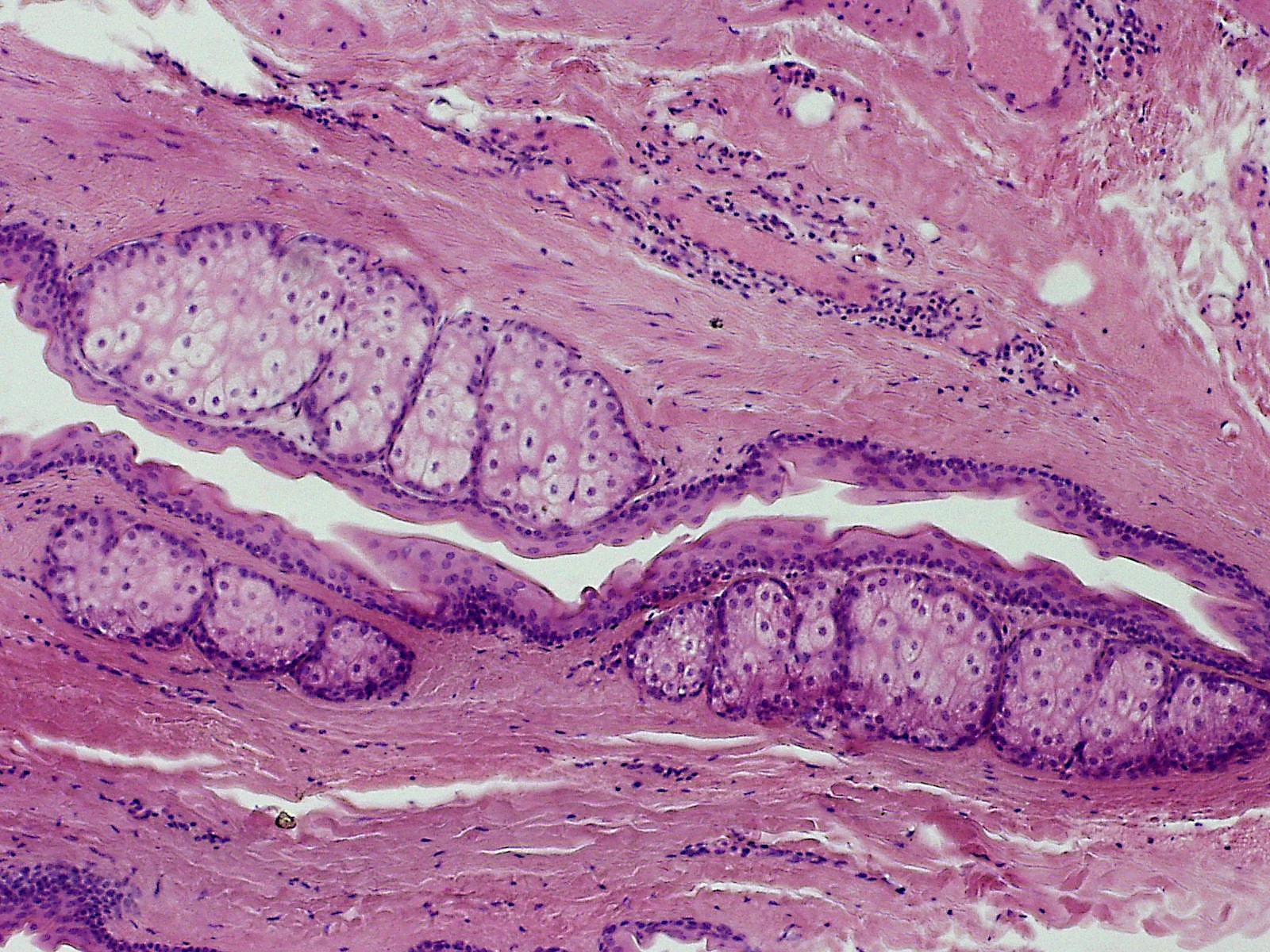
Steatocystoma multiplex is a benign, autosomal dominant congenital condition resulting in multiple cysts on a person's body. Steatocystoma simplex is the solitary counterpart to steatocystoma multiplex.
In steatocystoma multiplex, the tendency to develop cysts is inherited in an autosomal dominant fashion, so one parent can be expected to also have steatocystoma multiplex. It may also occur sporadically. Both males and females may be affected.
The onset at puberty is presumably due to hormonal stimulus of the pilosebaceous unit. They most often arise on the chest and may also occur on the abdomen, upper arms, armpits and face. In some cases cysts may develop all over the body.
The cysts are mostly small (2–20 mm) but they may be several centimetres in diameter. They tend to be soft to firm semi-translucent bumps, and contain an oily, yellow liquid. Sometimes a small central punctum can be identified and they may contain one or more hairs (eruptive vellus hair cysts). They may become inflamed and heal with scarring, like acne nodules (see nodulocystic acne and hidradenitis suppurativa).
On inflammation they can become incredibly painful and reach sizes between 4-6cm in diameter. The area around the cyst can become red and painful to the touch; making mobility, sitting, strenuous movement or everyday activities very difficult and painful.
Steatocystomas are thought to come from an abnormal lining of the passageway to the oil glands (sebaceous duct).
Localised, generalised, facial, acral, and suppurative types of steatocystoma multiplex have been described.
It is associated with defects in Keratin 17. The condition is inherited in an autosomal dominant manner. This indicates that the defective gene responsible for a disorder is located on an autosome, and only one copy of the defective gene is sufficient to cause the disorder, when inherited from a parent who has the disorder.
Hub AI
Steatocystoma multiplex AI simulator
(@Steatocystoma multiplex_simulator)
Steatocystoma multiplex
Steatocystoma multiplex is a benign, autosomal dominant congenital condition resulting in multiple cysts on a person's body. Steatocystoma simplex is the solitary counterpart to steatocystoma multiplex.
In steatocystoma multiplex, the tendency to develop cysts is inherited in an autosomal dominant fashion, so one parent can be expected to also have steatocystoma multiplex. It may also occur sporadically. Both males and females may be affected.
The onset at puberty is presumably due to hormonal stimulus of the pilosebaceous unit. They most often arise on the chest and may also occur on the abdomen, upper arms, armpits and face. In some cases cysts may develop all over the body.
The cysts are mostly small (2–20 mm) but they may be several centimetres in diameter. They tend to be soft to firm semi-translucent bumps, and contain an oily, yellow liquid. Sometimes a small central punctum can be identified and they may contain one or more hairs (eruptive vellus hair cysts). They may become inflamed and heal with scarring, like acne nodules (see nodulocystic acne and hidradenitis suppurativa).
On inflammation they can become incredibly painful and reach sizes between 4-6cm in diameter. The area around the cyst can become red and painful to the touch; making mobility, sitting, strenuous movement or everyday activities very difficult and painful.
Steatocystomas are thought to come from an abnormal lining of the passageway to the oil glands (sebaceous duct).
Localised, generalised, facial, acral, and suppurative types of steatocystoma multiplex have been described.
It is associated with defects in Keratin 17. The condition is inherited in an autosomal dominant manner. This indicates that the defective gene responsible for a disorder is located on an autosome, and only one copy of the defective gene is sufficient to cause the disorder, when inherited from a parent who has the disorder.