


Community hub
Recent from talks
Knowledge base stats:
Talk channels stats:
Members stats:
Steinmetz solid
In geometry, a Steinmetz solid is the solid body obtained as the intersection of two or three cylinders of equal radius at right angles. Each of the curves of the intersection of two cylinders is an ellipse.
The intersection of two cylinders is called a bicylinder. Topologically, it is equivalent to a square hosohedron. The intersection of three cylinders is called a tricylinder. A bisected bicylinder is called a vault, and a cloister vault in architecture has this shape.
Steinmetz solids are named after mathematician Charles Proteus Steinmetz, who solved the problem of determining the volume of the intersection. However, the same problem had been solved earlier, by Archimedes in the ancient Greek world, Zu Chongzhi in ancient China, and Piero della Francesca in the early Italian Renaissance. They appear prominently in the sculptures of Frank Smullin.
A bicylinder generated by two cylinders with radius r has the volume and the surface area


The upper half of a bicylinder is the square case of a domical vault, a dome-shaped solid based on any convex polygon whose cross-sections are similar copies of the polygon, and analogous formulas calculating the volume and surface area of a domical vault as a rational multiple of the volume and surface area of its enclosing prism hold more generally. In China, the bicylinder is known as móu hé fāng gài (牟合方蓋), literally "two square umbrella"; it was described by the third-century mathematician Liu Hui.
For deriving the volume formula it is convenient to use the common idea for calculating the volume of a sphere: collecting thin cylindric slices. In this case the thin slices are square cuboids (see diagram). This leads to It is well known that the relations of the volumes of a right circular cone, one half of a sphere and a right circular cylinder with same radii and heights are 1 : 2 : 3. For one half of a bicylinder a similar statement is true:
![{\displaystyle {\begin{aligned}V&=\int _{-r}^{r}(2x)^{2}\ \mathrm {d} z\\[2pt]&=4\cdot \int _{-r}^{r}x^{2}\ \mathrm {d} z\\[2pt]&=4\cdot \int _{-r}^{r}(r^{2}-z^{2})\ \mathrm {d} z\\[2pt]&={\frac {16}{3}}r^{3}.\end{aligned}}}](https://wikimedia.org/api/rest_v1/media/math/render/svg/0f156eb6bb32e603cee53130aeb1fd366599da09)
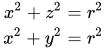
Consider the equations of the cylinders:
Hub AI
Steinmetz solid AI simulator
(@Steinmetz solid_simulator)
Steinmetz solid
In geometry, a Steinmetz solid is the solid body obtained as the intersection of two or three cylinders of equal radius at right angles. Each of the curves of the intersection of two cylinders is an ellipse.
The intersection of two cylinders is called a bicylinder. Topologically, it is equivalent to a square hosohedron. The intersection of three cylinders is called a tricylinder. A bisected bicylinder is called a vault, and a cloister vault in architecture has this shape.
Steinmetz solids are named after mathematician Charles Proteus Steinmetz, who solved the problem of determining the volume of the intersection. However, the same problem had been solved earlier, by Archimedes in the ancient Greek world, Zu Chongzhi in ancient China, and Piero della Francesca in the early Italian Renaissance. They appear prominently in the sculptures of Frank Smullin.
A bicylinder generated by two cylinders with radius r has the volume and the surface area
The upper half of a bicylinder is the square case of a domical vault, a dome-shaped solid based on any convex polygon whose cross-sections are similar copies of the polygon, and analogous formulas calculating the volume and surface area of a domical vault as a rational multiple of the volume and surface area of its enclosing prism hold more generally. In China, the bicylinder is known as móu hé fāng gài (牟合方蓋), literally "two square umbrella"; it was described by the third-century mathematician Liu Hui.
For deriving the volume formula it is convenient to use the common idea for calculating the volume of a sphere: collecting thin cylindric slices. In this case the thin slices are square cuboids (see diagram). This leads to It is well known that the relations of the volumes of a right circular cone, one half of a sphere and a right circular cylinder with same radii and heights are 1 : 2 : 3. For one half of a bicylinder a similar statement is true:
Consider the equations of the cylinders: