

Recent from talks
Stellar dynamics
Knowledge base stats:
Talk channels stats:
Members stats:
Stellar dynamics
Stellar dynamics is the branch of astrophysics which describes in a statistical way the collective motions of stars subject to their mutual gravity. The essential difference from celestial mechanics is that the number of body

Typical galaxies have upwards of millions of macroscopic gravitating bodies and countless number of neutrinos and perhaps other dark microscopic bodies. Also each star contributes more or less equally to the total gravitational field, whereas in celestial mechanics the pull of a massive body dominates any satellite orbits.
Stellar dynamics also has connections to the field of plasma physics. The two fields underwent significant development during a similar time period in the early 20th century, and both borrow mathematical formalism originally developed in the field of fluid mechanics.
In accretion disks and stellar surfaces, the dense plasma or gas particles collide very frequently, and collisions result in equipartition and perhaps viscosity under magnetic field. We see various sizes for accretion disks and stellar atmosphere, both made of enormous number of microscopic particle mass,
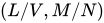
The system crossing time scale is long in stellar dynamics, where it is handy to note that

The long timescale means that, unlike gas particles in accretion disks, stars in galaxy disks very rarely see a collision in their stellar lifetime. However, galaxies collide occasionally in galaxy clusters, and stars have close encounters occasionally in star clusters.
As a rule of thumb, the typical scales concerned (see the Upper Portion of P.C.Budassi's Logarithmic Map of the Universe) are
Hub AI
Stellar dynamics AI simulator
(@Stellar dynamics_simulator)
Stellar dynamics
Stellar dynamics is the branch of astrophysics which describes in a statistical way the collective motions of stars subject to their mutual gravity. The essential difference from celestial mechanics is that the number of body
Typical galaxies have upwards of millions of macroscopic gravitating bodies and countless number of neutrinos and perhaps other dark microscopic bodies. Also each star contributes more or less equally to the total gravitational field, whereas in celestial mechanics the pull of a massive body dominates any satellite orbits.
Stellar dynamics also has connections to the field of plasma physics. The two fields underwent significant development during a similar time period in the early 20th century, and both borrow mathematical formalism originally developed in the field of fluid mechanics.
In accretion disks and stellar surfaces, the dense plasma or gas particles collide very frequently, and collisions result in equipartition and perhaps viscosity under magnetic field. We see various sizes for accretion disks and stellar atmosphere, both made of enormous number of microscopic particle mass,
The system crossing time scale is long in stellar dynamics, where it is handy to note that
The long timescale means that, unlike gas particles in accretion disks, stars in galaxy disks very rarely see a collision in their stellar lifetime. However, galaxies collide occasionally in galaxy clusters, and stars have close encounters occasionally in star clusters.
As a rule of thumb, the typical scales concerned (see the Upper Portion of P.C.Budassi's Logarithmic Map of the Universe) are
Recent media