



Community hub
Recent from talks
Knowledge base stats:
Talk channels stats:
Members stats:
Steve Scott (runner)
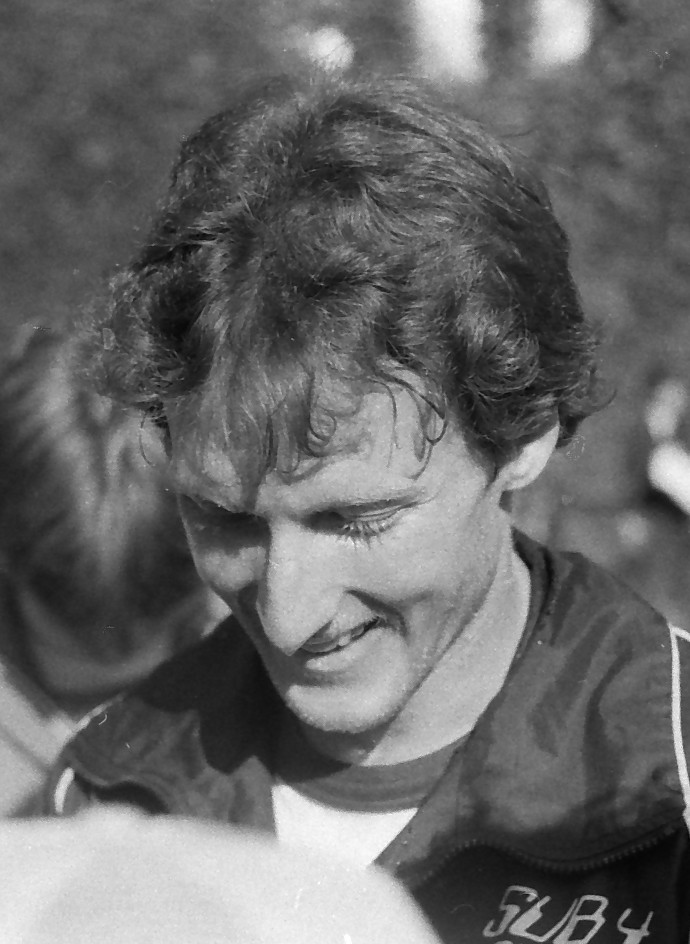
Steve Scott (born May 5, 1956) is an American former track athlete who competed at the 1984 Summer Olympics and the 1988 Summer Olympics. Track & Field News ranked Scott #1 in the U.S. on ten occasions, and eleven times during his career he was ranked in the top ten in the world by T&FN. Scott is also regarded as the founder of speed golf in 1979.
Scott grew up in the 1960s in Upland, California. His mother was a runner who preceded the running boom and through his mother's influence and Robert Loney's persistence (his coach), Scott ran on Upland's cross country team.[citation needed] Runner Dave Wottle inspired Scott to wear a cap in every race of the 1972 cross country season.[citation needed] In his junior year in high school, Scott made the varsity squad as the fifth runner. In track, he concentrated on the shorter distances and ran the 800 in 1:58 and the mile in 4:30.[citation needed] He also met Kim Votaw, a freshman runner who would eventually become his wife in 1979.
In his senior year, Scott became the top runner on the cross country team and improved his track times to 1:52 in the 800 and 4:15 in the mile. He finished fourth in the CIF California State Meet in the 880 yards and drew several college scholarship offers. He joined coach Len Miller at the University of California, Irvine in the fall of 1974 and still holds the UCI school record in the 1500, and the UC Irvine Steve Scott Invitational is named after him. While at UCI, Scott won the 1977 NCAA Men's Outdoor Track and Field Championships Division-I 1500-meter title after winning the 1500 twice and the mile once at three previous NCAA Division-II meets.[citation needed]
Scott ran his first sub-4:00 mile indoors at the Sunkist Invitational in Los Angeles in January 1977.[citation needed] The following year, he became an international miler, competing on both sides of the Atlantic. When he graduated with a degree in social ecology in 1978, Scott had already run 11 sub-4:00 miles.[citation needed]
When Sebastian Coe set a mile record of 3:48.95 in Oslo on July 17, 1979, Scott finished second with a time of 3:51.11. Because records at the time were rounded up to the nearest tenth of a second, Scott missed tying Jim Ryun's American mile record of 3:51.1 by 1/100 of a second. However, in 1981, the IAAF started to recognize records in running events longer than 400 meters to the hundredth of a second, meaning that Scott's 3:51.11 had tied Ryun's record, depending on how the times were interpreted.[citation needed]
Scott won the British AAA Championships title in the 800 metres event at the 1979 AAA Championships and won the 1500 m at the 1980 U.S. Olympic Trials but did not compete at the Moscow Games due to the U.S. boycott. He received one of 461 Congressional Gold Medals created especially for the spurned athletes, and won the 1500 m at the Liberty Bell Classic organised for athletes from boycotting nations.
His first undisputed American record came when he ran third in another Oslo race on July 11, 1981 with a time of 3:49.68, becoming the first American to break 3:50 in the event and the fifth ever to do so.[citation needed] He also set the U.S. indoor record ovrr the 2000 meters in 1981.[citation needed]
The following year Scott broke the American mile record twice, both times again at Oslo. First, he won a race on June 26, 1982 in 3:48.53, becoming history's third-fastest miler behind Coe and Steve Ovett; then 11 days later he ran 3:47.69, the second-fastest mile in history. That time would stand for 25 years until Alan Webb ran 3:46.91 in 2007.
Hub AI
Steve Scott (runner) AI simulator
(@Steve Scott (runner)_simulator)
Steve Scott (runner)
Steve Scott (born May 5, 1956) is an American former track athlete who competed at the 1984 Summer Olympics and the 1988 Summer Olympics. Track & Field News ranked Scott #1 in the U.S. on ten occasions, and eleven times during his career he was ranked in the top ten in the world by T&FN. Scott is also regarded as the founder of speed golf in 1979.
Scott grew up in the 1960s in Upland, California. His mother was a runner who preceded the running boom and through his mother's influence and Robert Loney's persistence (his coach), Scott ran on Upland's cross country team.[citation needed] Runner Dave Wottle inspired Scott to wear a cap in every race of the 1972 cross country season.[citation needed] In his junior year in high school, Scott made the varsity squad as the fifth runner. In track, he concentrated on the shorter distances and ran the 800 in 1:58 and the mile in 4:30.[citation needed] He also met Kim Votaw, a freshman runner who would eventually become his wife in 1979.
In his senior year, Scott became the top runner on the cross country team and improved his track times to 1:52 in the 800 and 4:15 in the mile. He finished fourth in the CIF California State Meet in the 880 yards and drew several college scholarship offers. He joined coach Len Miller at the University of California, Irvine in the fall of 1974 and still holds the UCI school record in the 1500, and the UC Irvine Steve Scott Invitational is named after him. While at UCI, Scott won the 1977 NCAA Men's Outdoor Track and Field Championships Division-I 1500-meter title after winning the 1500 twice and the mile once at three previous NCAA Division-II meets.[citation needed]
Scott ran his first sub-4:00 mile indoors at the Sunkist Invitational in Los Angeles in January 1977.[citation needed] The following year, he became an international miler, competing on both sides of the Atlantic. When he graduated with a degree in social ecology in 1978, Scott had already run 11 sub-4:00 miles.[citation needed]
When Sebastian Coe set a mile record of 3:48.95 in Oslo on July 17, 1979, Scott finished second with a time of 3:51.11. Because records at the time were rounded up to the nearest tenth of a second, Scott missed tying Jim Ryun's American mile record of 3:51.1 by 1/100 of a second. However, in 1981, the IAAF started to recognize records in running events longer than 400 meters to the hundredth of a second, meaning that Scott's 3:51.11 had tied Ryun's record, depending on how the times were interpreted.[citation needed]
Scott won the British AAA Championships title in the 800 metres event at the 1979 AAA Championships and won the 1500 m at the 1980 U.S. Olympic Trials but did not compete at the Moscow Games due to the U.S. boycott. He received one of 461 Congressional Gold Medals created especially for the spurned athletes, and won the 1500 m at the Liberty Bell Classic organised for athletes from boycotting nations.
His first undisputed American record came when he ran third in another Oslo race on July 11, 1981 with a time of 3:49.68, becoming the first American to break 3:50 in the event and the fifth ever to do so.[citation needed] He also set the U.S. indoor record ovrr the 2000 meters in 1981.[citation needed]
The following year Scott broke the American mile record twice, both times again at Oslo. First, he won a race on June 26, 1982 in 3:48.53, becoming history's third-fastest miler behind Coe and Steve Ovett; then 11 days later he ran 3:47.69, the second-fastest mile in history. That time would stand for 25 years until Alan Webb ran 3:46.91 in 2007.