



Community hub
Recent from talks
Knowledge base stats:
Talk channels stats:
Members stats:
Sticky bomb
The "Grenade, Hand, Anti-Tank No. 74", commonly known as the S.T. grenade or simply sticky bomb, was a British hand grenade designed and produced during the Second World War. The grenade was one of a number of ad hoc anti-tank weapons developed for use by the British Army and Home Guard after the loss of many anti-tank guns in France after the Dunkirk evacuation.
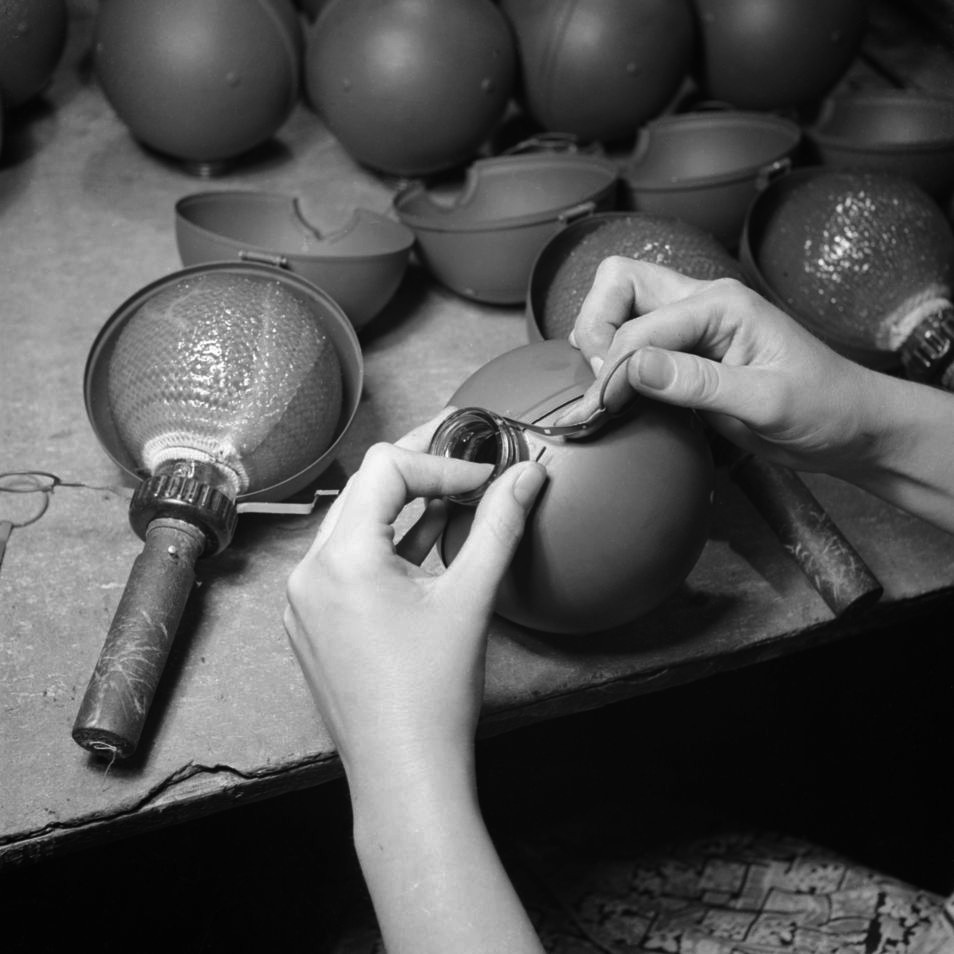
The grenade was designed by a team from MIR(c) including Major Millis Jefferis and Stuart Macrae. It consisted of a glass sphere containing an explosive made of nitroglycerin and additives which added stability. When the user pulled a pin on the handle, the casing would fall away and expose the sticky sphere. Pulling another pin would arm the firing mechanism and the user would attempt to attach the grenade to an enemy vehicle. Letting go of the handle would release a lever that would activate a five-second fuse, which would then detonate the nitroglycerin compound.
The grenade had several faults in its design. The Ordnance Board of the War Department did not approve the grenade for use by the British Army, but intervention by the prime minister, Winston Churchill, led to production of the grenade. Between 1940 and 1943, approximately 2.5 million were produced. It was primarily issued to the Home Guard but was also used by British and Commonwealth forces in North Africa. It was used by Allied Forces on the Anzio Beachhead, including the First Special Service Force; as well as by Australian Army units during the New Guinea campaign. The French Resistance were also issued a quantity of the grenades.
In 1938, Maj. Millis Jefferis developed an anti-tank weapon ideal for irregular warfare. It had an explosive charge deform so it had a substantial area of intimate contact with the surface of the target. Upon detonation, the explosion would be focused on a small area capable of rupturing an armoured plate. Sappers call such a device a "poultice" or "squash head" charge. Jefferis enlisted Bauer and Schulman of Cambridge University. They experimented with different lengths of bicycle inner tubes filled with plasticine to represent explosives, fit them with wooden handles, and dipped them in rubber solutions to make them sticky. In experiments, the prototypes proved difficult to aim and only stuck to the metal bins, representing tanks.
With the end of the Battle of France and the Dunkirk evacuation in June, 1940, a German invasion of Great Britain seemed likely. However, the British Army in the weeks after the Dunkirk evacuation could only field 27 divisions. The army had a shortage of anti-tank guns, only 167 were available in Britain; ammunition was so scarce for remaining guns that regulations forbade even single rounds being used for training purposes.
Under the circumstances, Jefferis considered that his idea might be more useful for the British Army and Home Guard. Jefferis was in charge of the MIR(c) department, tasked with developing and delivering weapons for use by guerrilla and resistance groups in occupied Europe. MIR(c) was now charged with development of the sticky bomb, with Stuart Macrae being assigned to design the sticky bomb.
Gordon Norwood, a master printer who recruited Macrae from his former magazine publishing employer, suggested a frangible container was needed to contain an explosive gel. He obtained a 150-Watt light bulb to demonstrate that a spherical glass flask inside a sock of woven wool would be rigid when thrown. Upon contact, the glass would break and the bomb would deform to the required shape. Experiments with glass flasks filled with cold porridge confirmed this was a viable solution.
The grenade needed a delay for the thrower to get clear, so the woollen sock was covered in a sticky substance, ensuring the bomb stayed in place immediately prior to denotation. Having covered the bomb in glue, a non-sticky handle was required. In the handle, a delay fuse was ignited by releasing a sprung lever so that a five-second time delay started as the grenade was thrown, similar to those on a conventional Mills bomb-type hand grenade.
Hub AI
Sticky bomb AI simulator
(@Sticky bomb_simulator)
Sticky bomb
The "Grenade, Hand, Anti-Tank No. 74", commonly known as the S.T. grenade or simply sticky bomb, was a British hand grenade designed and produced during the Second World War. The grenade was one of a number of ad hoc anti-tank weapons developed for use by the British Army and Home Guard after the loss of many anti-tank guns in France after the Dunkirk evacuation.
The grenade was designed by a team from MIR(c) including Major Millis Jefferis and Stuart Macrae. It consisted of a glass sphere containing an explosive made of nitroglycerin and additives which added stability. When the user pulled a pin on the handle, the casing would fall away and expose the sticky sphere. Pulling another pin would arm the firing mechanism and the user would attempt to attach the grenade to an enemy vehicle. Letting go of the handle would release a lever that would activate a five-second fuse, which would then detonate the nitroglycerin compound.
The grenade had several faults in its design. The Ordnance Board of the War Department did not approve the grenade for use by the British Army, but intervention by the prime minister, Winston Churchill, led to production of the grenade. Between 1940 and 1943, approximately 2.5 million were produced. It was primarily issued to the Home Guard but was also used by British and Commonwealth forces in North Africa. It was used by Allied Forces on the Anzio Beachhead, including the First Special Service Force; as well as by Australian Army units during the New Guinea campaign. The French Resistance were also issued a quantity of the grenades.
In 1938, Maj. Millis Jefferis developed an anti-tank weapon ideal for irregular warfare. It had an explosive charge deform so it had a substantial area of intimate contact with the surface of the target. Upon detonation, the explosion would be focused on a small area capable of rupturing an armoured plate. Sappers call such a device a "poultice" or "squash head" charge. Jefferis enlisted Bauer and Schulman of Cambridge University. They experimented with different lengths of bicycle inner tubes filled with plasticine to represent explosives, fit them with wooden handles, and dipped them in rubber solutions to make them sticky. In experiments, the prototypes proved difficult to aim and only stuck to the metal bins, representing tanks.
With the end of the Battle of France and the Dunkirk evacuation in June, 1940, a German invasion of Great Britain seemed likely. However, the British Army in the weeks after the Dunkirk evacuation could only field 27 divisions. The army had a shortage of anti-tank guns, only 167 were available in Britain; ammunition was so scarce for remaining guns that regulations forbade even single rounds being used for training purposes.
Under the circumstances, Jefferis considered that his idea might be more useful for the British Army and Home Guard. Jefferis was in charge of the MIR(c) department, tasked with developing and delivering weapons for use by guerrilla and resistance groups in occupied Europe. MIR(c) was now charged with development of the sticky bomb, with Stuart Macrae being assigned to design the sticky bomb.
Gordon Norwood, a master printer who recruited Macrae from his former magazine publishing employer, suggested a frangible container was needed to contain an explosive gel. He obtained a 150-Watt light bulb to demonstrate that a spherical glass flask inside a sock of woven wool would be rigid when thrown. Upon contact, the glass would break and the bomb would deform to the required shape. Experiments with glass flasks filled with cold porridge confirmed this was a viable solution.
The grenade needed a delay for the thrower to get clear, so the woollen sock was covered in a sticky substance, ensuring the bomb stayed in place immediately prior to denotation. Having covered the bomb in glue, a non-sticky handle was required. In the handle, a delay fuse was ignited by releasing a sprung lever so that a five-second time delay started as the grenade was thrown, similar to those on a conventional Mills bomb-type hand grenade.