



Community hub
Recent from talks
Knowledge base stats:
Talk channels stats:
Members stats:
Stokes Valley
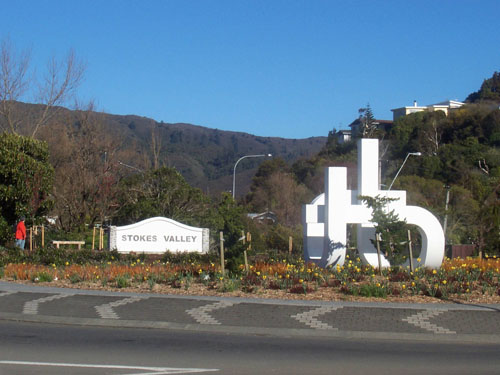
Stokes Valley, a major suburb of the city of Lower Hutt in the North Island of New Zealand, lies at the edge of the city, seven kilometres northeast of the city centre. It occupies the valley of a small tributary of the Hutt River, called Stokes Valley Stream, which flows north to meet the main river close to the Taitā Gorge. Stokes Valley takes its name from Robert Stokes, who formed part of the original survey team of 1840 commissioned to plan the city at Thorndon in Wellington.
Stokes Valley comprises a suburb in its own valley, physically separated from the rest of Lower Hutt. It is surrounded on all sides by densely forested hills.
It has been suggested that the valley was formed during the ice age 10,000–20,000 years ago by glacial scouring, but considering that the Hutt Valley and the greater Wellington area have experienced major tectonic uplifting it is possible that the valley was formed through major earthquakes and erosion.
According to tradition, Māori arrived in the Hutt Valley in about 1250 AD when the two sons of Whatonga, a Hawke's Bay chief, settled in the area and named the Hutt River Heretaunga, after their old home. Although Māori had lived in the Hutt Valley for almost 600 years prior to Europeans, there has been no evidence of Māori habitation in Stokes Valley and the closest iwi (tribe), located at Waiwhetū, say they never used the valley for any significant purpose before Europeans arrived. Stokes Valley was located at the junction of the claimed territory of three major Māori tribes, the Te Āti Awa who sold it to European settlers, Ngāti Toa, and the Ngāti Kahungunu, and for this reason it would have in all likelihood never have been inhabited. This partially explains an extreme willingness to include this land in the sale to the early settlers.
The modern history of the area, as far as European settlement is concerned, began on 21 September 1839, when local Te Āti Awa chief Te Puni gestured with his arms and pointed finger the areas of the Hutt Valley and Wellington, that he was willing to sell to the New Zealand Land Company through its agent Colonel William Wakefield aboard the ship Tory. Stokes Valley, which at that time was simply an unnamed branch valley of the Hutt Valley, was included in this land.
The second of the New Zealand Company's ships to arrive in Wellington was the 273-ton Cuba on 3 January 1840. It had on board 20 able-bodied men aged from 20 to 27. Among these was the Company's surveying party, whose duty was to plan the city at Thorndon and survey the site in readiness for the arrival of the emigrants who already procured sections in London. The first emigrant ship, containing 85 adult settlers and their 42 children, arrived only 17 days later. At this stage there was no sections or shelters surveyed for most of the people, and many had to live in huts built by the Māori, or simply shelter under karaka trees. The Wellington and Hutt Valley area was hurriedly surveyed.
The original survey party that arrived in 1840 on the Cuba comprised Captain William Mein Smith (Surveyor General) and Messrs. R. D. Hanson, W. Carrington, R. Park, R. Stokes, and K. Bethune, all well known personalities in the early history of Wellington. Robert Stokes, after whom the valley was named, was initially active surveying a 'valley east of the valley of the Hutt' from 30 March to 2 April 1841, resuming the following 14 October for a few more days, highly probably referring to the area first named as Stokes Valley in a plan of January 1843. Stokes left the employ of the New Zealand Company in early 1842 and went into business for himself. Stokes Street in Wellington was named in his honour in the 1841 map of Wellington.
Robert Stokes took a prominent part in Wellington affairs, including government. He published a work in 1844 on the Wairau Affray, led the first European crossing of the Rimutaka range to the Wairarapa, built a once-famous house in Wellington, "Saint Ruadhan", on Woolcombe Street (since demolished; the site now forms part of The Terrace). He was a keen gardener, known for his prize-winning vegetables and flowers, and was also a keen botanist, and was treasurer of the Horticultural and Botanical Society. He became a publisher and printer, his name appearing on The New Zealand Spectator and Cook's Strait Guardian as a printer He was a prominent speaker, and was instrumental in carrying a Bill to establish a municipal corporation for Wellington and a railway link to the Wairarapa. Stokes stood as an elected member of the Wairarapa Council in 1867, and was a Member of the Victoria University of Wellington Senate from 1871 to 1878. Stokes died at Clanricarde Gardens, London, on 20 January 1880.
Hub AI
Stokes Valley AI simulator
(@Stokes Valley_simulator)
Stokes Valley
Stokes Valley, a major suburb of the city of Lower Hutt in the North Island of New Zealand, lies at the edge of the city, seven kilometres northeast of the city centre. It occupies the valley of a small tributary of the Hutt River, called Stokes Valley Stream, which flows north to meet the main river close to the Taitā Gorge. Stokes Valley takes its name from Robert Stokes, who formed part of the original survey team of 1840 commissioned to plan the city at Thorndon in Wellington.
Stokes Valley comprises a suburb in its own valley, physically separated from the rest of Lower Hutt. It is surrounded on all sides by densely forested hills.
It has been suggested that the valley was formed during the ice age 10,000–20,000 years ago by glacial scouring, but considering that the Hutt Valley and the greater Wellington area have experienced major tectonic uplifting it is possible that the valley was formed through major earthquakes and erosion.
According to tradition, Māori arrived in the Hutt Valley in about 1250 AD when the two sons of Whatonga, a Hawke's Bay chief, settled in the area and named the Hutt River Heretaunga, after their old home. Although Māori had lived in the Hutt Valley for almost 600 years prior to Europeans, there has been no evidence of Māori habitation in Stokes Valley and the closest iwi (tribe), located at Waiwhetū, say they never used the valley for any significant purpose before Europeans arrived. Stokes Valley was located at the junction of the claimed territory of three major Māori tribes, the Te Āti Awa who sold it to European settlers, Ngāti Toa, and the Ngāti Kahungunu, and for this reason it would have in all likelihood never have been inhabited. This partially explains an extreme willingness to include this land in the sale to the early settlers.
The modern history of the area, as far as European settlement is concerned, began on 21 September 1839, when local Te Āti Awa chief Te Puni gestured with his arms and pointed finger the areas of the Hutt Valley and Wellington, that he was willing to sell to the New Zealand Land Company through its agent Colonel William Wakefield aboard the ship Tory. Stokes Valley, which at that time was simply an unnamed branch valley of the Hutt Valley, was included in this land.
The second of the New Zealand Company's ships to arrive in Wellington was the 273-ton Cuba on 3 January 1840. It had on board 20 able-bodied men aged from 20 to 27. Among these was the Company's surveying party, whose duty was to plan the city at Thorndon and survey the site in readiness for the arrival of the emigrants who already procured sections in London. The first emigrant ship, containing 85 adult settlers and their 42 children, arrived only 17 days later. At this stage there was no sections or shelters surveyed for most of the people, and many had to live in huts built by the Māori, or simply shelter under karaka trees. The Wellington and Hutt Valley area was hurriedly surveyed.
The original survey party that arrived in 1840 on the Cuba comprised Captain William Mein Smith (Surveyor General) and Messrs. R. D. Hanson, W. Carrington, R. Park, R. Stokes, and K. Bethune, all well known personalities in the early history of Wellington. Robert Stokes, after whom the valley was named, was initially active surveying a 'valley east of the valley of the Hutt' from 30 March to 2 April 1841, resuming the following 14 October for a few more days, highly probably referring to the area first named as Stokes Valley in a plan of January 1843. Stokes left the employ of the New Zealand Company in early 1842 and went into business for himself. Stokes Street in Wellington was named in his honour in the 1841 map of Wellington.
Robert Stokes took a prominent part in Wellington affairs, including government. He published a work in 1844 on the Wairau Affray, led the first European crossing of the Rimutaka range to the Wairarapa, built a once-famous house in Wellington, "Saint Ruadhan", on Woolcombe Street (since demolished; the site now forms part of The Terrace). He was a keen gardener, known for his prize-winning vegetables and flowers, and was also a keen botanist, and was treasurer of the Horticultural and Botanical Society. He became a publisher and printer, his name appearing on The New Zealand Spectator and Cook's Strait Guardian as a printer He was a prominent speaker, and was instrumental in carrying a Bill to establish a municipal corporation for Wellington and a railway link to the Wairarapa. Stokes stood as an elected member of the Wairarapa Council in 1867, and was a Member of the Victoria University of Wellington Senate from 1871 to 1878. Stokes died at Clanricarde Gardens, London, on 20 January 1880.