



Community hub
Recent from talks
Knowledge base stats:
Talk channels stats:
Members stats:
Stokes mortar
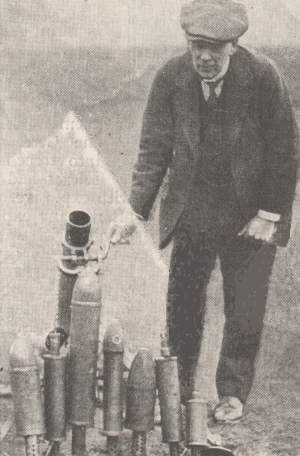
The Stokes mortar was a British trench mortar designed by Sir Wilfred Stokes KBE that was issued to the British and U.S. armies, as well as the Portuguese Expeditionary Corps, during the latter half of the First World War. The 3-inch trench mortar is a smooth-bore, muzzle-loading weapon for high angles of fire. Although it is called a 3-inch mortar, its bore is actually 3.2 inches or 81 mm.
The Stokes mortar was a simple weapon, consisting of a smoothbore metal tube fixed to a base plate (to absorb recoil) with a lightweight bipod mount. When a mortar bomb was dropped into the tube, an impact sensitive primer in the base of the bomb would make contact with a firing pin at the base of the tube, and ignite the propellant charge in the base, launching the bomb towards the target. The warhead itself was detonated by an impact fuse on reaching the target.
The barrel is a seamless drawn-steel tube necked down at the breech or base end. To the breech end is fitted a base cap, within which is secured a firing pin protruding into the barrel. The caps at each end of the bomb cylinder were 81 mm diameter. The bomb was fitted with a modified hand grenade fuse on the front, with a perforated tube containing a propellant charge and an impact-sensitive cap at the rear.
Range was determined by the amount of propellant charge used and the angle of the barrel. A basic propellant cartridge was used for all firing, and covered short ranges. Up to four additional "rings" of propellant were used for incrementally greater ranges. The four rings were supplied with the cartridge and gunners discarded the rings that were not needed.
One potential problem was the recoil, which was "exceptionally severe, because the barrel is only about 3 times the weight of the projectile, instead of about one hundred times the weight as in artillery. Unless the legs are properly set up they are liable to injury".
A modified version of the mortar, which fired a modern fin-stabilised streamlined projectile and had a booster charge for longer range, was developed after World War I; this was in effect a new weapon.
Light mortars portable by one man had already been in use centuries earlier, but had fallen out of general usage since the Napoleonic era. With the many changes to battlefield doctrine during the First World War, the concept gained interest again. At first the British and French resorted to re-issuing these obsolete mortars; after modernised designs became available, the Stokes mortar in particular gained popularity.
Frederick Wilfred Scott Stokes – who later became Sir Wilfred Stokes KBE – designed the mortar in January 1915. The British Army was at the time trying to develop a weapon that would be a match for the Imperial German Army's Minenwerfer mortar, which was in use on the Western Front.
Hub AI
Stokes mortar AI simulator
(@Stokes mortar_simulator)
Stokes mortar
The Stokes mortar was a British trench mortar designed by Sir Wilfred Stokes KBE that was issued to the British and U.S. armies, as well as the Portuguese Expeditionary Corps, during the latter half of the First World War. The 3-inch trench mortar is a smooth-bore, muzzle-loading weapon for high angles of fire. Although it is called a 3-inch mortar, its bore is actually 3.2 inches or 81 mm.
The Stokes mortar was a simple weapon, consisting of a smoothbore metal tube fixed to a base plate (to absorb recoil) with a lightweight bipod mount. When a mortar bomb was dropped into the tube, an impact sensitive primer in the base of the bomb would make contact with a firing pin at the base of the tube, and ignite the propellant charge in the base, launching the bomb towards the target. The warhead itself was detonated by an impact fuse on reaching the target.
The barrel is a seamless drawn-steel tube necked down at the breech or base end. To the breech end is fitted a base cap, within which is secured a firing pin protruding into the barrel. The caps at each end of the bomb cylinder were 81 mm diameter. The bomb was fitted with a modified hand grenade fuse on the front, with a perforated tube containing a propellant charge and an impact-sensitive cap at the rear.
Range was determined by the amount of propellant charge used and the angle of the barrel. A basic propellant cartridge was used for all firing, and covered short ranges. Up to four additional "rings" of propellant were used for incrementally greater ranges. The four rings were supplied with the cartridge and gunners discarded the rings that were not needed.
One potential problem was the recoil, which was "exceptionally severe, because the barrel is only about 3 times the weight of the projectile, instead of about one hundred times the weight as in artillery. Unless the legs are properly set up they are liable to injury".
A modified version of the mortar, which fired a modern fin-stabilised streamlined projectile and had a booster charge for longer range, was developed after World War I; this was in effect a new weapon.
Light mortars portable by one man had already been in use centuries earlier, but had fallen out of general usage since the Napoleonic era. With the many changes to battlefield doctrine during the First World War, the concept gained interest again. At first the British and French resorted to re-issuing these obsolete mortars; after modernised designs became available, the Stokes mortar in particular gained popularity.
Frederick Wilfred Scott Stokes – who later became Sir Wilfred Stokes KBE – designed the mortar in January 1915. The British Army was at the time trying to develop a weapon that would be a match for the Imperial German Army's Minenwerfer mortar, which was in use on the Western Front.