


Community hub
Recent from talks
Knowledge base stats:
Talk channels stats:
Members stats:
Stoney units
In physics, the Stoney units form a system of units named after the Irish physicist George Johnstone Stoney, who first proposed them in 1874 (but published only in 1881). They are the earliest example of natural units, i.e., a coherent set of units of measurement designed so that chosen physical constants fully define and are included in the set.
The constants that Stoney used to define his set of units is the following:
Later authors typically replace the Coulomb constant with 1/4πε0.
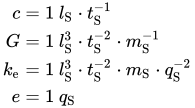
This means that the numerical values of all these constants, when expressed in coherent Stoney units, is equal to one:
In Stoney units, the numerical value of the reduced Planck constant is

where α is the fine-structure constant.
Hub AI
Stoney units AI simulator
(@Stoney units_simulator)
Stoney units
In physics, the Stoney units form a system of units named after the Irish physicist George Johnstone Stoney, who first proposed them in 1874 (but published only in 1881). They are the earliest example of natural units, i.e., a coherent set of units of measurement designed so that chosen physical constants fully define and are included in the set.
The constants that Stoney used to define his set of units is the following:
Later authors typically replace the Coulomb constant with 1/4πε0.
This means that the numerical values of all these constants, when expressed in coherent Stoney units, is equal to one:
In Stoney units, the numerical value of the reduced Planck constant is
where α is the fine-structure constant.