



Community hub
Recent from talks
Knowledge base stats:
Talk channels stats:
Members stats:
Strasbourg massacre
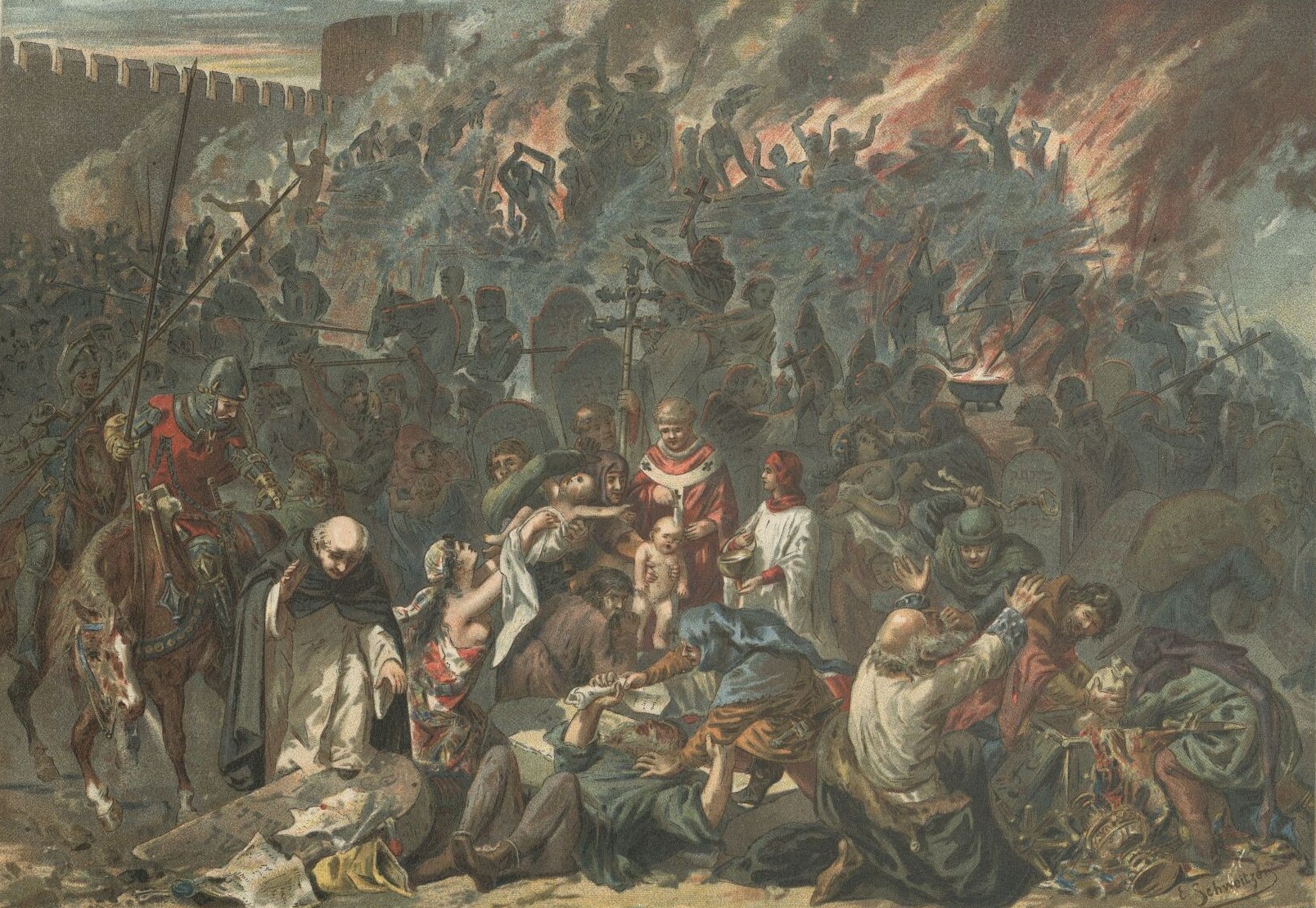
The Strasbourg massacre occurred on 14 February 1349, when the entire Jewish community of 2,000 Jews were publicly burnt to death as part of the Black Death persecutions.
Starting in the spring of 1348, pogroms against Jews had occurred in European cities, starting in Toulon. By November of that year, they spread via Savoy to German-speaking territories. In January 1349, burnings of Jews took place in Basel and Freiburg, and on 14 February the Jewish community in Strasbourg was destroyed.
This event was heavily linked to a revolt by the guilds five days previously, the consequences of which were the displacement of the master tradesmen, a reduction of the power of the patrician bourgeoisie, who had until then been ruling almost exclusively, and an increase in the power of the groups that were involved in the revolt. The aristocratic families of Zorn and Müllenheim, which had been displaced from the council and their offices in 1332, recovered most of their power. The guilds, which until then had no means of political participation, could occupy the most important position in the city, that of the Ammeister (equivalent to mayor). The revolt had occurred because a large part of the population, on the one hand, believed the power of the master tradesmen was too great, particularly that of the then-Ammeister Peter Schwarber. On the other hand, there was a desire to put an end to the policy of protecting Jews under Peter Schwarber.
Jews in Strasbourg were forbidden by local law, and often canon law, to own land or to be farmers.[citation needed] As one of the few roles available to them was money-lending, Jews took an important position in the city's economy. However, this led to conflict. Formally, the Jews still belonged to the King's chamber, but he had long since ceded these rights to the city (the confirmation of the relevant rights of the city by Charles IV occurred in 1347).[citation needed] Strasbourg, therefore, took in the most of the Jews' taxes, but in exchange had to take over their protection (the exact amount of the taxes was determined by written agreements). Pressure to meet tax obligations affected the Jews' business practices and fueled anti-Semitism among the population, particularly among the Jews' debtors.[citation needed]
With the threat of Black Death, there were also accusations of well poisoning, and calls for the burning of Jews.[citation needed]
The council and the master tradesmen attempted to calm the people and prevent a pogrom. The Catholic clergy had been advised by two papal bulls of Pope Clement VI the previous year (July and September 1348) to preach against anyone accusing the Jews of poisoning wells as "seduced by that liar, the Devil."[citation needed]
At first, the council tried to rebut the claims of well poisoning by initiating court proceedings against several Jews and torturing them. As expected, they did not confess to the crimes. Despite this, they were still killed on the breaking wheel. Furthermore, the Jewish quarter was sealed off and guarded by armed persons to protect the Jews from the population and possible over-reactions. There were concerns that a pogrom could escalate and turn into an uncontrollable revolt of the people, as evidenced by a letter from the city council of Cologne on 12 January 1349 to the leaders of Strasbourg, which warned that such riots by the common people had led to much evil and devastation in other towns.
On Monday, 9 February, the artisans gathered in front of the cathedral and, in front of the crowd, informed the masters that they would not allow them to remain in office anymore, as they had too much power. This action appears to have been organised beforehand among the guilds. The masters attempted to persuade the artisans to break up the assembled crowd—without success—but made no moves to comply with the rebels' demands. After an exhaustive debate that involved not only the guilds' representatives but also prominent knights and citizens, it became clear to the masters that they lacked support, and so they gave up their posts. One craftsman became Ammanmeister, namely "Betscholt der metziger" (Betscholt the butcher). Swarber was also stripped of his property on this day.
Hub AI
Strasbourg massacre AI simulator
(@Strasbourg massacre_simulator)
Strasbourg massacre
The Strasbourg massacre occurred on 14 February 1349, when the entire Jewish community of 2,000 Jews were publicly burnt to death as part of the Black Death persecutions.
Starting in the spring of 1348, pogroms against Jews had occurred in European cities, starting in Toulon. By November of that year, they spread via Savoy to German-speaking territories. In January 1349, burnings of Jews took place in Basel and Freiburg, and on 14 February the Jewish community in Strasbourg was destroyed.
This event was heavily linked to a revolt by the guilds five days previously, the consequences of which were the displacement of the master tradesmen, a reduction of the power of the patrician bourgeoisie, who had until then been ruling almost exclusively, and an increase in the power of the groups that were involved in the revolt. The aristocratic families of Zorn and Müllenheim, which had been displaced from the council and their offices in 1332, recovered most of their power. The guilds, which until then had no means of political participation, could occupy the most important position in the city, that of the Ammeister (equivalent to mayor). The revolt had occurred because a large part of the population, on the one hand, believed the power of the master tradesmen was too great, particularly that of the then-Ammeister Peter Schwarber. On the other hand, there was a desire to put an end to the policy of protecting Jews under Peter Schwarber.
Jews in Strasbourg were forbidden by local law, and often canon law, to own land or to be farmers.[citation needed] As one of the few roles available to them was money-lending, Jews took an important position in the city's economy. However, this led to conflict. Formally, the Jews still belonged to the King's chamber, but he had long since ceded these rights to the city (the confirmation of the relevant rights of the city by Charles IV occurred in 1347).[citation needed] Strasbourg, therefore, took in the most of the Jews' taxes, but in exchange had to take over their protection (the exact amount of the taxes was determined by written agreements). Pressure to meet tax obligations affected the Jews' business practices and fueled anti-Semitism among the population, particularly among the Jews' debtors.[citation needed]
With the threat of Black Death, there were also accusations of well poisoning, and calls for the burning of Jews.[citation needed]
The council and the master tradesmen attempted to calm the people and prevent a pogrom. The Catholic clergy had been advised by two papal bulls of Pope Clement VI the previous year (July and September 1348) to preach against anyone accusing the Jews of poisoning wells as "seduced by that liar, the Devil."[citation needed]
At first, the council tried to rebut the claims of well poisoning by initiating court proceedings against several Jews and torturing them. As expected, they did not confess to the crimes. Despite this, they were still killed on the breaking wheel. Furthermore, the Jewish quarter was sealed off and guarded by armed persons to protect the Jews from the population and possible over-reactions. There were concerns that a pogrom could escalate and turn into an uncontrollable revolt of the people, as evidenced by a letter from the city council of Cologne on 12 January 1349 to the leaders of Strasbourg, which warned that such riots by the common people had led to much evil and devastation in other towns.
On Monday, 9 February, the artisans gathered in front of the cathedral and, in front of the crowd, informed the masters that they would not allow them to remain in office anymore, as they had too much power. This action appears to have been organised beforehand among the guilds. The masters attempted to persuade the artisans to break up the assembled crowd—without success—but made no moves to comply with the rebels' demands. After an exhaustive debate that involved not only the guilds' representatives but also prominent knights and citizens, it became clear to the masters that they lacked support, and so they gave up their posts. One craftsman became Ammanmeister, namely "Betscholt der metziger" (Betscholt the butcher). Swarber was also stripped of his property on this day.