Hubbry Logo
Street elbowStreet elbowMain
Open search
Street elbow
Community hub
Street elbow
logo
8 pages, 0 posts
0 subscribers
Be the first to start a discussion here.
Street elbow
Street elbow
from Wikipedia
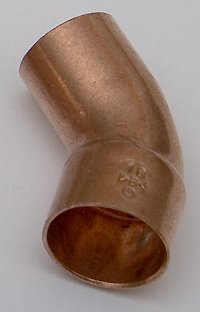
45° street elbow (copper sweat)

A street elbow (sometimes called a street ell or service ell) is a type of plumbing or piping fitting intended to join a piece of pipe and another fitting at an angle. The difference between a street elbow and a regular elbow is the gender of its two connections.

A regular elbow has a hub or female-threaded connection on each end, so it can join two male pipes. Instead, a street elbow has a female fitting on one end and a male fitting on the other. The advantage of the street elbow is that it can be connected directly to another fitting without having to use an additional short connecting piece (a pipe nipple).

Applications

[edit]

Street elbows are available with bend angles of 90°, 45°, and 22.5°. They can be used in many plumbing applications, including water supply, drainage, sewers, vents, central vacuum systems, compressed air and gas lines, heating and air conditioning, sump pump drains, and other locations where plumbing fittings would be used to join sections of pipe.

Plumbing codes regulate the use of street elbows. For example, Canada's national plumbing code prohibits them in natural gas and propane installations:[1]

Street elbows and tees are not permitted because these fittings have both male and female threaded ends. This makes alignment of the piping difficult since the direction of the piping does not always correspond with the fully seated position of the fitting. When the connection is backed off to align the piping, leakage may result.

See also

[edit]

References

[edit]
Revisions and contributorsEdit on WikipediaRead on Wikipedia
from Grokipedia
A street elbow is a type of pipe fitting used in systems to connect pipes or a pipe to another fitting at an , typically 90 degrees or 45 degrees, with one end featuring a male connection and the other a connection, typically threaded in metal fittings or spigot/socket in ones. This configuration distinguishes it from a standard , which has female connections on both ends, allowing the street elbow to directly join a male-ended pipe to a female-ended fitting without additional adapters. Street elbows are essential components in both and drain-waste-vent (DWV) systems, enabling directional changes in tight s and facilitating compact installations in residential, commercial, and industrial . They are commonly employed in applications such as redirecting fluid flow, high-pressure , and connections near service lines, where space constraints or direct connections are advantageous. Available in various materials to suit different system requirements, street elbows can be made from PVC or CPVC for corrosion-resistant DWV applications, for potable lines, or metals like , , galvanized steel, and for durable, high-strength setups. The term "street elbow" originates from its historical use in municipal water service connections at the edge of streets, where it provided a reliable angled between underground mains and building supply lines. Modern standards ensure these fittings meet pressure ratings and material specifications, for pressure systems such as Schedule 40 PVC under ASTM D2466 and for DWV such as ASTM D2661, to prevent leaks and maintain system integrity in diverse environments.

Definition and History

Definition

A street elbow is a specialized pipe fitting designed to join a pipe to another fitting at an angle, typically 90 degrees, with one end featuring male threads (or a spigot for ) and the other end featuring female threads (or a socket). Its primary function is to facilitate a change in direction within systems for or gas conveyance, while allowing a direct connection between a pipe and an adjacent fitting without requiring an intermediate or . This configuration reduces the overall length of the assembly and minimizes potential leak points in or industrial systems. Structurally, street elbows are available in common angles of 90° and 45°, with ends that can be threaded for screwed joints or prepared for (such as socket ) to ensure secure, pressure-resistant connections suitable for various conveyance applications. The term "street elbow" originates from its historical application in connecting residential or service lines directly to municipal street mains, where the fitting's dual-end design was essential for tapping into corporation cocks or water lines.

Historical Origin

The street elbow emerged during the rapid expansion of municipal water and sewer systems in the late , as urban centers in the United States and developed large-scale to meet growing demands for clean water and . This period saw the transition from rudimentary wooden pipes to more durable materials, driven by public health crises like outbreaks and the need for pressurized distribution networks. In the United States, cities such as pioneered early mains in the early 1800s, but widespread adoption accelerated in the mid-19th century amid industrialization and population booms. Similar developments occurred in , where pipes were used in as early as the 1660s for . The fitting's name derives from its primary role in connecting building service lines directly to street mains, facilitating the transition from underground municipal infrastructure to indoor piping without additional joints. Historically, water mains along streets featured fittings at service points, and the street elbow—often called a service —allowed plumbers to attach house lines at a 90-degree angle, simplifying installations in urban settings. This design addressed the challenges of aligning pipes from buried mains to building entries, a common necessity in 19th-century city planning. Key milestones include the first widespread use of street elbows in cast iron systems during the 1850s, coinciding with advancements in casting techniques and pipe manufacturing. By the early 1900s, adaptations to threaded designs proliferated, incorporating for resistance and galvanized for affordability, as these materials supported higher pressures in evolving residential and commercial plumbing. The evolution progressed from custom-forged pieces, laboriously made by local foundries, to standardized mass-produced fittings by the mid-20th century, spurred by regulatory frameworks such as the (UPC), first published in 1945, building on earlier standards like the 1928 Hoover Code. This code, along with similar standards, promoted interchangeable components, reducing variability and enhancing reliability in urban water systems.

Design and Specifications

Types and Variations

Street elbows are available in various angles to accommodate different requirements, with the 90° variant being the most common for creating sharp directional changes in systems. The 45° street elbow, in contrast, provides a gentler bend that minimizes flow resistance and , making it suitable for applications where smoother transitions are needed. Connection styles for street elbows vary by application and system type, including threaded designs compliant with or standards for secure, leak-resistant joints in low- to medium-pressure environments. Socket-weld street elbows, featuring one socket end and one threaded end, are used in high-pressure piping systems for welded connections that enhance structural integrity. For plastic systems like PVC, spigot x socket configurations allow for push-fit assemblies, simplifying installation in drainage and irrigation setups. Specialized variations include long-radius street elbows, which offer a broader curvature for reduced and smoother flow, commonly applied in HVAC systems to maintain efficient air or movement. Short-radius street elbows, with tighter bends, are designed for confined spaces, such as in drainage lines where space constraints prioritize compactness over flow optimization. These fittings typically range in nominal pipe size (NPS) from 1/8 inch to 6 inches, with smaller sizes (up to 2 inches) favored for residential and larger ones for commercial or industrial use.

Materials and Construction

Street elbows are constructed from materials chosen for their durability, resistance, and compatibility with specific environments. is a primary for potable applications due to its inherent resistance, which protects against degradation in systems. (PVC) and (CPVC) are favored for non-pressurized drainage systems, offering cost-effectiveness and resistance to chemicals and . , in grades such as 304 and 316, is utilized in chemical processing or high-temperature settings for its enhanced resistance to harsh conditions. Manufacturing processes for street elbows depend on the base material. Metallic versions, including and , are typically produced via methods like or , with threading applied to one end for connections and the other prepared for fittings post-casting. Plastic street elbows, such as those in PVC or CPVC, are formed through injection molding, enabling precise shaping and subsequent finishing like threading. Material properties play a critical role in performance and selection. Brass provides malleability and a yield strength of approximately 100-400 MPa, facilitating robust while allowing deformation without . PVC delivers lightweight design and electrical insulation but is restricted to service temperatures below 140°F to prevent softening. Stainless steel grades 304 and 316 offer superior resistance to in acidic environments, ensuring longevity in corrosive exposures. Regulatory and sustainability factors guide modern production. Lead-free alloys have been required since 2014 under the U.S. for potable water fittings, limiting lead content to 0.25% in pipes and fittings to minimize risks. Contemporary manufacturing emphasizes recyclable materials, with , , and PVC options supporting environmental through high recyclability rates.

Dimensions and Standards

Street elbows are sized according to the (NPS) system, which designates the approximate inside of the pipe they connect, ensuring compatibility across systems. For instance, a 1/2-inch NPS street elbow aligns with pipe having an outside of approximately 0.840 inches and an inside of 0.622 inches for Schedule 40 applications. Larger sizes, such as 1-inch NPS, feature an outside of 1.315 inches and inside of 1.049 inches. Pressure and temperature ratings for street elbows vary by material and schedule, with Schedule 40 PVC fittings having pressure ratings that vary by size, ranging from approximately 600 psi for 1/2-inch NPS to 140 psi for 6-inch NPS at 73°F for water service, with derating at higher temperatures (e.g., to about 91 psi at 110°F for a 6-inch size). Brass street elbows, commonly used in residential plumbing, are rated up to 150 psi for working pressures in non-shock cold water applications. Malleable iron fittings under Class 150 provide 300 psi for non-shock cold water, while Schedule 80 PVC variants exceed 400 psi for industrial uses, such as a 1-inch size rated at 450 psi at 73°F. Key standards govern the design and manufacturing of to promote safety and interoperability. Malleable iron threaded conform to ASME B16.3, which specifies dimensions and classes 150 and 300 for threaded fittings. PVC adhere to ASTM D2466 for injection-molded Schedule 40 fittings, ensuring dimensional accuracy and material integrity. Threading follows ISO 7/1 for -tight joints on tapered pipe threads, compatible with NPT equivalents. Compliance with plumbing codes like the (UPC) and International Plumbing Code (IPC) requires these fittings to meet referenced standards for and drainage systems. Tolerances in street elbows include thread engagement depths typically ranging from 0.5 to 1.5 times the pipe to achieve a secure seal without over-stressing, as per NPT guidelines allowing ±1 turn variation. Wall thickness varies by schedule; for example, Schedule 40 PVC at 1-inch NPS has a minimum wall thickness of 0.133 inches to withstand specified pressures.
NPS SizeExample Dimension: Center-to-End (/, inches) - Threaded ASME B16.11 Class 3000Wall Thickness (Schedule 40 PVC, inches)
1/21.10 / 1.610.109
11.73 / 2.240.133
These specifications facilitate precise integration in networks. Approximate values in inches; exact per ASME B16.11.

Installation and Applications

Installation Methods

Street elbows are installed using methods appropriate to their material and system type, including threaded connections for metals like , solvent-cementing for PVC, or for , and for certain metals like .

Preparation Steps

Before installing a street elbow, measure and cut the pipe to the required length using a pipe cutter or to ensure a square end, which promotes a secure connection. Clean the threads or sockets thoroughly to remove debris, burrs, or oxidation, using a deburring tool or for smooth surfaces. Apply thread , such as PTFE tape wrapped clockwise 2-3 times on the male end, to prevent leaks in threaded connections; for PVC socket ends, no sealant is needed at this stage but primer and cement will be applied later.

Threaded Installation

For threaded street elbows, typically made of , screw the end into the mating fitting by hand until snug, then tighten an additional 1-2 full turns using two adjustable wrenches to avoid twisting the pipe. This method ensures proper engagement without over-tightening, which can damage threads; for a 1/2-inch fitting, aim for approximately 20-30 ft-lbs of if using a , though hand-tight plus turns is the standard practice for NPT threads. Dry fit components first to verify alignment and measure insertion depth, typically 0.4 inches hand-tight for 1/2-inch NPT.

Solvent-Cement and Welded Methods

In PVC systems, use the solvent-cement method: apply PVC primer liberally to the pipe spigot and the socket interior of the street elbow, followed immediately by a heavy coat of medium- or heavy-bodied PVC on the pipe and a medium coat inside the socket. Insert the pipe fully into the socket, twist 1/4 turn to distribute the evenly, and hold for at least 30 seconds to set; allow 30 minutes to 24 hours for curing based on ambient conditions and manufacturer specifications. For metal street elbows in applications requiring , such as , employ TIG with a filler rod matching the base material (e.g., ER308L for 304 stainless) to join the elbow to pipe ends, ensuring clean preparation and proper heat control to avoid distortion. For street elbows, use or with lead-free and . These methods are suitable for pressure or drainage systems but require adherence to material-specific guidelines.

Best Practices

Maintain proper alignment during installation to prevent stress on the joint, which can lead to premature failure; use supports if needed for longer runs. After assembly, test the system for leaks at a pressure equal to the system's working pressure, but not less than 40 psi (276 kPa), for at least 15 minutes using water from a potable source, inspecting all connections visually and with soapy water for bubbles. For buried installations, place pipes not less than 12 inches below the frost line where the ground is subject to frost, or 12 inches below the undisturbed ground surface where not subject to frost, or as required by local jurisdiction, following International Plumbing Code requirements. Always wear safety gear, ensure ventilation, and comply with manufacturer instructions and applicable codes to guarantee a reliable, code-compliant installation.

Common Applications

Street elbows find widespread use in residential systems, where they facilitate direct connections between service lines and main shutoffs or fixtures like sinks and toilets, particularly in space-constrained areas such as under cabinets or behind walls. Their one-male, one-female end design allows for seamless integration without additional pipe stubs, simplifying installations in home lines and ensuring efficient flow redirection while maintaining pressure consistency. In municipal and applications, street elbows link lateral pipes to street water mains or hydrants, enabling compact turns in urban water distribution networks. They are also employed in setups for 90° directional changes at plant beds or valve manifolds, supporting underground and surface layouts in projects by providing secure, space-saving connections from pipes to sprinklers or emitters. Industrial and HVAC systems utilize street elbows to direct flow in lines or circuits, where their threaded configuration ensures leak-proof performance in high-pressure environments. In the oil and gas sector, they are common for connections and redirects in refineries, handling corrosive fluids and gases with durable materials like for reliable operation in tight spaces. For drainage and sewer applications, street elbows are integral to drain, waste, and vent (DWV) systems, supporting vent stack transitions by changing pipe direction 90° to facilitate air circulation and removal. ABS and PVC variants are particularly suited for underground septic tie-ins, providing smooth horizontal or vertical transitions in residential and commercial setups, including under-slab installations, to ensure efficient gravity-fed waste elimination without blockages.

Comparisons and Advantages

Comparison to Standard Elbows

A street elbow differs from a standard elbow primarily in its end configurations, where the street elbow features one threaded end (MIP) and one threaded end (FIP), allowing direct connection to another fitting without an intermediate pipe section. In contrast, a standard elbow has two threaded ends (FIP x FIP), necessitating the use of a or to join it to a male-ended pipe or fitting. This distinction is standardized under ASME B16.11 for threaded fittings. The space efficiency of street elbows provides a notable advantage in confined installations, such as penetrations or tight mechanical spaces, by eliminating the need for an additional close , which typically measures 1 to 1.5 inches in length. This results in a space saving of approximately 1-2 inches per connection compared to using a standard elbow with a . Standard elbows, while versatile for open layouts, require this extra component, increasing the overall assembly length. In terms of flow dynamics, both and standard elbows offer similar 90-degree bend radii and do not significantly differ in or resistance when sized equivalently, as the internal remains comparable. However, the elbow's integrated connection reduces the number of potential leak points in threaded systems by minimizing joints from three (elbow + two nipples) to two. Regarding cost and availability, street elbows typically cost slightly more than standard elbows due to the additional machining for the end. Standards are more widely stocked for general uniform connections, while street elbows are readily available but prioritized for space-constrained applications.

Advantages and Disadvantages

Street elbows offer several advantages in systems due to their unique male-to-female threaded design, which allows for direct connection between a pipe and another fitting without requiring an intermediate component such as a or . This compact configuration minimizes material usage by eliminating extra parts and reduces the overall footprint, making it particularly suitable for space-constrained installations like those in residential or tight mechanical setups. The direct connectivity also lowers the number of joints in the system, thereby decreasing potential leak points and enhancing reliability in low-to-medium pressure applications, typically rated up to 300 psi at 150°F for Class 150 malleable iron fittings. Additionally, this design provides versatility for transitioning between different pipe types or sizes in mixed systems, such as combining threaded and non-threaded components, which streamlines assembly and reduces installation time compared to using multiple standard fittings. Despite these benefits, street elbows have notable disadvantages, including the potential for higher costs depending on manufacturer and material due to specialized threading. The threaded male end also raises the risk of cross-threading during installation if alignment is not precise, potentially leading to damaged fittings and the need for replacements. Furthermore, they are limited in high-vibration environments, where loosening can occur without the use of thread-locking compounds, making them less ideal for dynamic applications like industrial machinery. Performance trade-offs include their optimization for low-to-medium pressures (up to 300 psi at 150°F for Class 150 fittings), beyond which higher-rated alternatives like welded elbows are preferred for and . In systems designed with all-female connections, street elbows may necessitate additional adapters to integrate properly, which can introduce complexity and extra potential failure points despite their otherwise streamlined design. From a maintenance perspective, the male end facilitates easier disassembly for repairs or inspections, allowing straightforward unscrewing without specialized tools in many cases. However, the exposed threads are more susceptible to in aggressive media, such as acidic or saline environments, accelerating degradation if protective coatings like or PTFE tape are not applied, potentially shortening service life compared to seamless alternatives.

References

Add your contribution
Related Hubs
User Avatar
No comments yet.