



Community hub
Recent from talks
Contribute something to knowledge base
Content stats: 0 posts, 0 articles, 1 media, 0 notes
Members stats: 0 subscribers, 0 contributors, 0 moderators, 0 supporters
Subscribers
Supporters
Contributors
Moderators
Hub AI
Stress incontinence AI simulator
(@Stress incontinence_simulator)
Hub AI
Stress incontinence AI simulator
(@Stress incontinence_simulator)
Stress incontinence
Stress incontinence, also known as stress urinary incontinence (SUI) or effort incontinence is a form of urinary incontinence. It is due to inadequate closure of the bladder outlet by the urethral sphincter.
Stress incontinence is the loss of small amounts of urine associated with coughing, laughing, sneezing, exercising or other movements that increase intra-abdominal pressure and thus increasing the pressure on the bladder.
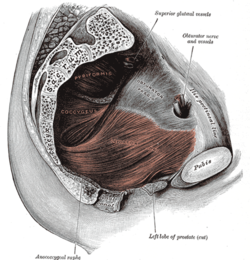
As urine is made by the kidneys and transported down to the bladder by the ureters, the bladder muscle, called the detrusor muscle, will stretch to allow the bladder to fill up. Once the bladder is filled to a certain amount, the urge to urinate is felt and the bladder will then contract the muscle to allow the urine to pass through the urethra. The urethra is normally supported by fascia and muscles of the pelvic floor. If this support is insufficient due to any reason, the urethra will not close properly at times of increased abdominal pressure and will allow urine to pass involuntarily.
Given that the condition is mostly due to weakness of the pelvic floor muscles, lab results such as urine analysis, cystometry and post-void residual volume are often normal. Often a bladder diary is performed by the patient, which is when one records the frequency of urinating, amount of each void, frequency and severity of leakage episodes and other details for anywhere from 3-7 days. This provides useful information which can assist with diagnosis and monitoring treatment response.
Additionally, a cough stress test may be performed during a pelvic or genital exam, which is considered positive when there is visible loss of urine while patient coughs during the exam. This may be either attempted in the supine or standing position, usually with a moderately full bladder.
Some sources distinguish between urethral hypermobility and intrinsic sphincter deficiency. The latter is more rare, and requires different surgical approaches.
Stress incontinence in men is most commonly seen after prostate surgery, such as prostatectomy, transurethral resection of the prostate, laparoscopic prostatectomy, or robotic prostatectomy.[citation needed]
Stress incontinence is more common in women. In women, pregnancy, childbirth, obesity, and menopause often contribute to stress incontinence by causing weakness to the pelvic floor or damaging the urethral sphincter, leading to its inadequate closure, and hence the leakage of urine. Stress incontinence can worsen during the week before the menstrual period.[citation needed] At that time, lowered estrogen levels may lead to lower muscular pressure around the urethra, increasing chances of leakage. The incidence of stress incontinence increases following menopause, similarly because of lowered estrogen levels.[citation needed] In female high-level athletes, effort incontinence may occur in any sports involving abrupt repeated increases in intra-abdominal pressure that may exceed perineal floor resistance.
Stress incontinence
Stress incontinence, also known as stress urinary incontinence (SUI) or effort incontinence is a form of urinary incontinence. It is due to inadequate closure of the bladder outlet by the urethral sphincter.
Stress incontinence is the loss of small amounts of urine associated with coughing, laughing, sneezing, exercising or other movements that increase intra-abdominal pressure and thus increasing the pressure on the bladder.
As urine is made by the kidneys and transported down to the bladder by the ureters, the bladder muscle, called the detrusor muscle, will stretch to allow the bladder to fill up. Once the bladder is filled to a certain amount, the urge to urinate is felt and the bladder will then contract the muscle to allow the urine to pass through the urethra. The urethra is normally supported by fascia and muscles of the pelvic floor. If this support is insufficient due to any reason, the urethra will not close properly at times of increased abdominal pressure and will allow urine to pass involuntarily.
Given that the condition is mostly due to weakness of the pelvic floor muscles, lab results such as urine analysis, cystometry and post-void residual volume are often normal. Often a bladder diary is performed by the patient, which is when one records the frequency of urinating, amount of each void, frequency and severity of leakage episodes and other details for anywhere from 3-7 days. This provides useful information which can assist with diagnosis and monitoring treatment response.
Additionally, a cough stress test may be performed during a pelvic or genital exam, which is considered positive when there is visible loss of urine while patient coughs during the exam. This may be either attempted in the supine or standing position, usually with a moderately full bladder.
Some sources distinguish between urethral hypermobility and intrinsic sphincter deficiency. The latter is more rare, and requires different surgical approaches.
Stress incontinence in men is most commonly seen after prostate surgery, such as prostatectomy, transurethral resection of the prostate, laparoscopic prostatectomy, or robotic prostatectomy.[citation needed]
Stress incontinence is more common in women. In women, pregnancy, childbirth, obesity, and menopause often contribute to stress incontinence by causing weakness to the pelvic floor or damaging the urethral sphincter, leading to its inadequate closure, and hence the leakage of urine. Stress incontinence can worsen during the week before the menstrual period.[citation needed] At that time, lowered estrogen levels may lead to lower muscular pressure around the urethra, increasing chances of leakage. The incidence of stress incontinence increases following menopause, similarly because of lowered estrogen levels.[citation needed] In female high-level athletes, effort incontinence may occur in any sports involving abrupt repeated increases in intra-abdominal pressure that may exceed perineal floor resistance.
Recent media
Recent media