



Community hub
Recent from talks
Contribute something to knowledge base
Content stats: 0 posts, 0 articles, 1 media, 0 notes
Members stats: 0 subscribers, 0 contributors, 0 moderators, 0 supporters
Subscribers
Supporters
Contributors
Moderators
Hub AI
Stretch marks AI simulator
(@Stretch marks_simulator)
Hub AI
Stretch marks AI simulator
(@Stretch marks_simulator)
Stretch marks
Stretch marks, also known as striae (/ˈstraɪiː/)[citation needed] or striae distensae, are a form of scarring on the skin with an off-color hue. Over time, they may diminish, but will not disappear completely. Striae are caused by tearing of the dermis during periods of rapid growth of the body, such as during puberty or pregnancy, in which they usually form during the last trimester. Usually on the belly, these striae also commonly occur on the breasts, thighs, hips, lower back, and buttocks. Pregnancy-related striae are known as striae gravidarum. Striae may also be influenced by the hormonal changes associated with puberty, pregnancy, bodybuilding, or hormone replacement therapy. There is no evidence that creams used during pregnancy prevent stretch marks. Once they have formed, there is no clearly effective treatment, though various methods have been attempted and studied.
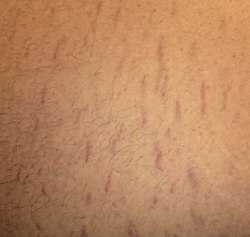
Striae, or "stretch marks", begin as reddish or purple lesions which can appear anywhere on the body, but are most likely to appear in places where larger amounts of fat are stored. The most common places are the abdomen (especially near the navel), breasts, upper arms, underarms, back, thighs (both inner and outer), hips, and buttocks. Over time, they tend to atrophy and lose pigmentation. The affected areas appear empty, and are soft to the touch.
Stretch marks occur in the dermis, the resilient middle tissue layer that helps the skin retain its shape. No stretch marks will form as long as there is support within the dermis; stretching plays a role in where the marks occur and in what direction they run.
They can (but do not always) cause a burning and itching sensation, as well as emotional distress. They pose no inherent health risk on their own, and do not compromise the body's ability to function normally and repair itself. However, some people dislike the way stretch marks look. Young women are generally affected the most and often seek treatment for them from a dermatologist and following pregnancy.
Stretch marks appear to be caused by stretching of the skin. This is especially true when there is an increase in cortisone – an increase in cortisone levels can increase the probability or severity of stretch marks by reducing the skin's pliability. More specifically, it affects the dermis by preventing the fibroblasts from forming collagen and elastin fibers necessary to keep rapidly growing skin taut; this can create a lack of supportive material as the skin is stretched, and lead to dermal and epidermal tearing, which in turn can produce scarring in the form of stretch marks. This is particularly the case when there is new tissue growth, which can interfere with the underlying physical support of the dermis or epidermis by displacing the supportive tissue.[citation needed]
Examples of cases where stretch marks are common include weight gain (in the form of fat and/or muscle), pregnancy, and adolescent growth spurts, though it is also noted that some medications, as well as other medical conditions and diseases, may increase the likelihood of stretch marks appearing. Common medications that can contribute to stretch marks include "corticosteroid creams, lotions and pills and chronic use of oral or systemic steroids". Medical conditions that can contribute to stretch marks include Ehlers–Danlos syndrome, Cushing's syndrome, Marfan syndrome, and adrenal gland diseases.
Asians are more prone to stretch marks.
Pregnancy stretch marks, also known as striae gravidarum, are a specific form of scarring of the skin of the abdominal area due to rapid expansion of the uterus as well as sudden weight gain during pregnancy. About 90% of pregnant women are affected.
Stretch marks
Stretch marks, also known as striae (/ˈstraɪiː/)[citation needed] or striae distensae, are a form of scarring on the skin with an off-color hue. Over time, they may diminish, but will not disappear completely. Striae are caused by tearing of the dermis during periods of rapid growth of the body, such as during puberty or pregnancy, in which they usually form during the last trimester. Usually on the belly, these striae also commonly occur on the breasts, thighs, hips, lower back, and buttocks. Pregnancy-related striae are known as striae gravidarum. Striae may also be influenced by the hormonal changes associated with puberty, pregnancy, bodybuilding, or hormone replacement therapy. There is no evidence that creams used during pregnancy prevent stretch marks. Once they have formed, there is no clearly effective treatment, though various methods have been attempted and studied.
Striae, or "stretch marks", begin as reddish or purple lesions which can appear anywhere on the body, but are most likely to appear in places where larger amounts of fat are stored. The most common places are the abdomen (especially near the navel), breasts, upper arms, underarms, back, thighs (both inner and outer), hips, and buttocks. Over time, they tend to atrophy and lose pigmentation. The affected areas appear empty, and are soft to the touch.
Stretch marks occur in the dermis, the resilient middle tissue layer that helps the skin retain its shape. No stretch marks will form as long as there is support within the dermis; stretching plays a role in where the marks occur and in what direction they run.
They can (but do not always) cause a burning and itching sensation, as well as emotional distress. They pose no inherent health risk on their own, and do not compromise the body's ability to function normally and repair itself. However, some people dislike the way stretch marks look. Young women are generally affected the most and often seek treatment for them from a dermatologist and following pregnancy.
Stretch marks appear to be caused by stretching of the skin. This is especially true when there is an increase in cortisone – an increase in cortisone levels can increase the probability or severity of stretch marks by reducing the skin's pliability. More specifically, it affects the dermis by preventing the fibroblasts from forming collagen and elastin fibers necessary to keep rapidly growing skin taut; this can create a lack of supportive material as the skin is stretched, and lead to dermal and epidermal tearing, which in turn can produce scarring in the form of stretch marks. This is particularly the case when there is new tissue growth, which can interfere with the underlying physical support of the dermis or epidermis by displacing the supportive tissue.[citation needed]
Examples of cases where stretch marks are common include weight gain (in the form of fat and/or muscle), pregnancy, and adolescent growth spurts, though it is also noted that some medications, as well as other medical conditions and diseases, may increase the likelihood of stretch marks appearing. Common medications that can contribute to stretch marks include "corticosteroid creams, lotions and pills and chronic use of oral or systemic steroids". Medical conditions that can contribute to stretch marks include Ehlers–Danlos syndrome, Cushing's syndrome, Marfan syndrome, and adrenal gland diseases.
Asians are more prone to stretch marks.
Pregnancy stretch marks, also known as striae gravidarum, are a specific form of scarring of the skin of the abdominal area due to rapid expansion of the uterus as well as sudden weight gain during pregnancy. About 90% of pregnant women are affected.
Recent media
Recent media