
Recent from talks
Strohmandeln
Knowledge base stats:
Talk channels stats:
Members stats:
Strohmandeln
Strohmandeln, also called Strohmandel, Strohmanntarock, Strohmanntarok, Zweiertarock, Strawman Tarock or Straw Man Tarock, is an old, two-hand card game from the Austrian branch of the Tarock family. It takes its name from the three-packet talon of four cards, the Strohmänner ("strawmen"), each player has at the start of the game. While the original game has been described as jejune, it was eventually superseded by an attractive successor which is both challenging and very exciting.
The forerunner to Strohmandeln was a two-hand variant of the 78-card Tarock game recorded as early as early as 1800 in a Viennese games compendium, Neuestes Spielbuch, where it was called "Taroc en deux" in which a face-down dummy of 25 cards was dealt but never used during the game. The 54-card version first appeared in 1829, when it was described as "Tarok-Tappen between two players or the so-called Strohmandel". However, in these rules the dummy or 'straw man' was actually used; the winner of a trick picking up the top card of the straw man pile and adding it to his trick cards. This game was easy to win if the straw man yields a lot of Kings and other court cards, leaving an opponent with just tarocks or Skartindels (low-counting cards). But, according to an 1839 Austrian games compendium, because the game depends more on luck than skill, it "would probably only be chosen by people who are completely unaware of the noble game of Piquet." Fortunately by no later than 1890, this "rather jejune game was ousted by a much better and quite different one"; a genuine two-player game in which the 'straw men' comprise three packets of four cards that form the initially unseen part of a player's hand. This later variant has been described as a "very attractive" game for two which is both challenging and very exciting.
The only other two-handed Tarock game is the more complex Kosakeln or Kosaken ("Cossack"), which was introduced in the 1950s, but was more based on Illustrated Tarock than Tapp Tarock.
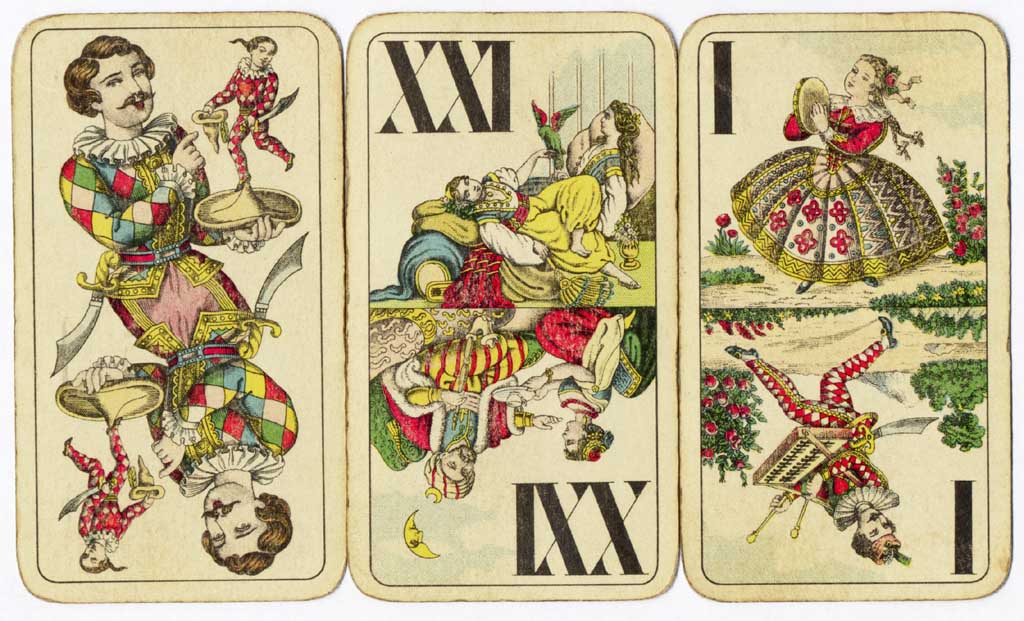
The game is played with the usual Industrie und Glück card deck of 54 cards used for other Tarock games in Austria and other areas of the former Habsburg Empire (for more details, see Königrufen). This pack contains 22 tarocks as trumps and 32 cards in the four French suits. The card ranking is K Q C V 10 9 8 7 in the black suits and K Q C V 1 2 3 4 in the red suits. The cards are widely available online.
The description of the rules largely follows that of Beck.
Higher-value plain cards beat lower value plain cards in their own suit, tarocks beat suit cards and lower tarocks. Players must follow suit (Farbzwang), but there is no pressure to win the trick (no Stichzwang). If the lead suit cannot be followed, a Tarock must be played (Tarockzwang).
The deck is cut to decide which of the two players deals first, then dealing alternates with each hand of cards. After shuffling and cutting, the dealer deals three packets of five cards each, beginning with forehand. The players then assess their cards. After assessing her hand, forehand has the right to decide first whether to "play" (Ich nehme auf) or to "pass" (Weiter or Ich passe). If she passes, this right passes to the dealer. If he passes as well, the cards are thrown in and a new hand dealt by the player who was forehand. Alternatively, they can agree to play regardless, but at a lower game value. Once a player has elected to "play", he or she becomes the declarer. The dealer then deals three packets of four cards to each player as talons, beginning with forehand again. These form the 'strawmen' (Strohmänner).
When the game begins and the strawmen have been placed, the top card of the first (left-hand) one is flipped. Tarocks and kings are set aside, face up, for the player in question, other suit cards remain face up as the top card of the strawman. The process of uncovering and setting aside is repeated for the other strawmen, from left to right. The last card of each strawman packet, regardless of its value, is added to the player's hand without being revealed. Then the cards set aside are also added to the respective players' hands after the process of uncovering is over and the opponent has viewed these cards.
Hub AI
Strohmandeln AI simulator
(@Strohmandeln_simulator)
Strohmandeln
Strohmandeln, also called Strohmandel, Strohmanntarock, Strohmanntarok, Zweiertarock, Strawman Tarock or Straw Man Tarock, is an old, two-hand card game from the Austrian branch of the Tarock family. It takes its name from the three-packet talon of four cards, the Strohmänner ("strawmen"), each player has at the start of the game. While the original game has been described as jejune, it was eventually superseded by an attractive successor which is both challenging and very exciting.
The forerunner to Strohmandeln was a two-hand variant of the 78-card Tarock game recorded as early as early as 1800 in a Viennese games compendium, Neuestes Spielbuch, where it was called "Taroc en deux" in which a face-down dummy of 25 cards was dealt but never used during the game. The 54-card version first appeared in 1829, when it was described as "Tarok-Tappen between two players or the so-called Strohmandel". However, in these rules the dummy or 'straw man' was actually used; the winner of a trick picking up the top card of the straw man pile and adding it to his trick cards. This game was easy to win if the straw man yields a lot of Kings and other court cards, leaving an opponent with just tarocks or Skartindels (low-counting cards). But, according to an 1839 Austrian games compendium, because the game depends more on luck than skill, it "would probably only be chosen by people who are completely unaware of the noble game of Piquet." Fortunately by no later than 1890, this "rather jejune game was ousted by a much better and quite different one"; a genuine two-player game in which the 'straw men' comprise three packets of four cards that form the initially unseen part of a player's hand. This later variant has been described as a "very attractive" game for two which is both challenging and very exciting.
The only other two-handed Tarock game is the more complex Kosakeln or Kosaken ("Cossack"), which was introduced in the 1950s, but was more based on Illustrated Tarock than Tapp Tarock.
The game is played with the usual Industrie und Glück card deck of 54 cards used for other Tarock games in Austria and other areas of the former Habsburg Empire (for more details, see Königrufen). This pack contains 22 tarocks as trumps and 32 cards in the four French suits. The card ranking is K Q C V 10 9 8 7 in the black suits and K Q C V 1 2 3 4 in the red suits. The cards are widely available online.
The description of the rules largely follows that of Beck.
Higher-value plain cards beat lower value plain cards in their own suit, tarocks beat suit cards and lower tarocks. Players must follow suit (Farbzwang), but there is no pressure to win the trick (no Stichzwang). If the lead suit cannot be followed, a Tarock must be played (Tarockzwang).
The deck is cut to decide which of the two players deals first, then dealing alternates with each hand of cards. After shuffling and cutting, the dealer deals three packets of five cards each, beginning with forehand. The players then assess their cards. After assessing her hand, forehand has the right to decide first whether to "play" (Ich nehme auf) or to "pass" (Weiter or Ich passe). If she passes, this right passes to the dealer. If he passes as well, the cards are thrown in and a new hand dealt by the player who was forehand. Alternatively, they can agree to play regardless, but at a lower game value. Once a player has elected to "play", he or she becomes the declarer. The dealer then deals three packets of four cards to each player as talons, beginning with forehand again. These form the 'strawmen' (Strohmänner).
When the game begins and the strawmen have been placed, the top card of the first (left-hand) one is flipped. Tarocks and kings are set aside, face up, for the player in question, other suit cards remain face up as the top card of the strawman. The process of uncovering and setting aside is repeated for the other strawmen, from left to right. The last card of each strawman packet, regardless of its value, is added to the player's hand without being revealed. Then the cards set aside are also added to the respective players' hands after the process of uncovering is over and the opponent has viewed these cards.
Recent media