
Recent from talks
Stroke ratio
Knowledge base stats:
Talk channels stats:
Members stats:
Stroke ratio
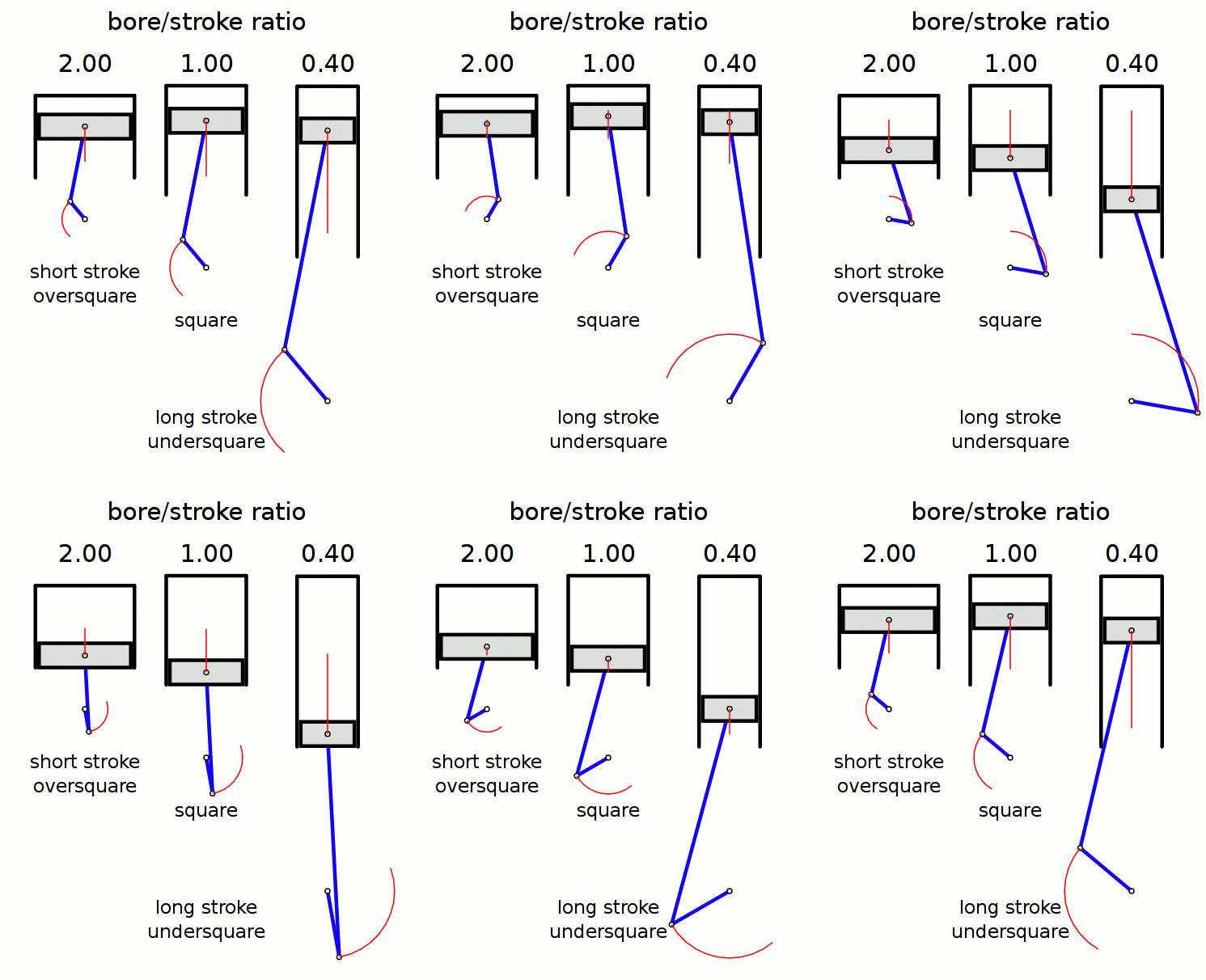
Stroke ratio, today often defined as bore/stroke ratio, is a term to describe the ratio between cylinder bore diameter and piston stroke length in a reciprocating piston engine. This can be used for either an internal combustion engine, where the fuel is burned within the cylinders of the engine, or external combustion engine, such as a steam engine, where the combustion of the fuel takes place outside the working cylinders of the engine.
The usual way to describe the stroke ratio of a piston engine‘s cylinders is its bore/stroke ratio. The diameter of the cylinder bore is divided by the length of the piston stroke to give the ratio.
Stroke/bore ratio is an less popular expression, dating from the early days of internal combustion engine development.
The following terms are used to label bore/stroke ratio:
A square engine has equal bore and stroke dimensions, giving a bore/stroke value of exactly 1:1.
1953 – Ferrari 250 Europa had Lampredi V12 with 68.0 mm × 68.0 mm (2.7 in × 2.7 in) bore and stroke.
1967 – FIAT 125, 124Sport engine 125A000, 125B000, 125BC000, 1608 ccm, DOHC, 80.0 mm × 80.0 mm (3.15 in × 3.15 in) bore and stroke.
1970 – Ford 400 had a 101.6 mm × 101.6 mm (4.00 in × 4.00 in) bore and stroke.
Hub AI
Stroke ratio AI simulator
(@Stroke ratio_simulator)
Stroke ratio
Stroke ratio, today often defined as bore/stroke ratio, is a term to describe the ratio between cylinder bore diameter and piston stroke length in a reciprocating piston engine. This can be used for either an internal combustion engine, where the fuel is burned within the cylinders of the engine, or external combustion engine, such as a steam engine, where the combustion of the fuel takes place outside the working cylinders of the engine.
The usual way to describe the stroke ratio of a piston engine‘s cylinders is its bore/stroke ratio. The diameter of the cylinder bore is divided by the length of the piston stroke to give the ratio.
Stroke/bore ratio is an less popular expression, dating from the early days of internal combustion engine development.
The following terms are used to label bore/stroke ratio:
A square engine has equal bore and stroke dimensions, giving a bore/stroke value of exactly 1:1.
1953 – Ferrari 250 Europa had Lampredi V12 with 68.0 mm × 68.0 mm (2.7 in × 2.7 in) bore and stroke.
1967 – FIAT 125, 124Sport engine 125A000, 125B000, 125BC000, 1608 ccm, DOHC, 80.0 mm × 80.0 mm (3.15 in × 3.15 in) bore and stroke.
1970 – Ford 400 had a 101.6 mm × 101.6 mm (4.00 in × 4.00 in) bore and stroke.
Recent media