
Recent from talks
Strontium aluminate
Knowledge base stats:
Talk channels stats:
Members stats:
Strontium aluminate
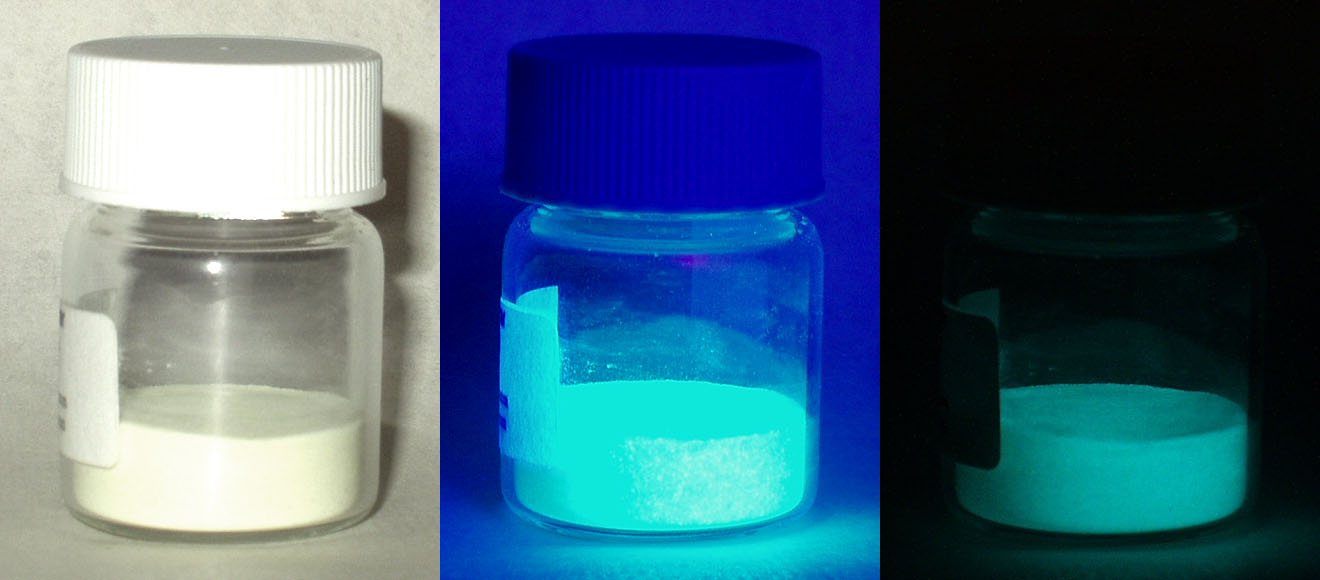
Strontium aluminate is an aluminate compound with the chemical formula SrAl2O4 (sometimes written as SrO·Al2O3). It is a pale yellow, monoclinic crystalline powder that is odourless and non-flammable. When activated with a suitable dopant (e.g. europium, written as Eu:SrAl2O4), it acts as a photoluminescent phosphor with long persistence of phosphorescence.
Strontium aluminates exist in a variety of other compositions including SrAl4O7 (monoclinic), Sr3Al2O6 (cubic), SrAl12O19 (hexagonal), and Sr4Al14O25 (orthorhombic). The different compositions cause different colours of light to be emitted.
Phosphorescent materials were discovered in the 1700s, and people have been studying them and making improvements over the centuries. The development of strontium aluminate pigments in 1993 was spurred on by the need to find a substitute for glow-in-the-dark materials with high luminance and long phosphorescence, especially those that used promethium. This led to the discovery by Yasumitsu Aoki (Nemoto & Co.) of materials with luminance approximately 10 times greater than zinc sulfide and phosphorescence approximately 10 times longer, and 10 times more expensive. The invention was patented by Nemoto & Co., Ltd. in 1994 and licensed to other manufacturers and watch brands. Strontium aluminates are now the longest lasting and brightest phosphorescent material commercially available.
For many phosphorescence-based purposes, strontium aluminate is a superior phosphor to its predecessor, copper-activated zinc sulfide, being about 10 times brighter and 10 times longer glowing.[citation needed] It is frequently used in glow in the dark objects, where it replaces the cheaper but less efficient Cu:ZnS that many people recognize with nostalgia – this is what made 'glow in the dark stars' stickers glow.
Advancements in understanding of phosphorescent mechanisms, as well as advancements in molecular imaging, have enabled the development of novel, state-of-the-art strontium aluminates.
Strontium aluminate phosphors produce green and aqua hues, where green gives the greatest brightness and aqua the longest glow time. Different aluminates can be used as the host matrix. This influences the wavelength of emission of the europium ion, by its covalent interaction with surrounding oxygens, and crystal field splitting of the 5d orbital energy levels.
The excitation wavelengths for strontium aluminate range from 200 to 450 nm, and the emission wavelengths range from 420 to 520 nm. The wavelength for its green formulation is 520 nm, its aqua, or blue-green, version emits at 505 nm, and its blue emits at 490 nm. Strontium aluminate can be formulated to phosphoresce at longer (yellow to red) wavelengths as well, though such emission is often dimmer than that of more common phosphorescence at shorter wavelengths.
For europium-dysprosium doped aluminates, the peak emission wavelengths are 520 nm for SrAl2O4, 480 nm for SrAl4O7, and 400 nm for SrAl12O19.
Hub AI
Strontium aluminate AI simulator
(@Strontium aluminate_simulator)
Strontium aluminate
Strontium aluminate is an aluminate compound with the chemical formula SrAl2O4 (sometimes written as SrO·Al2O3). It is a pale yellow, monoclinic crystalline powder that is odourless and non-flammable. When activated with a suitable dopant (e.g. europium, written as Eu:SrAl2O4), it acts as a photoluminescent phosphor with long persistence of phosphorescence.
Strontium aluminates exist in a variety of other compositions including SrAl4O7 (monoclinic), Sr3Al2O6 (cubic), SrAl12O19 (hexagonal), and Sr4Al14O25 (orthorhombic). The different compositions cause different colours of light to be emitted.
Phosphorescent materials were discovered in the 1700s, and people have been studying them and making improvements over the centuries. The development of strontium aluminate pigments in 1993 was spurred on by the need to find a substitute for glow-in-the-dark materials with high luminance and long phosphorescence, especially those that used promethium. This led to the discovery by Yasumitsu Aoki (Nemoto & Co.) of materials with luminance approximately 10 times greater than zinc sulfide and phosphorescence approximately 10 times longer, and 10 times more expensive. The invention was patented by Nemoto & Co., Ltd. in 1994 and licensed to other manufacturers and watch brands. Strontium aluminates are now the longest lasting and brightest phosphorescent material commercially available.
For many phosphorescence-based purposes, strontium aluminate is a superior phosphor to its predecessor, copper-activated zinc sulfide, being about 10 times brighter and 10 times longer glowing.[citation needed] It is frequently used in glow in the dark objects, where it replaces the cheaper but less efficient Cu:ZnS that many people recognize with nostalgia – this is what made 'glow in the dark stars' stickers glow.
Advancements in understanding of phosphorescent mechanisms, as well as advancements in molecular imaging, have enabled the development of novel, state-of-the-art strontium aluminates.
Strontium aluminate phosphors produce green and aqua hues, where green gives the greatest brightness and aqua the longest glow time. Different aluminates can be used as the host matrix. This influences the wavelength of emission of the europium ion, by its covalent interaction with surrounding oxygens, and crystal field splitting of the 5d orbital energy levels.
The excitation wavelengths for strontium aluminate range from 200 to 450 nm, and the emission wavelengths range from 420 to 520 nm. The wavelength for its green formulation is 520 nm, its aqua, or blue-green, version emits at 505 nm, and its blue emits at 490 nm. Strontium aluminate can be formulated to phosphoresce at longer (yellow to red) wavelengths as well, though such emission is often dimmer than that of more common phosphorescence at shorter wavelengths.
For europium-dysprosium doped aluminates, the peak emission wavelengths are 520 nm for SrAl2O4, 480 nm for SrAl4O7, and 400 nm for SrAl12O19.
Recent media