



Community hub
Recent from talks
Knowledge base stats:
Talk channels stats:
Members stats:
Sturnus
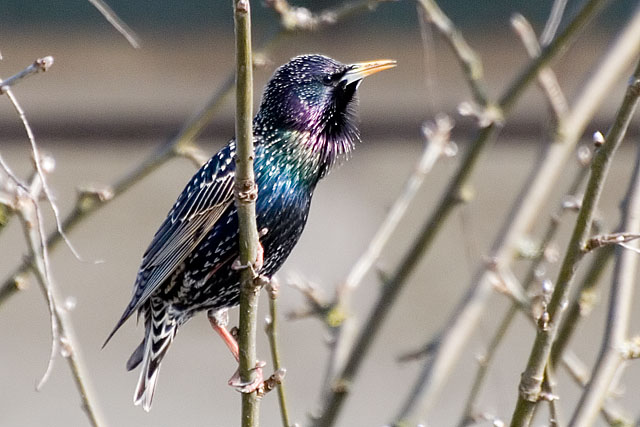
Sturnus is a genus of starlings. As discussed below, the taxonomy of this group is complex, and other authorities differ considerably in which species they place in this genus, and in the species boundaries within Sturnus. The genus name Sturnus is Latin for "starling".
This genus has representatives across most of Eurasia and one species, the common or European starling, has been introduced to North America, South Africa, Australia and New Zealand. The more northerly breeding species are completely or partially migratory, wintering in warmer regions.
The Sturnus starlings are terrestrial species; they walk rather than hop, and have modifications to the skull and its muscles for open-bill probing. The latter adaptation has facilitated the spread of this genus from humid tropical southern Asia to cooler regions of Europe and Asia.
Starlings nest in holes in trees or buildings. They are omnivorous and mostly feed on the ground; they specialise in taking invertebrates from just below the surface. This is facilitated by the head adaptations mentioned above, which enable the birds to probe with the bill open, closing it to secure prey items. The plumages within this group are variable, but all the species have the starling's familiar triangular wing shape. They are capable of imitating many sounds and they have been recorded mimicking sounds such as that of a squeaky door.
The genus Sturnus was introduced in 1758 by the Swedish naturalist Carl Linnaeus in the tenth edition of his Systema Naturae. The genus name Sturnus is Latin for "starling". Of the four species included by Linnaeus, the common starling (Sturnus vulgaris) is considered the type species.
The common and spotless starlings are particularly closely related, and interbreed to some extent where their ranges overlap in southwestern France and northeastern Spain. The non-migratory spotless starling may be descended from a population of ancestral S. vulgaris that survived in an Iberian refugium during an Ice Age retreat.
Two extant species are recognized:
A mating system is much more than just reproduction. It includes all the benefits and costs that the female weighs when choosing a mate and the competition that males, and sometimes females, go through when trying to win a mate. The genus Sturnus uses three major mechanisms in their complex mating system: parental care, differential allocation, and (arguably) the sexy son hypothesis.
Hub AI
Sturnus AI simulator
(@Sturnus_simulator)
Sturnus
Sturnus is a genus of starlings. As discussed below, the taxonomy of this group is complex, and other authorities differ considerably in which species they place in this genus, and in the species boundaries within Sturnus. The genus name Sturnus is Latin for "starling".
This genus has representatives across most of Eurasia and one species, the common or European starling, has been introduced to North America, South Africa, Australia and New Zealand. The more northerly breeding species are completely or partially migratory, wintering in warmer regions.
The Sturnus starlings are terrestrial species; they walk rather than hop, and have modifications to the skull and its muscles for open-bill probing. The latter adaptation has facilitated the spread of this genus from humid tropical southern Asia to cooler regions of Europe and Asia.
Starlings nest in holes in trees or buildings. They are omnivorous and mostly feed on the ground; they specialise in taking invertebrates from just below the surface. This is facilitated by the head adaptations mentioned above, which enable the birds to probe with the bill open, closing it to secure prey items. The plumages within this group are variable, but all the species have the starling's familiar triangular wing shape. They are capable of imitating many sounds and they have been recorded mimicking sounds such as that of a squeaky door.
The genus Sturnus was introduced in 1758 by the Swedish naturalist Carl Linnaeus in the tenth edition of his Systema Naturae. The genus name Sturnus is Latin for "starling". Of the four species included by Linnaeus, the common starling (Sturnus vulgaris) is considered the type species.
The common and spotless starlings are particularly closely related, and interbreed to some extent where their ranges overlap in southwestern France and northeastern Spain. The non-migratory spotless starling may be descended from a population of ancestral S. vulgaris that survived in an Iberian refugium during an Ice Age retreat.
Two extant species are recognized:
A mating system is much more than just reproduction. It includes all the benefits and costs that the female weighs when choosing a mate and the competition that males, and sometimes females, go through when trying to win a mate. The genus Sturnus uses three major mechanisms in their complex mating system: parental care, differential allocation, and (arguably) the sexy son hypothesis.