



Community hub
Recent from talks
Contribute something to knowledge base
Content stats: 0 posts, 0 articles, 1 media, 0 notes
Members stats: 0 subscribers, 0 contributors, 0 moderators, 0 supporters
Subscribers
Supporters
Contributors
Moderators
Hub AI
Submandibular gland AI simulator
(@Submandibular gland_simulator)
Hub AI
Submandibular gland AI simulator
(@Submandibular gland_simulator)
Submandibular gland
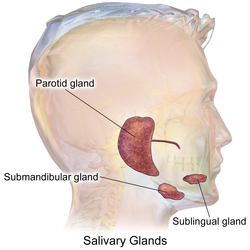
The paired submandibular glands (historically known as submaxillary glands) are major salivary glands located beneath the floor of the mouth. In adult humans, they each weigh about 15 grams and contribute some 60–67% of unstimulated saliva secretion; on stimulation their contribution decreases in proportion as parotid gland secretion rises to 50%. The average length of the normal adult human submandibular salivary gland is approximately 27 mm, while the average width is approximately 14.3 mm.
Each submandibular gland is divided into a superficial lobe and a deep lobe, the two being separated by the mylohyoid muscle:
Secretions are delivered into the submandibular duct on the deep portion after which they hook around the posterior edge of the mylohyoid muscle and proceed on the superior surface laterally. The excretory ducts are then crossed by the lingual nerve, and ultimately drain into the sublingual caruncles, which are small prominences on either side of the lingual frenulum along with the major sublingual duct. The gland can be bilaterally palpated (felt) inferior and posterior to the body of the mandible, moving inward from the inferior border of the mandible near its angle with the head tilted forwards.
The terminal part of the submandibular (Wharton) duct is located in the mouth floor and opens as an orifice of the submandibular duct papilla. The position of the duct and its 0.5–1.5 mm wide ostium is invariably symmetric, but quite unpredictable; consequently, submandibular duct papillae can occasionally be challenging to recognize. Based on the macroscopic appearance of the papillae and a sialoendoscopic approach, Anicin et al. described four different types of submandibular gland papillae: types A, B, C, and D.
Lobes contain smaller lobules, which contain adenomeres, the secretory units of the gland. Each adenomere contains one or more acini, or alveoli, which are small clusters of cells that secrete their products into a duct. The acini of each adenomere are composed of either serous or mucous cells, with serous adenomeres predominating. Some mucous adenomeres may also be capped with a serous demilune, a layer of lysozyme-secreting serous cells resembling a half moon.
Like other exocrine glands, the submandibular gland can be classified by the microscopic anatomy of its secretory cells and how they are arranged. Because the glands are branched, and because the tubules forming the branches contain secretory cells, submandibular glands are classified as branched tubuloacinar glands. Further, because the secretory cells are of both serous and mucous types, the submandibular gland is a mixed gland, and though most of the cells are serous, the exudate is chiefly mucous. It has long striated ducts and short intercalated ducts.
The secretory acinar cells of the submandibular gland have distinct functions. The mucous cells are the most active and therefore the major product of the submandibular glands is saliva which is mucoid in nature. Mucous cells secrete mucin which aids in the lubrication of the food bolus as it travels through the esophagus. In addition, the serous cells produce salivary amylase, which aids in the breakdown of starches in the mouth. The submandibular gland's highly active acini account for most of the salivary volume. The parotid and sublingual glands account for the remaining.
The gland receives its blood supply from the facial and lingual arteries. The gland is supplied by sublingual and submental arteries and drained by common facial and lingual veins.
Submandibular gland
The paired submandibular glands (historically known as submaxillary glands) are major salivary glands located beneath the floor of the mouth. In adult humans, they each weigh about 15 grams and contribute some 60–67% of unstimulated saliva secretion; on stimulation their contribution decreases in proportion as parotid gland secretion rises to 50%. The average length of the normal adult human submandibular salivary gland is approximately 27 mm, while the average width is approximately 14.3 mm.
Each submandibular gland is divided into a superficial lobe and a deep lobe, the two being separated by the mylohyoid muscle:
Secretions are delivered into the submandibular duct on the deep portion after which they hook around the posterior edge of the mylohyoid muscle and proceed on the superior surface laterally. The excretory ducts are then crossed by the lingual nerve, and ultimately drain into the sublingual caruncles, which are small prominences on either side of the lingual frenulum along with the major sublingual duct. The gland can be bilaterally palpated (felt) inferior and posterior to the body of the mandible, moving inward from the inferior border of the mandible near its angle with the head tilted forwards.
The terminal part of the submandibular (Wharton) duct is located in the mouth floor and opens as an orifice of the submandibular duct papilla. The position of the duct and its 0.5–1.5 mm wide ostium is invariably symmetric, but quite unpredictable; consequently, submandibular duct papillae can occasionally be challenging to recognize. Based on the macroscopic appearance of the papillae and a sialoendoscopic approach, Anicin et al. described four different types of submandibular gland papillae: types A, B, C, and D.
Lobes contain smaller lobules, which contain adenomeres, the secretory units of the gland. Each adenomere contains one or more acini, or alveoli, which are small clusters of cells that secrete their products into a duct. The acini of each adenomere are composed of either serous or mucous cells, with serous adenomeres predominating. Some mucous adenomeres may also be capped with a serous demilune, a layer of lysozyme-secreting serous cells resembling a half moon.
Like other exocrine glands, the submandibular gland can be classified by the microscopic anatomy of its secretory cells and how they are arranged. Because the glands are branched, and because the tubules forming the branches contain secretory cells, submandibular glands are classified as branched tubuloacinar glands. Further, because the secretory cells are of both serous and mucous types, the submandibular gland is a mixed gland, and though most of the cells are serous, the exudate is chiefly mucous. It has long striated ducts and short intercalated ducts.
The secretory acinar cells of the submandibular gland have distinct functions. The mucous cells are the most active and therefore the major product of the submandibular glands is saliva which is mucoid in nature. Mucous cells secrete mucin which aids in the lubrication of the food bolus as it travels through the esophagus. In addition, the serous cells produce salivary amylase, which aids in the breakdown of starches in the mouth. The submandibular gland's highly active acini account for most of the salivary volume. The parotid and sublingual glands account for the remaining.
The gland receives its blood supply from the facial and lingual arteries. The gland is supplied by sublingual and submental arteries and drained by common facial and lingual veins.
Recent media
Recent media