



Community hub
Recent from talks
Contribute something to knowledge base
Content stats: 0 posts, 0 articles, 1 media, 0 notes
Members stats: 0 subscribers, 0 contributors, 0 moderators, 0 supporters
Subscribers
Supporters
Contributors
Moderators
Hub AI
Palpation AI simulator
(@Palpation_simulator)
Hub AI
Palpation AI simulator
(@Palpation_simulator)
Palpation
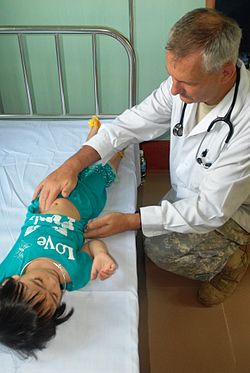
Palpation is the process of using one's hands to check the body, especially while perceiving/diagnosing a disease or illness. Usually performed by a health care practitioner, it is the process of feeling an object in or on the body to determine its size, shape, firmness, or location (for example, a veterinarian can feel the stomach of a pregnant animal to ensure good health and successful delivery).
Palpation is an important part of the physical examination; the sense of touch is just as important in this examination as the sense of sight is. Physicians develop great skill in palpating problems below the surface of the body, becoming able to detect things that untrained persons would not. Mastery of anatomy and much practice are required to achieve a high level of skill. The concept of being able to detect or notice subtle tactile signs and to recognize their significance or implications is called appreciating them (just as in general vocabulary one can speak of appreciating the importance of something). Nonetheless, some things are not palpable, which is why additional medical tests, such as medical imaging and laboratory tests, are often needed to make a diagnosis. However, many other problems are palpable. Examples include pulses, abdominal distension, cardiac thrills, fremitus, and various hernias, joint dislocations, bone fractures, and tumors, among others.
Palpation is used by physicians, as well as chiropractors, nurses, massage therapists, physical therapists, osteopaths and occupational therapists, to assess the texture of a patient's tissue (such as swelling or muscle tone), to locate the spatial coordinates of particular anatomical landmarks (e.g., to assess range and quality of joint motion), and assess tenderness through tissue deformation (e.g. provoking pain with pressure or stretching). In summary, palpation might be used either to determine painful areas and to qualify pain felt by patients, or to locate three-dimensional coordinates of anatomical landmarks to quantify some aspects of the palpated subject.
Palpation is typically used for thoracic and abdominal examinations, but can also be used to diagnose edema. Palpation is also a simple method of examining the pulse. It is used by veterinarians to check animals for pregnancy, and by midwives to determine the position of a fetus.
Tactile palpation is one of the oldest, simplest, and least expensive methods for approximate intraocular pressure assessment.
Quantitative palpation of anatomical landmarks for measurements must occur according to strict protocols if one wishes to achieve reproducible measurements. Palpation protocols are usually based on well-described definitions for the location of anatomical, usually skeletal, landmarks.
Locating anatomical landmarks can be performed using two palpation protocols: 1) manual palpation that allows the spatial location of landmarks using hands combined or not with three-dimensional (3D) digitizing, and 2) virtual palpation on 3D computer models obtained, for example, from medical imaging.
Manual palpation of skeletal landmarks (illustrated here on a patient's shoulder, see left image). The palpating hand locates the palpated landmarks with a satisfactory accuracy (below 1 cm). Reflective markers are part of the scientific protocol and allow further quantified motion analysis for joint disorders follow-up.
Virtual palpation of skeletal landmarks located on a 3D bone model (illustrated here on a patient's knee model obtained from medical imaging, see right image). Colored spheres on bones indicate palpated skeletal landmarks. This method combined with quantified manual palpation allows subject-specific visualization of joint behavior during particular motion tasks (e.g., walking, stair climbing, etc.).
Palpation
Palpation is the process of using one's hands to check the body, especially while perceiving/diagnosing a disease or illness. Usually performed by a health care practitioner, it is the process of feeling an object in or on the body to determine its size, shape, firmness, or location (for example, a veterinarian can feel the stomach of a pregnant animal to ensure good health and successful delivery).
Palpation is an important part of the physical examination; the sense of touch is just as important in this examination as the sense of sight is. Physicians develop great skill in palpating problems below the surface of the body, becoming able to detect things that untrained persons would not. Mastery of anatomy and much practice are required to achieve a high level of skill. The concept of being able to detect or notice subtle tactile signs and to recognize their significance or implications is called appreciating them (just as in general vocabulary one can speak of appreciating the importance of something). Nonetheless, some things are not palpable, which is why additional medical tests, such as medical imaging and laboratory tests, are often needed to make a diagnosis. However, many other problems are palpable. Examples include pulses, abdominal distension, cardiac thrills, fremitus, and various hernias, joint dislocations, bone fractures, and tumors, among others.
Palpation is used by physicians, as well as chiropractors, nurses, massage therapists, physical therapists, osteopaths and occupational therapists, to assess the texture of a patient's tissue (such as swelling or muscle tone), to locate the spatial coordinates of particular anatomical landmarks (e.g., to assess range and quality of joint motion), and assess tenderness through tissue deformation (e.g. provoking pain with pressure or stretching). In summary, palpation might be used either to determine painful areas and to qualify pain felt by patients, or to locate three-dimensional coordinates of anatomical landmarks to quantify some aspects of the palpated subject.
Palpation is typically used for thoracic and abdominal examinations, but can also be used to diagnose edema. Palpation is also a simple method of examining the pulse. It is used by veterinarians to check animals for pregnancy, and by midwives to determine the position of a fetus.
Tactile palpation is one of the oldest, simplest, and least expensive methods for approximate intraocular pressure assessment.
Quantitative palpation of anatomical landmarks for measurements must occur according to strict protocols if one wishes to achieve reproducible measurements. Palpation protocols are usually based on well-described definitions for the location of anatomical, usually skeletal, landmarks.
Locating anatomical landmarks can be performed using two palpation protocols: 1) manual palpation that allows the spatial location of landmarks using hands combined or not with three-dimensional (3D) digitizing, and 2) virtual palpation on 3D computer models obtained, for example, from medical imaging.
Manual palpation of skeletal landmarks (illustrated here on a patient's shoulder, see left image). The palpating hand locates the palpated landmarks with a satisfactory accuracy (below 1 cm). Reflective markers are part of the scientific protocol and allow further quantified motion analysis for joint disorders follow-up.
Virtual palpation of skeletal landmarks located on a 3D bone model (illustrated here on a patient's knee model obtained from medical imaging, see right image). Colored spheres on bones indicate palpated skeletal landmarks. This method combined with quantified manual palpation allows subject-specific visualization of joint behavior during particular motion tasks (e.g., walking, stair climbing, etc.).
Recent media
Recent media