
Recent from talks
Martingale (probability theory)
Knowledge base stats:
Talk channels stats:
Members stats:
Martingale (probability theory)
In probability theory, a martingale is a stochastic process in which the expected value of the next observation, given all prior observations, is equal to the most recent value. In other words, the conditional expectation of the next value, given the past, is equal to the present value. Martingales are used to model fair games, where future expected winnings are equal to the current amount regardless of past outcomes.
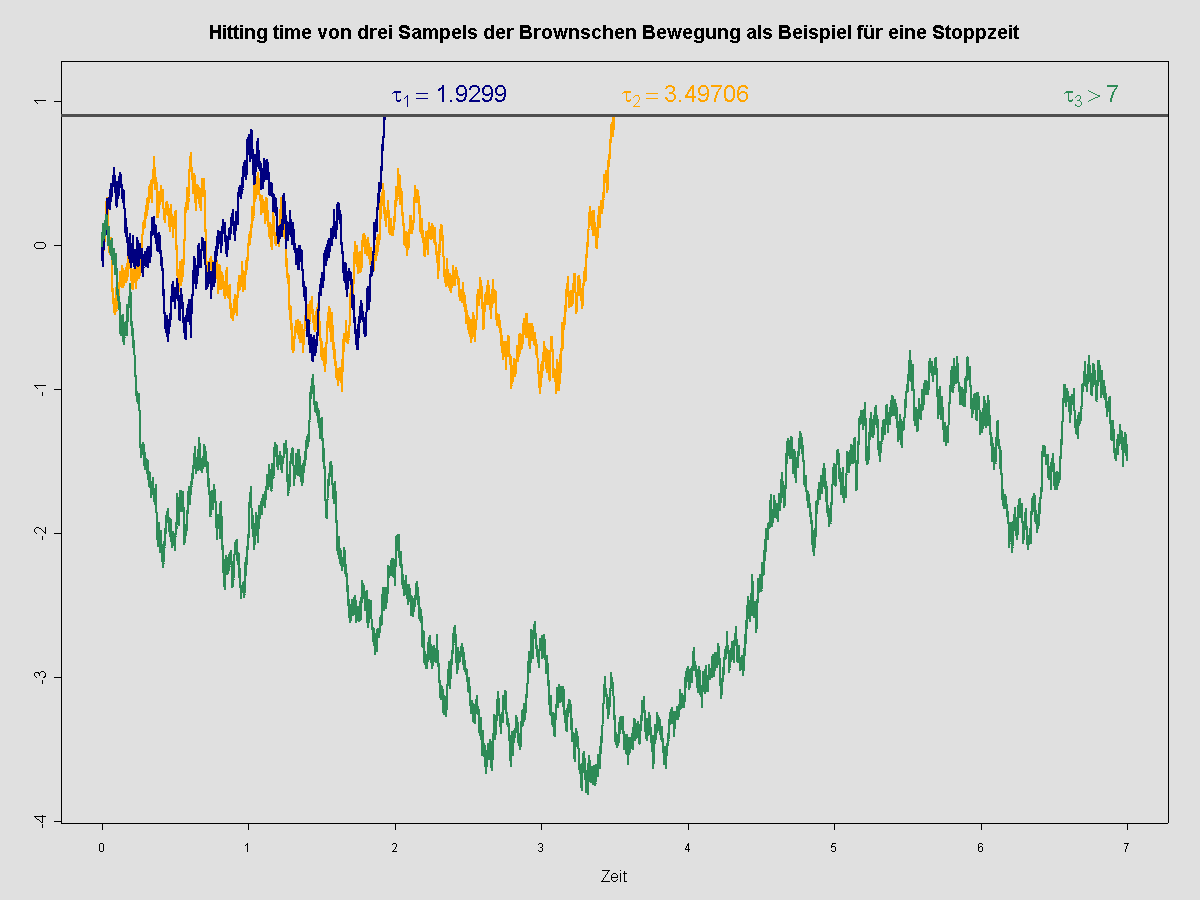
Originally, martingale referred to a class of betting strategies that was popular in 18th-century France. The simplest of these strategies was designed for a game in which the gambler wins their stake if a coin comes up heads and loses it if the coin comes up tails. The strategy had the gambler double their bet after every loss so that the first win would recover all previous losses plus win a profit equal to the original stake. As the gambler's wealth and available time jointly approach infinity, their probability of eventually flipping heads approaches 1, which makes the martingale betting strategy seem like a sure thing. However, the exponential growth of the bets eventually bankrupts its users due to finite bankrolls. Stopped Brownian motion, which is a martingale process, can be used to model the trajectory of such games.
The concept of martingale in probability theory was introduced by Paul Lévy in 1934, though he did not name it. The term "martingale" was introduced later by Ville (1939), who also extended the definition to continuous martingales. Much of the original development of the theory was done by Joseph Leo Doob among others. Part of the motivation for that work was to show the impossibility of successful betting strategies in games of chance.
A basic definition of a discrete-time martingale is a discrete-time stochastic process (i.e., a sequence of random variables) X1, X2, X3, ... that satisfies for any time n,
That is, the conditional expected value of the next observation, given all the past observations, is equal to the most recent observation.
More generally, a sequence Y1, Y2, Y3 ... is said to be a martingale with respect to another sequence X1, X2, X3 ... if for all n
Similarly, a continuous-time martingale with respect to the stochastic process Xt is a stochastic process Yt such that for all t
This expresses the property that the conditional expectation of an observation at time t, given all the observations up to time , is equal to the observation at time s (of course, provided that s ≤ t). The second property implies that is measurable with respect to .


Hub AI
Martingale (probability theory) AI simulator
(@Martingale (probability theory)_simulator)
Martingale (probability theory)
In probability theory, a martingale is a stochastic process in which the expected value of the next observation, given all prior observations, is equal to the most recent value. In other words, the conditional expectation of the next value, given the past, is equal to the present value. Martingales are used to model fair games, where future expected winnings are equal to the current amount regardless of past outcomes.
Originally, martingale referred to a class of betting strategies that was popular in 18th-century France. The simplest of these strategies was designed for a game in which the gambler wins their stake if a coin comes up heads and loses it if the coin comes up tails. The strategy had the gambler double their bet after every loss so that the first win would recover all previous losses plus win a profit equal to the original stake. As the gambler's wealth and available time jointly approach infinity, their probability of eventually flipping heads approaches 1, which makes the martingale betting strategy seem like a sure thing. However, the exponential growth of the bets eventually bankrupts its users due to finite bankrolls. Stopped Brownian motion, which is a martingale process, can be used to model the trajectory of such games.
The concept of martingale in probability theory was introduced by Paul Lévy in 1934, though he did not name it. The term "martingale" was introduced later by Ville (1939), who also extended the definition to continuous martingales. Much of the original development of the theory was done by Joseph Leo Doob among others. Part of the motivation for that work was to show the impossibility of successful betting strategies in games of chance.
A basic definition of a discrete-time martingale is a discrete-time stochastic process (i.e., a sequence of random variables) X1, X2, X3, ... that satisfies for any time n,
That is, the conditional expected value of the next observation, given all the past observations, is equal to the most recent observation.
More generally, a sequence Y1, Y2, Y3 ... is said to be a martingale with respect to another sequence X1, X2, X3 ... if for all n
Similarly, a continuous-time martingale with respect to the stochastic process Xt is a stochastic process Yt such that for all t
This expresses the property that the conditional expectation of an observation at time t, given all the observations up to time , is equal to the observation at time s (of course, provided that s ≤ t). The second property implies that is measurable with respect to .
Recent media