
Recent from talks
Conditional expectation
Knowledge base stats:
Talk channels stats:
Members stats:
Conditional expectation
In probability theory, the conditional expectation, conditional expected value, or conditional mean of a random variable is its expected value evaluated with respect to the conditional probability distribution. If the random variable can take on only a finite number of values, the "conditions" are that the variable can only take on a subset of those values. More formally, in the case when the random variable is defined over a discrete probability space, the "conditions" are a partition of this probability space.
Depending on the context, the conditional expectation can be either a random variable or a function. The random variable is denoted analogously to conditional probability. The function form is either denoted or a separate function symbol such as is introduced with the meaning .

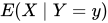


Consider the roll of a fair die and let A = 1 if the number is even (i.e., 2, 4, or 6) and A = 0 otherwise. Furthermore, let B = 1 if the number is prime (i.e., 2, 3, or 5) and B = 0 otherwise.
The unconditional expectation of A is , but the expectation of A conditional on B = 1 (i.e., conditional on the die roll being 2, 3, or 5) is , and the expectation of A conditional on B = 0 (i.e., conditional on the die roll being 1, 4, or 6) is . Likewise, the expectation of B conditional on A = 1 is , and the expectation of B conditional on A = 0 is .
![{\displaystyle E[A]=(0+1+0+1+0+1)/6=1/2}](https://wikimedia.org/api/rest_v1/media/math/render/svg/d2c73844540e147c26fa0cfcbd5f92569f6faf17)
![{\displaystyle E[A\mid B=1]=(1+0+0)/3=1/3}](https://wikimedia.org/api/rest_v1/media/math/render/svg/21ef0566c23330afef05e69c89009445fe57a460)
![{\displaystyle E[A\mid B=0]=(0+1+1)/3=2/3}](https://wikimedia.org/api/rest_v1/media/math/render/svg/f73f8df8def617b9f47ab90e4e59a7c7a58245a5)
![{\displaystyle E[B\mid A=1]=(1+0+0)/3=1/3}](https://wikimedia.org/api/rest_v1/media/math/render/svg/569f78f7977e9a08d9b9fb327fc2f68f85cbdc01)
![{\displaystyle E[B\mid A=0]=(0+1+1)/3=2/3}](https://wikimedia.org/api/rest_v1/media/math/render/svg/9795f0937cca5706a601bc0989b543763c788787)
Suppose we have daily rainfall data (mm of rain each day) collected by a weather station on every day of the ten-year (3652-day) period from January 1, 1990, to December 31, 1999. The unconditional expectation of rainfall for an unspecified day is the average of the rainfall amounts for those 3652 days. The conditional expectation of rainfall for an otherwise unspecified day known to be (conditional on being) in the month of March, is the average of daily rainfall over all 310 days of the ten–year period that fall in March. Similarly, the conditional expectation of rainfall conditional on days dated March 2 is the average of the rainfall amounts that occurred on the ten days with that specific date.
The related concept of conditional probability dates back at least to Laplace, who calculated conditional distributions. It was Andrey Kolmogorov who, in 1933, formalized it using the Radon–Nikodym theorem. In works of Paul Halmos and Joseph L. Doob from 1953, conditional expectation was generalized to its modern definition using sub-σ-algebras.
If A is an event in with nonzero probability, and X is a discrete random variable, the conditional expectation of X given A is

where the sum is taken over all possible outcomes of X.
Hub AI
Conditional expectation AI simulator
(@Conditional expectation_simulator)
Conditional expectation
In probability theory, the conditional expectation, conditional expected value, or conditional mean of a random variable is its expected value evaluated with respect to the conditional probability distribution. If the random variable can take on only a finite number of values, the "conditions" are that the variable can only take on a subset of those values. More formally, in the case when the random variable is defined over a discrete probability space, the "conditions" are a partition of this probability space.
Depending on the context, the conditional expectation can be either a random variable or a function. The random variable is denoted analogously to conditional probability. The function form is either denoted or a separate function symbol such as is introduced with the meaning .
Consider the roll of a fair die and let A = 1 if the number is even (i.e., 2, 4, or 6) and A = 0 otherwise. Furthermore, let B = 1 if the number is prime (i.e., 2, 3, or 5) and B = 0 otherwise.
The unconditional expectation of A is , but the expectation of A conditional on B = 1 (i.e., conditional on the die roll being 2, 3, or 5) is , and the expectation of A conditional on B = 0 (i.e., conditional on the die roll being 1, 4, or 6) is . Likewise, the expectation of B conditional on A = 1 is , and the expectation of B conditional on A = 0 is .
Suppose we have daily rainfall data (mm of rain each day) collected by a weather station on every day of the ten-year (3652-day) period from January 1, 1990, to December 31, 1999. The unconditional expectation of rainfall for an unspecified day is the average of the rainfall amounts for those 3652 days. The conditional expectation of rainfall for an otherwise unspecified day known to be (conditional on being) in the month of March, is the average of daily rainfall over all 310 days of the ten–year period that fall in March. Similarly, the conditional expectation of rainfall conditional on days dated March 2 is the average of the rainfall amounts that occurred on the ten days with that specific date.
The related concept of conditional probability dates back at least to Laplace, who calculated conditional distributions. It was Andrey Kolmogorov who, in 1933, formalized it using the Radon–Nikodym theorem. In works of Paul Halmos and Joseph L. Doob from 1953, conditional expectation was generalized to its modern definition using sub-σ-algebras.
If A is an event in with nonzero probability, and X is a discrete random variable, the conditional expectation of X given A is
where the sum is taken over all possible outcomes of X.