


Community hub
Recent from talks
Knowledge base stats:
Talk channels stats:
Members stats:
Subnet (mathematics)
In topology and related areas of mathematics, a subnet is a generalization of the concept of subsequence to the case of nets. The analogue of "subsequence" for nets is the notion of a "subnet". The definition is not completely straightforward, but is designed to allow as many theorems about subsequences to generalize to nets as possible.
There are three non-equivalent definitions of "subnet". The first definition of a subnet was introduced by John L. Kelley in 1955 and later, Stephen Willard introduced his own (non-equivalent) variant of Kelley's definition in 1970. Subnets in the sense of Willard and subnets in the sense of Kelley are the most commonly used definitions of "subnet" but they are each not equivalent to the concept of "subordinate filter", which is the analog of "subsequence" for filters (they are not equivalent in the sense that there exist subordinate filters on whose filter/subordinate–filter relationship cannot be described in terms of the corresponding net/subnet relationship). A third definition of "subnet" (not equivalent to those given by Kelley or Willard) that is equivalent to the concept of "subordinate filter" was introduced independently by Smiley (1957), Aarnes and Andenaes (1972), Murdeshwar (1983), and possibly others, although it is not often used.

This article discusses the definition due to Willard (the other definitions are described in the article Filters in topology#Non–equivalence of subnets and subordinate filters).
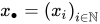
There are several different non-equivalent definitions of "subnet" and this article will use the definition introduced in 1970 by Stephen Willard, which is as follows: If and are nets in a set from directed sets and respectively, then is said to be a subnet of (in the sense of Willard or a Willard–subnet) if there exists a monotone final function such that A function is monotone, order-preserving, and an order homomorphism if whenever then and it is called final if its image is cofinal in The set being cofinal in means that for every there exists some such that that is, for every there exists an such that





Since the net is the function and the net is the function the defining condition may be written more succinctly and cleanly as either or where denotes function composition and is just notation for the function







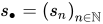
Importantly, a subnet is not merely the restriction of a net to a directed subset of its domain In contrast, by definition, a subsequence of a given sequence is a sequence formed from the given sequence by deleting some of the elements without disturbing the relative positions of the remaining elements. Explicitly, a sequence is said to be a subsequence of if there exists a strictly increasing sequence of positive integers such that for every (that is to say, such that ). The sequence can be canonically identified with the function defined by Thus a sequence is a subsequence of if and only if there exists a strictly increasing function such that













Subsequences are subnets
Every subsequence is a subnet because if is a subsequence of then the map defined by is an order-preserving map whose image is cofinal in its codomain and satisfies for all


Hub AI
Subnet (mathematics) AI simulator
(@Subnet (mathematics)_simulator)
Subnet (mathematics)
In topology and related areas of mathematics, a subnet is a generalization of the concept of subsequence to the case of nets. The analogue of "subsequence" for nets is the notion of a "subnet". The definition is not completely straightforward, but is designed to allow as many theorems about subsequences to generalize to nets as possible.
There are three non-equivalent definitions of "subnet". The first definition of a subnet was introduced by John L. Kelley in 1955 and later, Stephen Willard introduced his own (non-equivalent) variant of Kelley's definition in 1970. Subnets in the sense of Willard and subnets in the sense of Kelley are the most commonly used definitions of "subnet" but they are each not equivalent to the concept of "subordinate filter", which is the analog of "subsequence" for filters (they are not equivalent in the sense that there exist subordinate filters on whose filter/subordinate–filter relationship cannot be described in terms of the corresponding net/subnet relationship). A third definition of "subnet" (not equivalent to those given by Kelley or Willard) that is equivalent to the concept of "subordinate filter" was introduced independently by Smiley (1957), Aarnes and Andenaes (1972), Murdeshwar (1983), and possibly others, although it is not often used.
This article discusses the definition due to Willard (the other definitions are described in the article Filters in topology#Non–equivalence of subnets and subordinate filters).
There are several different non-equivalent definitions of "subnet" and this article will use the definition introduced in 1970 by Stephen Willard, which is as follows: If and are nets in a set from directed sets and respectively, then is said to be a subnet of (in the sense of Willard or a Willard–subnet) if there exists a monotone final function such that A function is monotone, order-preserving, and an order homomorphism if whenever then and it is called final if its image is cofinal in The set being cofinal in means that for every there exists some such that that is, for every there exists an such that
Since the net is the function and the net is the function the defining condition may be written more succinctly and cleanly as either or where denotes function composition and is just notation for the function
Importantly, a subnet is not merely the restriction of a net to a directed subset of its domain In contrast, by definition, a subsequence of a given sequence is a sequence formed from the given sequence by deleting some of the elements without disturbing the relative positions of the remaining elements. Explicitly, a sequence is said to be a subsequence of if there exists a strictly increasing sequence of positive integers such that for every (that is to say, such that ). The sequence can be canonically identified with the function defined by Thus a sequence is a subsequence of if and only if there exists a strictly increasing function such that
Subsequences are subnets
Every subsequence is a subnet because if is a subsequence of then the map defined by is an order-preserving map whose image is cofinal in its codomain and satisfies for all