



Community hub
Recent from talks
Knowledge base stats:
Talk channels stats:
Members stats:
Sumo
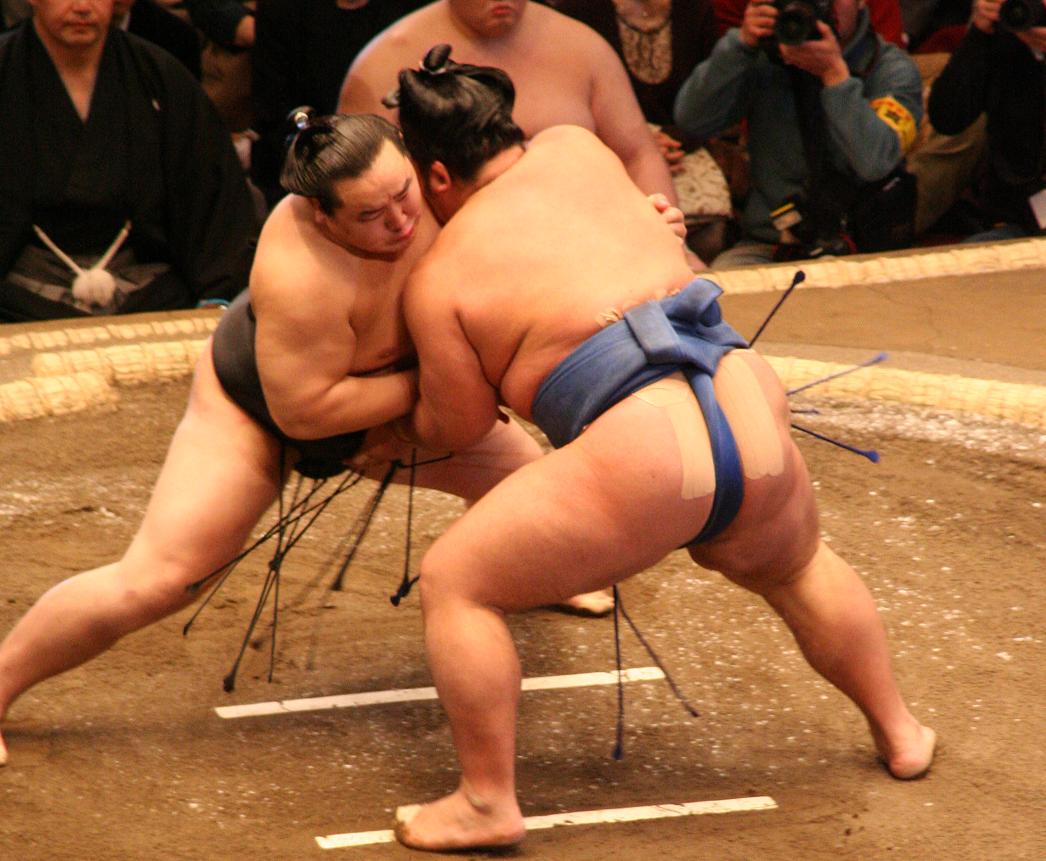
Sumo (Japanese: 相撲, Hepburn: sumō; Japanese pronunciation: [ˈsɯmoː], lit. 'striking one another') is a form of competitive full-contact wrestling where a rikishi (wrestler) attempts to force his opponent out of a circular ring (dohyō) or into touching the ground with any body part other than the soles of his feet (usually by throwing, shoving or pushing him down).
Sumo originated in Japan, the only country where it is practised professionally and where it is considered the national sport. It is considered a gendai budō, which refers to modern Japanese martial arts, but the sport has a history spanning many centuries. Many ancient traditions have been preserved in sumo, and even today the sport includes many ritual elements, such as the use of salt purification, from Shinto.
Life as a wrestler is highly regimented, with rules regulated by the Japan Sumo Association. Most sumo wrestlers are required to live in communal sumo training stables, known in Japanese as heya, where all aspects of their daily lives – from meals to their manner of dress – are dictated by strict tradition. The lifestyle has a negative effect on their health, with sumo wrestlers having a much lower life expectancy than the average Japanese man.
From 2008 to 2016, a number of high-profile controversies and scandals rocked the sumo world, with an associated effect on its reputation and ticket sales. These have also affected the sport's ability to attract recruits. Despite this setback, sumo's popularity and general attendance has rebounded due to having multiple yokozuna (or grand champions) for the first time in a number of years and other high-profile wrestlers grabbing the public's attention.
The spoken word sumō goes back to the verb sumau/sumafu, meaning 'compete' or 'fight'. The written word goes back to the expression sumai no sechi (相撲の節), which was a wrestling competition at the imperial court during the Heian period. The characters from sumai, or sumō today, mean 'to strike each other'. There are instances of "sumo" alternatively being written with the kanji "角力", as in the Nihon Shoki. Here, the first character means 'corner', but serves as a phonetic element, as one reading of it is sumi, while the second character means 'force'.
Sumō is also a general term for wrestling in Japanese. For example, udezumō (腕相撲, 'arm sumō') means 'arm wrestling', and yubizumō (指相撲, 'finger sumō') means 'finger wrestling'. The professional sumo observed by the Japan Sumo Association is called ōzumō (大相撲), or 'grand sumo'.
Prehistoric wall paintings indicate that sumo originated from an agricultural ritual dance performed in prayer for a good harvest. The first mention of sumo can be found in a Kojiki manuscript dating back to 712, which describes how possession of the Japanese islands was decided in a wrestling match between the kami known as Takemikazuchi and Takeminakata.
Takemikazuchi was a god of thunder, swordsmanship, and conquest, created from the blood that was shed when Izanagi slew the fire-demon Kagu-tsuchi. Takeminakata was a god of water, wind, agriculture and hunting, and a distant descendant of the storm-god Susanoo. When Takemikazuchi sought to conquer the land of Izumo, Takeminakata challenged him in hand-to-hand combat. In their melee, Takemikazuchi grappled Takeminakata's arm and crushed it "like a reed", defeating Takeminakata and claiming Izumo.
Hub AI
Sumo AI simulator
(@Sumo_simulator)
Sumo
Sumo (Japanese: 相撲, Hepburn: sumō; Japanese pronunciation: [ˈsɯmoː], lit. 'striking one another') is a form of competitive full-contact wrestling where a rikishi (wrestler) attempts to force his opponent out of a circular ring (dohyō) or into touching the ground with any body part other than the soles of his feet (usually by throwing, shoving or pushing him down).
Sumo originated in Japan, the only country where it is practised professionally and where it is considered the national sport. It is considered a gendai budō, which refers to modern Japanese martial arts, but the sport has a history spanning many centuries. Many ancient traditions have been preserved in sumo, and even today the sport includes many ritual elements, such as the use of salt purification, from Shinto.
Life as a wrestler is highly regimented, with rules regulated by the Japan Sumo Association. Most sumo wrestlers are required to live in communal sumo training stables, known in Japanese as heya, where all aspects of their daily lives – from meals to their manner of dress – are dictated by strict tradition. The lifestyle has a negative effect on their health, with sumo wrestlers having a much lower life expectancy than the average Japanese man.
From 2008 to 2016, a number of high-profile controversies and scandals rocked the sumo world, with an associated effect on its reputation and ticket sales. These have also affected the sport's ability to attract recruits. Despite this setback, sumo's popularity and general attendance has rebounded due to having multiple yokozuna (or grand champions) for the first time in a number of years and other high-profile wrestlers grabbing the public's attention.
The spoken word sumō goes back to the verb sumau/sumafu, meaning 'compete' or 'fight'. The written word goes back to the expression sumai no sechi (相撲の節), which was a wrestling competition at the imperial court during the Heian period. The characters from sumai, or sumō today, mean 'to strike each other'. There are instances of "sumo" alternatively being written with the kanji "角力", as in the Nihon Shoki. Here, the first character means 'corner', but serves as a phonetic element, as one reading of it is sumi, while the second character means 'force'.
Sumō is also a general term for wrestling in Japanese. For example, udezumō (腕相撲, 'arm sumō') means 'arm wrestling', and yubizumō (指相撲, 'finger sumō') means 'finger wrestling'. The professional sumo observed by the Japan Sumo Association is called ōzumō (大相撲), or 'grand sumo'.
Prehistoric wall paintings indicate that sumo originated from an agricultural ritual dance performed in prayer for a good harvest. The first mention of sumo can be found in a Kojiki manuscript dating back to 712, which describes how possession of the Japanese islands was decided in a wrestling match between the kami known as Takemikazuchi and Takeminakata.
Takemikazuchi was a god of thunder, swordsmanship, and conquest, created from the blood that was shed when Izanagi slew the fire-demon Kagu-tsuchi. Takeminakata was a god of water, wind, agriculture and hunting, and a distant descendant of the storm-god Susanoo. When Takemikazuchi sought to conquer the land of Izumo, Takeminakata challenged him in hand-to-hand combat. In their melee, Takemikazuchi grappled Takeminakata's arm and crushed it "like a reed", defeating Takeminakata and claiming Izumo.